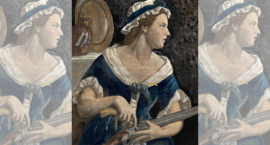
The Radical Potential of Traditional Femininity 

In the 1700s and 1800s in the U.S., women were presumed to be subordinate to men: naturally helpless, emotional, vulnerable.

Reading through the thousands of petitions submitted by revolutionary-era women to the state, one might get the impression that all women accepted their subordinate status to men with humility and grace.

But what if they didn’t? What if their engagement with the discourse of feminine dependence was merely a shrewd tool, effectively deployed to cater to precisely what their readers—white, male elites—wanted to hear? What if the radical act of seeking a divorce in the 18th century contradicted the conservative language they employed? 

In most cases, we’ll never be able to deduce these women petitioners’ true feelings on their social and legal status. Many women petitioners in the revolutionary era left no trail for the historian to follow. 

What we can know is that the employment of this discourse of dependence, cunningly constructed in a sympathetic narrative neatly packaged for a patriarchal audience, was immensely effective. For the most part, women who engaged with these tropes of feminine subordination saw their petitions granted. Those that did not—including those who rebuked men—largely saw their pleas rejected or ignored. 

(This essay is part of the FEMINIST 250: Founding Feminists series, marking the 250th anniversary of America by reclaiming the revolution through the women and gender-expansive people whose ideas, labor and resistance shaped U.S. democracy.)

Dissecting Trump’s (Short) Women’s History Month Statement, Line by Line

When the White House issued a presidential message to kick off Women’s History Month, my first reaction was genuine surprise. Honestly, I did not think WHM was still recognized by the federal government.

President Donald Trump’s brief (four paragraphs) public statement doubled down on the administration’s regressive societal vision, casting women primarily as caretakers and pillars of the “American family,” while pointing to a slate of policies he claims empower them.

But a closer look at the statement reveals a familiar mix of culture-war signaling, selective policy claims, and omissions that obscure the real impacts of the administration’s agenda on women and families.

I think often about the role of the media at this moment—an obligation intrinsically greater than reporting the verbiage that comes out of the White House. It is on all of us to explicitly counter double-speak and lies and to leave a paper trail of truth for posterity. This week’s column does just that: It dissects Trump’s WHM proclamation line by line and tests each claimed reform against the record.

Claiming the Revolution: Gender, Sexuality and the Radical Promise of 1776

The American Revolution can feel like a legacy that belongs to a select few. It has often been told as the story of wealthy white men—many of them enslavers, many of them beneficiaries of Indigenous dispossession—who rebelled in the name of liberty while denying it to most of the people around them. From this perspective, those who are most marginalized—including women, LGBTQ people and communities of color—may feel as if they are reinforcing political amnesia, or worse, complicity, in patriotic celebrations of 1776.   

(This essay is part of the FEMINIST 250: Founding Feminists series, marking the 250th anniversary of America by reclaiming the revolution through the women and gender-expansive people whose ideas, labor and resistance shaped U.S. democracy.)

ERA Road Tour: Weekly Road Diary (March 2-7)

Inspired by the 1916 suffrage road trip that helped win women the vote, activists behind Driving the Vote for Equality are traveling across the country in the restored Golden Flyer II to build support for recognizing the Equal Rights Amendment as the 28th Amendment.

Each week, Ms. will share highlights from the road.

During its first week on the road, the Golden Flyer II carried the push for the ERA through the Mid-Atlantic. In New York, New Jersey, Washington, D.C., and Virginia, ERA advocates connected historic sites of feminist resistance with renewed calls for constitutional equality.

‘This Is Our Country Too!’: The Enduring Legacy of Spanish-Speaking Women in Early America

Centuries before the American Revolution, Spanish-speaking women crossed oceans and deserts to build communities whose legacies still shape the United States.

As anti-Latino sentiment coincides with the 250th anniversary of the United States, we must remember that long before the American Revolution, Spanish-speaking women inhabited territory that would become the United States. 

Like their English Protestant counterparts in New England, Spanish-speaking women were founding mothers of our nation. Their legacies live on through their descendants and the many other Latinas who immigrated to the U.S. over the past 250 years. Faced with the widespread detention of Spanish-speaking women, it is crucial to remember that it has long been their country too.  

(This essay is part of the FEMINIST 250: Founding Feminists series, marking the 250th anniversary of America by reclaiming the revolution through the women and gender-expansive people whose ideas, labor and resistance shaped U.S. democracy.)

Women’s History Month: Looking Back on How Far We’ve Come and the Hill That Lies Ahead

Weekend Reading on Women’s Representation is a compilation of stories about women’s representation in politics, on boards, in sports and entertainment, in judicial offices and in the private sector in the U.S. and around the world—with a little gardening and goodwill mixed in for refreshment!

This week:
—Primary season marks few advances for women.
—Donald Trump’s endorsements were overwhelmingly male, and they mattered.
—LA Charter Commission recommends ranked-choice voting.
—German women oppose online hate speech.

… and more.

‘Lone Star Three’: How Three UT Austin Students Paved the Way for Birth Control Access in 1960s Texas

In 1969 Victoria Foe, Judy Smith and Barbara Hines were students at the University of Texas in Austin when Smith invited Foe and Hines to attend women’s liberation meetings at her house. Their discussions led them to start a campus Birth Control Information Center and eventually evolved into an underground network that helped women access safe abortion at a time when it was illegal in Texas. 

Their activism would eventually extend far beyond their university campus, planting the seeds for Roe v. Wade, the landmark Supreme Court decision that would legalize abortion in the U.S. Not until 1965 did birth control in the U.S. become legal for married women. Not until 1972 did it become legal for anyone, married or unmarried, to access birth control.

A new documentary, Lone Star Three, directed by Karen Stirgwolt, tells the story of the women who formed the underground networks that allowed young women to access reproductive care in Texas in the days leading up to Roe v. Wade. Ms. recently spoke with Foe and Hines (Smith passed away in 2013), and archivist Alice Embree, about their activism from the 1960s to the present moment.

America’s Founding Feminists: Rewriting America’s Origin Story

Two hundred and fifty years ago, a small group of men declared that “all men are created equal,” casting a vision of liberty that has shaped the American imagination ever since.

Yet even as they debated freedom in Philadelphia, women were writing, organizing, governing, resisting and insisting on their place within the nation taking form. Some, like Mary Katherine Goddard, literally set their names in print; others, like Phillis Wheatley, wrote themselves into intellectual existence against a backdrop of enslavement and doubt. Still others left their mark through acts of refusal and flight, choosing freedom when the republic would not grant it.

A new series, Founding Feminists—launching at the start of Women’s History Month—unfolds over two months, twice a week. On this semiquincentennial of the United States, Ms. turns to these “founding feminists” not as anachronistic heroines, but as architects of an unfinished democratic project. There is no nation without women at its core—no democracy without their labor, intellect, resistance and imagination.

From Haudenosaunee matrilineal governance, to Black women’s freedom-seeking acts, from revolutionary manifestos to quiet domestic rebellions, our Founding Feminists series reexamines the past to illuminate our present moment of backlash and possibility.

If the Declaration of Independence set forth a promise of equality, it was women—across race, class, sexuality and nationality—who pressed the nation to live up to it.

Two hundred and fifty years later, their questions remain ours: What does freedom truly mean, and who gets to claim it?

Who’s American? Whose America? Bad Bunny’s Radical Halftime Message

Thirteen minutes is how long it lasted, and global superstar Bad Bunny—full name Benito Antonio Martínez Ocasio—more than delivered. Set against pulsating Afro-Latin rhythms and brimming with the energetic dancing bodies of Black, Brown and other multicolored peoples, the 2026 Super Bowl halftime show transformed this historic moment of the first all-Spanish musical spectacle into a cultural reset. Now counted among the most watched halftime performances—with close to 130 million views—the Super Bowl was rightfully renamed the “Benito Bowl.”

Bad Bunny’s performance came just one week after he made history as the first artist recording exclusively in Spanish to win the Grammy’s top honor for Album of the Year. It arrived, too, amid escalating violence tied to ICE enforcement and the policing and deportation of Brown and Black communities. At a moment when the U.S. president is railing against diversity, equity and inclusion—and circulating virulently racist content targeting his predecessor and the nation’s first Black president and first lady during Black History Month—the cultural resonance of this halftime show feels all the more potent.

Bad Bunny’s dynamic performance is an affirmation of the same communities currently terrorized by state-sanctioned violence. At rallies and marches, people play Bad Bunny. In moments of grief and passion, people play Bad Bunny. His refusal to be silenced, to be forgotten, is an inspiration of hope and resilience for social movements. His music is music of the revolution, which was spectacularly televised in the middle of a widely watched football game.  

Olympians on Olympians: Women Athletes Honor the Trailblazers Who Made Today’s Games Possible

Organizers of the 2026 Milano-Cortina Winter Olympics are touting “the most gender-balanced Olympic Winter Games in history,” reflecting years of pressure from athletes who have questioned why women and men do not always have the same number of events or chances to participate.

These gains did not happen on their own—they are the result of sustained advocacy by women athletes who have pushed the International Olympic Committee to expand women’s participation, add events, and commit to gender equity in both athlete quotas and medal opportunities. Even as parity edges closer, competitors and supporters continue to call out the remaining gaps—keeping the pressure on Olympic leadership to deliver full equality across all sports.