Our reaction to current events—and our commitment to action—requires that we hold tight to the optimism our foremothers possessed.

This piece was originally published by The Contrarian.
It’s Week 2 of Women’s History Month, and just knowing the federal government might well ban those three words in sequence—along with “gender,” “female,” “feminism” and about 250 others—you can bet I’m feeling extra rebellious as I write this column.
For one, I am back from celebrating International Women’s Day (March 8) at South by Southwest, where my speaking and listening tour included everything from abortion to maternal mortality to women’s midlife health to menopause. The entire scene was, dare I say it, optimistic?
Optimism might be in short supply for a New Yorker like me visiting Texas, the state that incubates and instigates of some of the most egregious voter suppression laws in the country, whose governor essentially outlawed abortion nine months prior to the Dobbs ruling, and in which just this week the legislature introduced a bill that would criminalize identifying as transgender.
Yet, among the festival keynotes, Chelsea Clinton urged that optimism is fundamentally a moral and political choice. Remaining optimistic, she remarked, is like “saying we do not have to accept the status quo. … We do accept that we may not be able to do everything all at once, but we can always do something.”
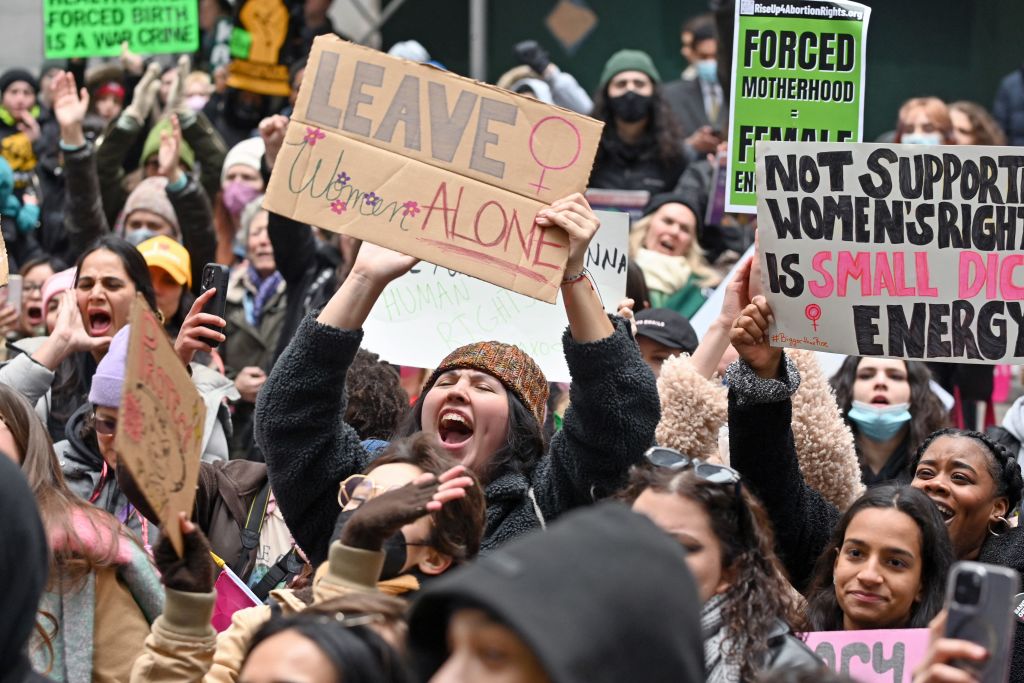
In that spirit, behold a quick and dirty timeline of what the optimism of feminists past and present has accomplished—and the “somethings” they made possible over the past half century:
- Equal Pay Act (1963)
- no-fault divorce (1969)
- Title IX (1972)
- the right to birth control for unmarried couples (1972)
- legalization of abortion (1973)
- Equal Credit Opportunity Act (1974)
- Pregnancy Discrimination Act (1978)
- Family and Medical Leave Act (1993)
- Violence Against Women Act (1994)
- Lily Ledbetter Fair Pay Restoration Act (2009)
- legalization of same-sex marriage (2015)
- Pregnant Workers Fairness Act (2022)
… to name a very few.
Yes, it is within my own Gen X lifetime that a woman could not even have a credit card in her own name. (Though, noted TIME magazine, because passage of the Equal Credit Opportunity Act happened five years after Apollo 11, “Women literally helped put a man on the moon before they could get their own credit cards.”)
Today the world looks vastly different for young women—who not only out-enroll their male counterparts in higher education but also surpass men in the college-educated workforce. Gen Z women overwhelmingly identify (53 percent) as feminists—a data point that would otherwise be cause for optimism, but for the fact that their alignment is surely motivated by the need to fight longstanding inequities like the persistent gender pay gap, and to tackle new affronts like the evisceration of abortion rights and the nauseating reality that contraception is in the Supreme Court’s crosshairs.
But just this week, a disturbing new survey reveals that Gen Z men are tilting the scale—holding more extreme, more regressive views about gender equality than any other generation—with the majority (57 percent) agreeing we have “gone so far in promoting women’s equality that we are discriminating against men.”
At the same time, political scientists Michael Tesler, John Sides and Colette Marcellin shared new data in the New York Times showing that support for traditional gender roles is increasing, especially among Republicans, both men and women. Machismo is daily sport in the political ecosystem; this week Elon Musk has veered between trying to out-mansplain Marco Rubio in the Oval Office and Steve Bannon on the social media.
“What Mark Zuckerberg lauded as ‘masculine energy’ [is] on the rise,” Tesler, Sides and Marcellin write, “fueled by a ‘manosphere’ of podcasters and a subculture of women, the so-called tradwives, who have embraced homemaking and domesticity.”
All of which is to acknowledge that we face a chasm that is far wider, deeper and increasingly more threatening than the White House occupants and conservative supermajority of the Supreme Court alone. Women’s History Month is a solemn reminder that our reaction—and our commitment to action—also requires that we hold tight to the optimism our foremothers possessed.
When Women Resist
Last week I started a new update, “When Women Resist,” a companion to the Democracy Movement roundup.
This week’s shoutout goes to the playwright Bess Wohl, whose new production Liberation is on a limited Broadway run. The show toggles between the aspirations of a consciousness-raising group in 1970 and the reality of one of the members’ daughters in 2025. No spoilers, but it brings Chelsea Clinton’s words to life: that refusal to accept the status quo— and that doing so by creating community and embodying optimism—is a most powerful form of resistance. Will it get the job done? Will we even know if we have gotten the job done? In Trump’s America, quite frankly, it is too hard and too soon to tell. But fight ahead we must— and we will.