Equal Pay Is Getting Pushed Further Away. We’re Pushing Back.

Amid the celebrations of Women’s History Month, it is a bitter irony Equal Pay Day—marking how far into the year women must work to earn what men did in the previous year—has been pushed back to March 26. The end of the month is shadowed by the knowledge that the gender pay gap still exists and is widening.

Black women, women with disabilities, moms and all women of color are paid significantly less than white men in comparable positions. Affordability is already a concern, with prices rising at the gas station and the grocery store. The pay gap is compounding these concerns to create further financial disparities for women of color.

The Road to the ERA Runs Through Congress

In 1916, just as Americans were beginning to enjoy the new travel freedoms that came with motorized vehicles, a couple of frustrated leaders of the campaign to secure women’s rights to vote, Alice Snitjer Burke and Nell Richardson, secured one of the first gas-driven automobiles in the country. They named the car, a Saxon, Golden Flyer and set off across the country to get support for what would become the 19th Amendment, guaranteeing women the right to vote.

Yes, the original ‘road trip’ was an act of political audacity. Long before women even had the vote, these two women drove into towns across America, on their own, spoke in town squares, slept in boarding houses and not surprisingly, endured ridicule and resistance. They were history’s first “Thelma and Louise.” This road trip had a very different ending, of course, as it led to the passage of constitutional clarity on the question of voting rights, at least for white women, with the 19th Amendment. Getting that right guaranteed for all women, whatever race or circumstances, would still take other struggles. And the campaign for full equality for all women didn’t end with the Drive across America for voting rights.

The struggle for a constitutional guarantee of equality has led to another road trip across America: Driving the Vote for Women’s Equality Tour.

When Burke and Richardson set out in the Golden Flyer in 1916, they did not know the outcome. They only knew that democracy requires action. And the action now is to finish the work through the ERA joint resolution. The message to policymakers is direct and clear: Recognize the will of the states and acknowledge that the ratification threshold has been met. Finish the work.

Equal means equal. It did in 1916. It does now. And this time, we will not stop until the Constitution says so.

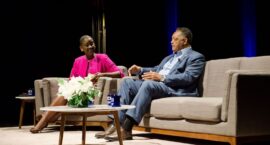
He Called Me ‘Doc.’ I Called Him ‘Rev.’ Remembering Jesse Jackson’s Moral Leadership

I knew Rev. Jackson beyond the conventions. He married me and my husband, Gregory Shaffer, almost 25 years ago. He always showed up and gave graciously of himself when I called—whether it was to host a convening on HIV/AIDS at Rainbow PUSH in the early 2000s, or to bring together hundreds of working-class residents from the South Side of Chicago to engage on matters of national healthcare, or to meet with (mostly women) academics coming together to figure out the intersections of law, family and reproductive rights at the University of Chicago Club 20 years ago. 

He called me “Doc” or “Doctor Michele.” I called him “Rev.”

A week ago, by his father’s bedside, Rep. Jonathan Jackson (D-Ill.) and I spoke by phone. He had just delivered a speech at the National Prayer Breakfast calling the president to account—to be more humane and just, and to “do what is right.” It was clear that Rev. Jackson’s legacy is already living on.

Keeping Score: Renee Good Fatally Shot by ICE; Women Work Longer and Are Paid Less Worldwide; N.Y. Fights Back Against Federal Childcare Freeze

In every issue of Ms., we track research on our progress in the fight for equality, catalogue can’t-miss quotes from feminist voices and keep tabs on the feminist movement’s many milestones. We’re Keeping Score online, too—in this biweekly roundup.

This week:
—”We had whistles. They had guns,” said Becca Good, wife of Renee Good, who was killed in Minneapolis by ICE agent Jonathan Ross.
—In central Texas, five months after the Sandy Creek flooding, “many are still homeless, and only 36 percent of FEMA claims in our area have been approved,” said survivor Brandy Gerstner. “FEMA must be independent, fully funded and strengthened—because when it fails to function, real families pay the price.”
—Anti-Muslim and anti-South Asian hate increased around the election of NYC Mayor Zohran Mamdani.
—The Department of Veterans Affairs announced new abortion bans.
—Meta has removed the social media accounts of dozens of reproductive health and LGBTQ groups.
—Women worldwide earn just a third of what men do when unpaid domestic labor is taken into account.

… and more.

Social Services Cuts Will Mean More Women Stop Working—and Maybe That’s the Point

The current federal administration is very pro-family—they tell us that all the time. One of JD Vance’s first public appearances as vice president was his speech at the antiabortion March for Life rally in January 2025, where he called for more births in the U.S. and framed his agenda as both “pro-life” and “pro-family.” Trump reaffirmed that position in March, where he reiterated that this was a pro-family administration.

But at the start of this year, on Jan. 6, 2026, alleging concerns about fraud in state-run social services programs (even though the only concerns that have been raised—not proven—are in Minnesota), the Trump-Vance administration’s U.S. Department of Health and Human Services suspended three programs that provide support to children—not only in Minnesota, but also in California, Colorado, New York and Illinois. Those states, all led by Democrats, will lose access to billions in funding through the Temporary Assistance for Needy Families (TANF) program, the Child Care and Development Fund, and the Social Services Block Grant program. To be clear, these funds are the backbone of services-provision for families living in poverty in most communities, Republicans and Democrats alike.

This announcement comes days after the administration moved to eliminate a rule that had capped childcare copayments for low‑income families at 7 percent of their income.

It also comes after last year’s efforts to eliminate support for Head Start, quality and affordable education and other services for young children living in poverty.

All this from the pro-family party.

Calling Foul: Breaking Down WNBA Pay and Why It Matters

There’s a long history of women in sport fighting for equal pay, and what’s happening with the WNBA today is less of a mirror of the current gender pay gap and more of a throwback to a time when women’s efforts were even more deeply devalued. The WNBA is a visible legacy of Title IX, and an indication of how far there is left to go. 

These are women at a pinnacle of professional achievement, who are still beholden to structural barriers. This is not a sports issue. It is a feminist issue.

This International Day of the Girl, ‘Doing Nothing Is Not an Acceptable Choice’

On Oct. 11, we celebrate International Day of the Girl, a global call to recognize girls’ rights and confront persistent inequality.

When hope wavers and progress stalls, I look for words that steady me. Recently, I found them in writer Roxane Gay’s powerful essay in The New York Times, “Civility Is a Fantasy,” where she writes: “As a writer, as a person, I do not know how to live and write and thrive in a world where working for decency and fairness and equality can be seen as incivility … I worry and I worry and I worry, and I feel helpless and angry and tired, but also recognize that doing nothing is not an acceptable choice.”

After reading Gay’s words, I reminded myself of the girl I am and the change I lead, and thought about the many girls who might be feeling that same helplessness right now—those watching rights roll back, hearing their worth debated or wondering if their voices still matter. So, on International Day of the Girl, this letter is for them. It’s a call for action.

Tradwives and ‘The People That People Come Out Of’

For the first time in years, the number of U.S. mothers with young children in the workforce is shrinking—over 212,000 women left between January and June 2025 alone.

Childcare costs, in-office pressures, and a cultural nudge toward traditional gender roles are pushing moms out, while men in power nod along.

Meanwhile, the tradwife movement parades its perfect, baked-from-scratch, filtered-life versions of domesticity online, making the impossible look effortless.

It’s absurd. It’s dangerous. And it’s time we stop letting the economy treat raising kids as invisible labor.

How Rising Prices and Policy Cuts Are Squeezing Moms and Families

Articles on tariffs, the labor market, and economic growth or decline often neglect to report how these policies are affecting real people’s ability to keep a roof over their head or put food on the table for their families each night.

When U.S. companies face higher costs for importing goods, those costs get passed directly to consumers, which means everyday goods—from diapers to carrots—become more expensive. Women, in particular, shoulder the brunt of these increased costs.

When we make sure moms and babies have what they need to thrive, we’re not just addressing today’s crises … we’re building tomorrow’s prosperity.

‘If You’re Not Centering the People Who Are Most Impacted, Your Policy Solution Will Fall Apart’: Gaylynn Burroughs Is Fighting for Economic Justice at the Intersections

Burroughs, the vice president of education and workplace justice at the National Women’s Law Center, connected the dots between poverty, policy and culture change in the latest episode of the Ms. Studios podcast Looking Back, Moving Forward. “Once you start seeing these problems as being problems that policy can solve,” she told me, “a whole world opens up.”

Listen to the latest episode of Looking Back, Moving Forward, “Women Can’t Afford to Wait for a Feminist Economic Future (with Premilla Nadasen, Rakeen Mabud and Lenore Palladino, Aisha Nyandoro, Gaylynn Burroughs, and Dolores Huerta)” on Spotify, Apple Podcasts or wherever you get your podcasts.