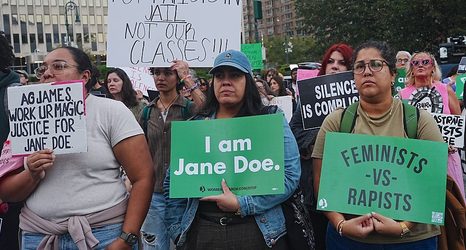
MAGA Republicans are back in the White House, and Project 2025 is their guide—the right-wing plan to turn back the clock on women’s rights, remove abortion access, and force women into roles as wives and mothers in the “ideal, natural family structure.” We know an empowered female electorate is essential to democracy. That’s why day after day, we stay vigilant in our goals to dismantle patriarchy at every turn. We are watching, and we refuse to go back. This is the War on Women Report.
Since our last report…
+ A federal judge has sentenced Sean “Diddy” Combs to just over four years in prison after a jury acquitted him of his most serious charges—sex trafficking and racketeering conspiracy—this summer. Even though prosecutors pushed for an 11-year sentence, Judge Arun Subramanian said the sentence will “send a message to abusers and victims alike that exploitation and violence against women is met with real accountability.”
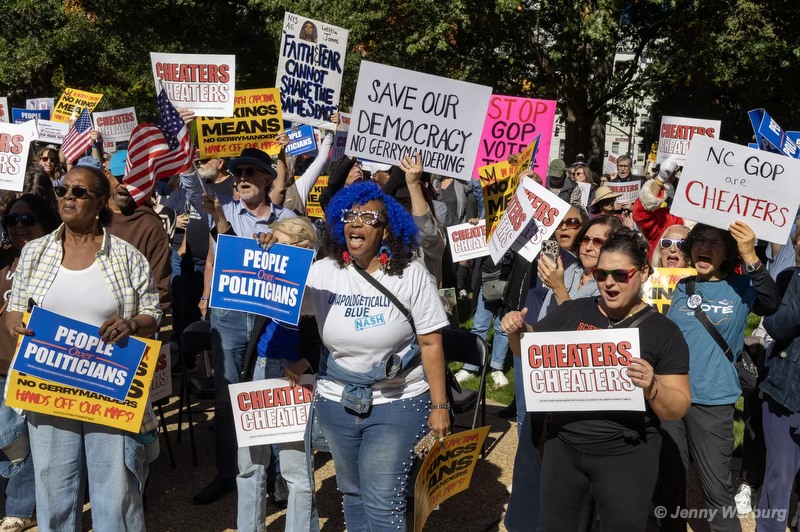
+ On Oct. 18, an estimated 7 million demonstrators showed up across 2,700 cities for a second “No Kings” protest, a significant increase in turnout since the June 14 event. Since this summer, Trump and his administration have ramped up crackdowns on immigration and free speech, including deploying the National Guard to at least five cities.
+ Turning Point U.S.A. (TPUSA) hosted an event at the University of Alabama advocating the death penalty as punishment for abortion patients. TPUSA, founded by late right-wing personality Charlie Kirk, held the panel on Oct. 7 and featured so-called “abortion-abolitionists” like Jeff Durbin, head of religious organization End Abortion Now, who has said, “If you take the life of a human being, unjustly, then what the state owes you…is capital punishment. You forfeit your right to live.”
Let’s not forget what else was sent our way over the last month …
Monday, Sept. 29: Trump DOJ Invokes Abortion Clinic Access Law to Prosecute Protests
The U.S. Department of Justice has filed a lawsuit against pro-Palestine demonstrators for protesting outside a synagogue in New Jersey—using the Freedom of Access to Clinic Entrances (FACE) Act, which protects patients’ access to abortion clinics. Although the FACE Act, in part, prohibits force, physical obstruction or property damage at places of worship as well as clinics, the law primarily exists to protect patients from violence and harassment when trying to enter reproductive healthcare facilities. The FACE Act, which was passed under the Clinton administration in 1994, has traditionally been used to prosecute antiabortion protestors blocking access to abortion clinics.
Since the start of this year, the Trump administration has signaled that it would not use the FACE Act as originally intended. In January, Trump pardoned 23 antiabortion extremists who were in prison for violating the FACE Act by violently harassing abortion patients. In June, House Republicans voted unanimously to advance HR 589, the FACE Act Repeal Act of 2025. The bill, introduced by Rep. Chip Roy (R-Texas), would repeal the FACE Act entirely despite rising rates of antiabortion violence at clinics post-Dobbs. The latest DOJ lawsuit seems to suggest that even if the FACE Act remains, the Trump administration will no longer use it to protest abortion clinic violence.
Tuesday, Sept. 30: FDA Approves a Generic Version of Abortion Pill Mifepristone
The Food and Drug Administration approved another generic form of the medication. The first generic version was approved in 2019, but this decision will serve to further expand access to the medication. In recent years, backlash to mifepristone from abortion opponents has been rising, particularly as the number of medication abortions has risen significantly since Dobbs.

Notably, the FDA operates under the Department of Health and Human Services (HHS), headed by Robert F. Kennedy Jr., a supporter of scientific misinformation who infamously said, “every abortion is a tragedy,” at his confirmation hearing. FDA commissioner Marty Makary has also conveyed a vague stance on mifepristone, having presented misinformation about abortion on FOX News back in 2022. This April, when Sen. Josh Hawley (R-Mo.) made junk science claims about the dangers of mifepristone, Makary said he was “committed to conducting a review” of the drug’s safety. However, Makary has not taken any steps to ban medication abortion since his appointment in January.
Project 2025 includes specific directives on restricting mifepristone, so the FDA’s decision to approve the drug’s generic equivalent is a significant shift from the conservative plan to shut down access to abortion pills.
Wednesday, Oct. 1: U.S. Government Shuts Down After Congress Fails to Agree on a Federal Spending Plan
Since the first of the month, the shutdown has already resulted in numerous budget cuts to essential programs, including the Supplemental Nutrition Assistance Program (SNAP) and healthcare programs.
Forty-two million Americans rely on SNAP to access food and groceries, including 6.7 million participants in the Women, Infants and Children (WIC) nutrition program. In 2020, roughly two-thirds of SNAP recipients were women, and one-third of non-elderly recipients were women of color. Food banks are straining to handle the overflow of demand expected when the SNAP cutoff begins Nov. 1.
The shutdown is also jeopardizing funding to the Affordable Care Act (ACA), as Democrats trying to push back against healthcare cuts made in July’s Republican budget bill are yet to achieve significant success. Anything the federal government deems ‘non-essential’ is at risk of delay or shutdown. Currently, the government has said Medicaid has enough funds to continue operation through the end of the year. Many research projects, grants and non-essential services at the NIH and CDC have been halted, with only 25 percent of NIH staff deemed essential enough to work through the shutdown.
Some additional consequences of the shutdown include…
- At least 750,000 federal workers suspended or working without pay,
- An estimated economic loss of $7 to $14 billion in GDP,
- And the potential jeopardizing of student loans and federal educational grants.
Sunday, Oct. 12: Illinois Woman Denied Emergency Care for Ectopic Pregnancy
After being denied care for her ectopic pregnancy by an antiabortion OB-GYN, a 28-year-old woman in Illinois was forced to travel to multiple hospitals and healthcare centers before receiving life-saving care.
The woman, Harmonie (who prefers to keep her last name private), shared her story on TikTok as well as with Jessica Valenti and Kylie Cheung of Abortion, Every Day. At the emergency room, Harmonie said the OB-GYN specialist told her and her husband that she wouldn’t intervene because there was supposedly a 1 percent chance the ectopic pregnancy was still viable—even though abortion is legal in Illinois.
After losing her right fallopian tube in another ectopic pregnancy a few years ago, Harmonie thought she was going to die before getting the care she needed. When she finally reached another hospital 40 minutes away, doctors saved Harmonie’s life by ending her pregnancy. However, the delay in care meant Harmonie later had to have her damaged second fallopian tube removed.
@catlife669 Honestly, it is so scary to be a woman in 2025 in America. Your religious beliefs should never come before my life or giving me life saving treatment. That’s just crazy to me. I can’t believe that this specialist try to convince me that it was a state law that she couldn’t intervene to save my life, but I go over to a hospital. That’s not practicing their religious beliefs before life-saving treatment and they can give me the treatment immediately because they understand it’s life-saving treatment not an abortion. This is just sick. I have honestly never been so afraid to die in my life, and I really did think I was gonna die. I felt like I kept hitting walls and nobody cared about my life or my choice for my body. ##abortionishealthcare##womenshealth##ectopicpregnancy##storytime ♬ original sound – Catlife669
According to Abortion, Every Day, the OB-GYN at the first hospital was associated with the Catholic health system Ascension, which was found to have violated the Emergency Medical Treatment and Labor Act (EMTALA) when they refused a woman in Texas care for her ectopic pregnancy in 2023. EMTALA, passed in 1986, requires hospitals to provide emergency medical care to anyone who comes to their emergency rooms. After the end of Roe v. Wade in 2022, President Biden issued additional guidance requiring hospitals to offer emergency abortion care when a woman’s life is at risk, even in states where abortion is illegal. However, Trump rescinded this guidance in June.
Since 2022, there have been numerous abortion-related EMTALA lawsuits throughout the country. In our October print issue, Ms. reported on California taking legal action against a Catholic hospital system that denied a woman an emergency abortion after she miscarried.
Wednesday, Oct. 15: Republicans Introduce Bill That Would Eliminate ACA Abortion Coverage Nationwide
Vocal abortion opponent Sen. Josh Hawley (R-Mo.) introduced the Prohibiting Abortion and Transgender Procedures on the Exchanges Act, seeking to halt any healthcare plans under the Affordable Care Act (ACA) from funding abortions, even in states that preserve abortion access. The bill also seeks to halt any use of ACA funding to support gender-affirming care for minors.
Under the 1977 Hyde Amendment, federal funds cannot be used to cover abortions, but some states use their own funding, allowing abortion to be covered by ACA plans. Hawley’s bill threatens to prevent any ACA plan, even these state-led ones, from covering abortion care.
Hawley’s website cites support from Susan B. Anthony Pro-Life America, an antiabortion lobby headed by Marjorie Dannenfelser that helped fund campaigns to overturn Roe.
Thursday, Oct. 16: New Wyoming Bill Would Make Fake Health Clinics Virtually Untouchable
Lawmakers in Wyoming are advancing a bill that would protect crisis pregnancy centers (CPCs)—unlicensed, unregulated “clinics” run by antiabortion activists to dissuade pregnant women from having abortions—from legal regulation. The so-called Care Act was created by Alliance Defending Freedom (ADF), the national Christian legal group behind the Supreme Court case that struck down Roe v. Wade in 2022.
The draft of the Care Act states that the bill will “prohibit the state and specified governmental entities from adopting any law, rule or policy that targets pregnancy centers from oversight or regulation based on the centers’ stand against abortion.” Essentially, the Care Act would make crisis pregnancy centers—already an underregulated industry—immune from legislative oversight in Wyoming.
Crisis pregnancy centers already routinely prey on low-income women, especially Black women, with stigmatizing judgment and misinformation about their health and pregnancies. Many falsely claim to patients that abortion and even birth control are dangerous.
Denise Burke, senior counsel for ADF, defended the Care Act, claiming it would prevent CPCs in Wyoming from being “singled out” for regulation “simply because of their pro-life ethic and practices.”
University of Wyoming student Sophia Gomelsky, testifying against the bill draft, asked, “ When we talk about protecting freedom of expression, [we] should ask ourselves: Whose expression really counts? The trained doctors, nurses and midwives who are providing evidence-based care, or unregulated centers that are impersonating them?”
ADF is pushing similar legislation in other states to shield CPCs from government regulation. Montana passed a version of the law earlier this year, and a bill was introduced in South Carolina before getting stuck in the House.
Friday, Oct. 24: Judges in Texas Can Now Refuse to Perform Same-Sex Weddings
The Texas Supreme Court has ruled that judges can decline to marry same-sex couples if doing so goes against their religious beliefs. The amendment, which took immediate effect, adds one line to Canon 4 of the Texas Code of Judicial Conduct: “It is not a violation of these canons for a judge to publicly refrain from performing a wedding ceremony based upon a sincerely held religious belief.”
While the language doesn’t specify that the change is targeting same-sex couples, Texas has a history of local clerks and officials refusing to preside over gay marriages. In 2019, a McLennan County judge was publicly admonished for performing heterosexual marriages but refusing to perform same-sex ones, but the sanction has since been withdrawn.