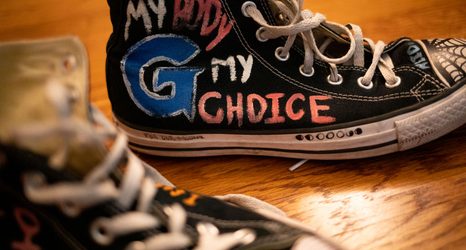
With many students arriving on campus without basic consent education, a new program targets athletes as key influencers in preventing sexual violence.

June 2026 will mark the 54th anniversary of Title IX, the 1972 federal law barring sex-based discrimination in education, ensuring equal participation in sports and prohibiting sexual violence in educational programs receiving federal funding.
But even though Title IX passed more than half a century ago, and significantly more women now go to college than men, gender-based violence is still rampant among college students.
- Thirteen percent of U.S. college students experience rape or sexual assault during their time on (or off) campus.
- For women, that number doubles: 26.4 percent of women (and 6.8 percent of men) undergraduates experience sexual violence.
- Young women are especially vulnerable, compared to older grad students, and women college students aged 18 to 24 are three times more likely to experience gender-based violence than women in general.
Most colleges and universities have standard anti-sexual violence training during freshman orientation (often just required videos or something students click through online), but this information is often forgotten or not practical enough for students to apply to their own lives and interactions.
The nonprofit sexual assault prevention organization It’s On Us is seeking to change that with the The Playbook 2.0, a research-based workshop series for college athletes.
The Playbook 2.0 is updated for the 2026-27 academic year and builds on The Playbook for Men in College Athletics, which It’s On Us released in 2024 and has since used to train 3,000 men in college athletics.
The Playbook 2.0 also includes a new companion program for women athletes, and both programs cover topics including sexual communication and consent, bystander intervention, healthy relationships and navigating breakups.
HOW TO HOST YOUR TRAININGS
The Playbook 2.0 includes four workshops for men and four workshops for women, each designed to build practical skills in:
- Sexual communication & consent
- Bystander intervention
- Healthy relationships
- Navigating breakups
- Trauma-informed mental health
Implementation
It’s On Us leaders facilitate the Playbook 2.0 through team-based sessions of up to 50 athletes, with larger teams split into smaller groups as needed. Trainings can be in person or virtual, and each session blends icebreakers, guided discussion, and interactive exercises to keep athletes engaged and actively participating.
Filling the Gaps
It’s On Us surveyed more than 700 male student athletes in 38 focus groups between 2023 and 2024 to develop the content for the training programs. The focus groups covered a wide range of topics, including what kind of education the young men had previously had on sex and relationships and what kind of sexual violence prevention programming they’d been exposed to, from K-12 or at the college level.
The responses were eye-opening. According to Tracey Vitchers, executive director of It’s On Us, less than half of the men polled had ever had any kind of formal training on consent prior to coming to college. For the ones who had, the education varied widely based on where they went to middle and high school, what kind of school they went to (public, private, religious, etc.) and what those states’ regulations and restrictions were around sexual health education. (For the record, not all schools include violence prevention as part of their standard sex ed curriculum, and only 37 percent of states require sexual education in schools to be medically accurate.)
“So many of the prevention education programs that colleges were implementing assumed that all of the students were coming with shared baseline knowledge around sexuality education, consent, bystander intervention, and that just isn’t true,” Vitchers told Ms. “We really wanted to build a program that would be responsive to the fact that you could have 50 guys on the offensive line of the football team, and that they are going to have 50 different sexual health and relationship education experiences prior to coming to college.”
Even though college athletics programs typically have some form of prevention training, It’s On Us is attempting to fill in the gaps with its programming.
“We had found through our own independent research that while college athletes are subject to additional prevention education programs, both through federal requirements such as the Campus SaVE Act as well as NCAA requirements, they were self-reporting that the programming they were receiving was extremely ineffective,” said Vitchers. “They did not find the educational programs that their schools were providing them to be interesting, helpful or enable them to build the actual knowledge and skills that they needed to understand really critical prevention lessons.”
Based on feedback from the men they surveyed, It’s On Us developed a program honing on key areas such as consent, how to be an active bystander, how to support a friend who’s experiencing violence and, especially, how to navigate conflict within a relationship.
Vitchers says implementing the programs in a team environment turned out to be especially helpful: “Those young guys already have relationships with each other. They have built-in trust. They have built-in relationships.”
Unlike the previous version, based on student feedback, The Playbook 2.0 also weaves bystander intervention into all of the other training sessions instead of having it as its own standalone. This approach helps the athletes feel equipped to be active bystanders in multiple different situations, including subtle ones, like what to do if they witness a teammate having a heated argument with his partner. According to the young men It’s On Us surveyed, other sexual violence prevention trainings they’d gone through focused only on the most extreme situations, like having to stop a teammate from taking home someone who’s too drunk to consent or breaking down a door to stop a sexual assault from happening.
It’s On Us heard from the men that previous trainings the men had gone though focused on what not to do (“Don’t rape,” “Don’t hit your girlfriend,” “Don’t commit sexual violence”) as opposed to focusing on actionable steps to prevent violence.
The new training programs for both men and women also take into account the different levels of knowledge and experience students of different genders might be coming to these trainings from. At some of It’s On Us’ trainings with men athletes, the participants have all said they don’t know anyone who has experienced sexual violence. Meanwhile, in a room full of women athletes, every hand in the room might go up.
“Young women are raised in a rape culture, and they are way more aware of these issues than men are on campus, and so we want to make sure that we are still offering high quality education to both student populations, but doing so in ways that are going to be relevant to them,” Vitchers says.
College sexual violence happens not just in sports programs but in all parts of campus life, from Greek life to parties to extracurriculars. However, It’s On Us has found that doing these prevention trainings with athletes is especially impactful, not just because men who participate in college athletics and Greek life are at a heightened risk for perpetrating sexual violence, but because of the status student-athletes have on campus.
“These athletes are major influencers on college campuses, regardless of what division,” says Kyle Richard, It’s On Us’ Director of Men’s Engagement. “We want those people who are representing the school the most to be the best people on campus.”
Training Pays Off
Richard, a former college football player himself, travels around the country hosting It’s On Us’ workshops at colleges and universities. His background in sexual violence prevention is personal: When he was in college at SUNY Cortland in 2017, he and his friends intervened in what could have been an act of sexual assault at a party, leading the assailant to shoot him twice.
After his recovery, Richard continued to lead the football team for another two years, and now his story gives him a unique way to connect with the student-athletes he works with. He said he regularly gets DMs from students he’s met in the past asking him if he’s coming back to do next year’s training.
Some guys are initially wary of having to sit through yet another mandated training, but “they’ve always been able to lock in, especially after understanding my background,” Richard says. Still, he says it doesn’t take having a crazy story to do prevention work. “I think I genuinely get respect based off the fact that I played multiple sports, and I have respect for them. I always leave off with, ‘It’s not about me, it’s about you guys. I appreciate your time.’”
For Joshua Simon, a junior at Muhlenberg College and a member of the tennis team, participating in The Playbook trainings inspired him to become first an intern and then a student ambassador for the program. Now, he leads some of the trainings himself, including the one focused on trauma.
Simon said his school’s previous trainings before the one from It’s On Us focused mostly on alcohol and overdose prevention while paying less attention to sexual violence prevention. “I do feel like the past trainings that we’ve been through haven’t given a good explanation of what resources we have on campus,” he says.
At the same time, it’s really important that student-athletes become anti-violence leaders on campus at a school like Muhlenberg, which has a relatively small number of students and a large proportion who are athletes. Many of these student-athletes are also involved in other student groups, so the sexual violence prevention training they receive extends to other areas of campus life.
“I myself am part of IFC, which is the Interfraternal Council, and I’m in a fraternity as well. And so a lot of the prevention that It’s On Us teaches goes hand in hand with the consent that we need to learn as a member of these chapters and clubs on campus,” Simon says. He is also a biology major on the pre-med track, and says having this awareness of sexual violence prevention and its role in public health can only help him in his future medical career.
It’s On Us started in 2014 as a public awareness campaign of the Obama-Biden administration to fight campus sexual assault. Since then, the program left its White House roots and become the country’s largest college sexual assault prevention program, but in this current age of Trump and Epstein, conversations about these topics in the U.S. are shifting and, for many, retrogressing.
Not long after Donald Trump first took office in 2017, then-Department of Education Secretary Betsy DeVos rolled back Obama’s protections against sexual violence. In August 2020, Trump issued new guidelines that made it much harder for survivors to report sexual assault, including requiring a live hearing and forcing survivors to be subject to cross-examinations by representatives of the accused in order for their testimony to be head. When Biden came into office, he released new federal guidelines strengthening protections for survivors in 2024.
However, Trump was reelected just months later in November 2024, and the U.S. once again has a president whom at least 27 different women have accused of sexual harassment or assault, combined with additional attacks on Title IX, women’s rights and trans rights.
“Right now, we are seeing Title IX be used and abused and weaponized against trans youth on campus and in K-12 schools under the guise of protecting women and girls. Meanwhile, we’ve seen reporting that the Department of Education, Office for Civil Rights has been opening fewer cases into incidents of sexual violence, into fewer OCR complaints from student survivors who’ve had their rights violated, and they’re just dismissing those cases outright. And that, to me, then goes against the claim that they’re that they’re focused on protecting women and girls,” Vitchers says.
“Groups like It’s On Us and others have been very outspoken against this misuse of Title IX, and we will continue to be going forward, because we know that the way that you create sexual violence prevention for campuses is not by terrorizing a minority student group on campus. It’s about actually implementing evidence based solutions to prevention and creating pathways to justice and healing for survivors when sexual violence does happen.”