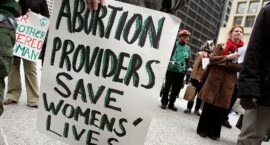
A Single Abortion Clinic Closing Rarely Makes Headlines. What Happens When None Are Left?

Picture a map of the United States. It’s 2022, and in southern states like Texas and Tennessee, there are clusters of black dots that represent independent clinic closures. These are abortion care black holes: communities where it’s no longer possible to get an abortion at a nearby clinic.

Fast forward to present. It’s 2026, four years after the Supreme Court’s decision in Dobbs v. Jackson Women’s Health Organization, and black dots have multiplied in states across the country. It no longer matters if the state is red or blue, governed by conservatives or progressives. None are immune to the increasing weight of political pressure, financial strain and operational difficulty that are forcing independent clinics to close or stop providing abortion care.

Each of these black dots is a community suffering a healthcare crisis, and they are proliferating across the United States at a rapid rate.

Independent clinics are often the only places to get clinical abortion care, unbiased information and support for pregnancy options. They are where people go to feel safe and respected, whether they are getting an abortion, continuing a pregnancy or getting gender-affirming care. In small towns and rural spaces, these clinics are often the only safe place for many people, especially those who are LGBTQIA+. If clinics close, there is often nowhere else to go.

And once abortion clinics close, it’s not as simple as reopening when they can, if they can. Even if a specific restriction is lifted, severe financial constraints, continued political hostility, threats of violence and legal uncertainty still stand.

The ‘One Big Beautiful Bill’ Will Strip Healthcare From Millions—Especially Women and Disabled People

Over 70 million people depend on Medicaid. The Trump administration and members of Congress who constantly turn to the program to make cuts, want you to think that’s a problem. It isn’t—it’s the point.

Every talking point repeated by politicians, amplified by the media and embedded in the rhetoric of those who just voted to gut $1 trillion from the program, is not a policy argument. It’s a cover story. The administration’s story of a typical Medicaid beneficiary is rooted in falsehoods about who is currently supported by the program.

The reality of Medicaid looks like:

… a 59-year-old woman in North Carolina who closed her small business because her eyesight failed, who sorts recyclables at a concert venue when the season allows, who survives on less than $10,000 a year and who relies on Medicaid for arthritis medication and blood pressure care.

Or a 63-year-old woman in Arkansas who spent her career working and now serves as the sole caregiver for her husband with advanced cancer, who is unable to leave him to log the 80 hours a month the federal government will soon demand of her on top of the role she already plays, filling gaps in a system that was already threadbare before it was slashed.

Or a young mom who has been trying for years to find an answer for the rare disease that makes her periodically unable to walk, while struggling to hold down her retail job and care for her kids while waiting months to see specialists.

These are the faces of Medicaid, and this is who HR 1—the so-called One Big Beautiful Bill Act—and the cuts within it, will harm.

And now, with a new interim final rule from the Centers for Medicare and Medicaid Services (CMS), the situation has gotten measurably worse by an administration going further than Congress intended, leaving states scrambling.

The public comment period on the interim final rule closes July 31, 2026. Make your voice heard today.

What to Know About Later Abortions: Myths, Barriers and Patient Stories

Later abortion is one of the most stigmatized and least understood aspects of reproductive health, and yet some of the voices perpetuating that stigma come from inside the reproductive rights movement itself. Meanwhile, while most abortions happen in the first trimester, later abortions are increasing as restrictions and bans are delaying care and creating the very conditions that make them necessary.

To address these misconceptions, Erika Christensen and Garin Marschall created Patient Forward after Christensen experienced a later abortion in 2016. The organization is dedicated to eliminating later abortion stigma and barriers.

“We have a lot of folks in the media, including repro[ductive rights] advocates, saying, ‘Nobody wants to do this,’ or, ‘It’s not even available,’ or, ‘Nobody’s getting abortions that late.’ Yes, they are. They’re getting them in safe, modern, incredibly compassionate abortion clinics,” said Christensen. “We do a lot of destigmatizing work.”

Patient Forward emphasizes that most people who obtain a later abortion would have preferred to access an abortion earlier: “Contrary to popular rhetoric, patients do not wait. Rather, they are delayed.”

“We have found that young people are much later to recognize they’re pregnant because their periods are irregular anyway, because they may not be familiar with all the symptoms of pregnancy,” says Dr. Diana Foster Greene of University of California San Francisco. “People with chronic health conditions are also later to discover they’re pregnant because often chronic health conditions have the same symptoms of pregnancy.”

A Federal Court Just Struck Down Idaho Abortion Restrictions. The Win Could Set the Stage for a Bigger Fight at the Ballot Box.

When most people think about post-Dobbs abortion litigation, they assume every lawsuit is trying to overturn the Supreme Court’s decision. But a groundbreaking case in Idaho charts a different course. Brought by maternal-fetal medicine specialist Dr. Stacy Seyb, the lawsuit argues that medically necessary abortion care is protected by a constitutional right Dobbs never addressed: the fundamental right to self-preservation.

To understand this novel legal strategy, I spoke with Wendy Heipt, a senior attorney at Legal Voice and a member of Seyb’s legal team. Rather than asking the courts to revive Roe, Heipt argues that no state can force a pregnant person to sacrifice their life or health by denying medically necessary care.

“This case isn’t about abortion,” she told me. “It’s about self-defense.”

If the courts agree, the case could establish a new constitutional framework for protecting pregnant women facing medical emergencies—even under the legal landscape created by Dobbs.

It is a reminder that some of the most consequential battles over reproductive freedom may turn not on revisiting old precedents, but on recognizing constitutional protections the Supreme Court never considered.

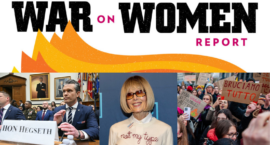
War on Women Report: Trump Administration Defines Embryos as ‘Children,’ Eliminates LGBTQ Veteran Healthcare *and* Guts Teen Pregnancy Prevention Programs

MAGA Republicans are back in the White House, and Project 2025 is their guide: the right-wing plan to turn back the clock on women’s rights, remove abortion access, and force women into roles as wives and mothers in the “ideal, natural family structure.”

We know an empowered female electorate is essential to democracy. That’s why day after day, we stay vigilant in our goals to dismantle patriarchy at every turn. We are watching, and we refuse to go back. This is the War on Women Report.

Since our last report:
—This month marked the fourth anniversary of Dobbs. Today, 41 states have some form of abortion restrictions in place, including 13 states that ban abortion entirely.
—HHS has terminated 53 of its 67 grants for the federal Teen Pregnancy Prevention Program, totaling about $68 million and affecting grantees in two dozen states.
—Two family planning programs sued the Trump administration for curtailing the Title X grant program, which funded clinics providing reproductive healthcare services to low-income patients.

… and more.

The Antiabortion Playbook Is Coming for Birth Control

The United States is on its way to banning or severely restricting birth control.

I know this statement will be met with incredulity—but I would refer you to the disbelief so many of us in the reproductive health field faced when we warned that the constitutional right to abortion was in danger. Nearly four years later, we are living in this reality that so many dismissed as alarmist fantasy.

If the anti-contraception tactics we see today look extremely familiar, it’s because they come straight from the antiabortion playbook: spreading mis- and disinformation, advancing incremental regressive policies, and denying problems with access—the same tactics that helped pave the way for the eventual overturning of Roe.

Public Health Under Fire: Military Flu Outbreak Illustrates the Danger of Politicizing Vaccine Policy

Few medical advances have saved more lives than vaccines. Yet the Trump administration continues to undermine that success by politicizing public health and discrediting decades of scientific evidence. The recent flu outbreak at Lackland Air Force Base—which sickened nearly 300 service members after Defense Secretary Pete Hegseth ended the military’s longstanding flu vaccine requirement—offers a stark reminder of what happens when ideology replaces evidence.

This is not an isolated incident. From weakening federal vaccine recommendations under Robert F. Kennedy Jr., to fueling distrust in routine immunizations, the administration’s anti-science agenda is already contributing to preventable outbreaks and declining vaccination rates.

Public health should never be a partisan project, and the costs of treating it as one are measured in illness, lost readiness and lives put at unnecessary risk.

TV Still Has a Lot to Learn About Abortion

Four years after Dobbs, television has become more willing to acknowledge the legal and political barriers to abortion care—but too often, it still reinforces harmful myths.

While shows like Grey’s Anatomy have depicted the devastating consequences of abortion bans, others continue to fall back on familiar tropes. In And Just Like That, the show largely sidesteps abortion as a normal, legitimate choice—especially for an affluent married mother in New York. And recently, the critically acclaimed Margo’s Got Money Troubles builds its entire premise around a young woman rejecting abortion despite pressure from those around her.

Those storytelling choices matter. Research shows that accurate abortion storylines can increase public understanding, reduce stigma and even help people feel more confident in their own reproductive healthcare decisions.

Yet television still rarely reflects the reality of abortion today—from the fact that most abortion patients are already parents, to the widespread use of medication abortion.

In an era of widespread confusion and misinformation, TV has the power to inform millions of viewers, but only if it moves beyond outdated narratives and portrays abortion as the ordinary healthcare decision it is for so many people.

Keeping Score: Abortion Bans Cost $140B Per Year; Federal Courts Protect Trans Youth and Incarcerated Trans Women; Feminists React to FBI Raid on Ohio Voting Rights Organization

In every issue of Ms., we track research on our progress in the fight for equality, catalogue can’t-miss quotes from feminist voices and keep tabs on the feminist movement’s many milestones. We’re Keeping Score online, too—in this biweekly roundup.

This week:
—Rep. Lizzie Fletcher (D-Texas) is working to get Republicans on the record on the Right to Contraception Act.
—ICE has already reported the deaths of 18 detainees this year, on pace to surpass the highest number of deaths in decades.
—Abortion restrictions could cost the U.S. economy $140 billion annually in lost earnings.
—”I love the inflation,” says Trump.
—The EEOC will no longer require federal agencies to report on race, ethnicity, sex or gender identity.
—83 percent of American voters agree that emergency contraception should be easily accessible.
—Abortion ban states are slowly losing a generation of women medical students and doctors.
—More than 770,000 children have already lost access to SNAP benefits after last year’s funding cuts.
—A new study found trans women athletes have no significant physical advantages over cis women.
—Missouri has restored access to medication abortions after a Jackson County judge struck down key state restrictions, allowing clinics to resume providing the service and marking the first time medication abortion has been available in Missouri since 2018.
—Republicans passed a reconciliation bill that provides roughly $70 billion for ICE and CBP, sending it to President Trump’s desk. (This is on top of more than $140 billion Republicans already provided for those agencies last year.)

… and more.

Four Years After Dobbs, Women’s Healthcare Is a Scarce Resource

This week marks four years since the Supreme Court revoked the federal right to abortion, catapulting the nation into an era of state-sanctioned deprivation of bodily autonomy for American women.

On this anniversary, we write to take stock of one of the underreported outcomes of Dobbs: the growing number of individuals and families for whom access to healthcare is diminishing because of a rise in medical deserts.

It’s common sense—there is no reason for highly mobile professionals to remain in places where they find themselves increasingly facing the prospect of personal risk for practicing medicine.

Not surprisingly, medical deserts are prevalent in conservative and rural states; the downstream pressure suggests it soon will become an issue for blue states, too.

The impact on America’s unconscionable maternal and infant mortality rates cannot be overstated. The United States has the highest maternal mortality rate of any wealthy country; as rates continue to drop worldwide, they climb higher here, with Black women more than three times more likely than white women to die in childbirth. Infant mortality has risen specifically in states that enacted abortion restrictions since 2022, again with impacts worse among Black infants.