The Curious Case of Afong Moy: Asian Womanhood and National Belonging In the U.S. 

The Asian woman in America has long been both overnamed and erased—reduced to stereotypes that obscure her humanity while fixating on her image.

In Afong Moy, a teenage girl exhibited across the U.S. as “The Chinese Lady,” we see how fascination and domination intertwine: her body staged as spectacle, her silence misread as passivity, her personhood collapsed into an object for public consumption.

That same logic shaped the law. From Chy Lung v. Freeman to the Page Act of 1875, Asian women were treated as presumptively immoral, their bodies scrutinized and excluded based on racialized assumptions.

What began as spectacle hardened into policy—ensuring that Asian women’s belonging in America has never been fully granted, only contested.

(This essay is part of the FEMINIST 250: Founding Feminists series, marking the 250th anniversary of America by reclaiming the revolution through the women and gender-expansive people whose ideas, labor and resistance shaped U.S. democracy.)

The Abolitionist Origins of American Feminism

From Mary Wollstonecraft to Sojourner Truth, the fight for women’s rights emerged alongside—and was fundamentally shaped by—the struggle to abolish slavery and secure universal human rights.

On the 250th anniversary of the founding of the republic, it is timely to trace the history of American feminism, whose roots lie in the revolutionary era and are inextricably bound with the movement to abolish slavery. 

(This essay is part of the FEMINIST 250: Founding Feminists series, marking the 250th anniversary of America by reclaiming the revolution through the women and gender-expansive people whose ideas, labor and resistance shaped U.S. democracy.)

ERA Road Tour Rolls Through Texas, Linking Suffrage History to Today’s Fight to Enshrine Equality in the Constitution

The Driving the Vote for Equality Tour is a cross-country campaign retracing the 1916 suffrage road trip, when activists drove across the United States to demand voting rights for women—this time calling on Congress to recognize the Equal Rights Amendment as the 28th Amendment. Traveling in a restored 1914 Saxon car known as the Golden Flyer II, organizers are connecting past and present while gathering support nationwide.

This week’s installment highlights recent stops in Houston, Seguin and Georgetown, Texas.

Sally Hemings and the Making of Democracy

The United States was founded not through declarations of equality, but through the labor of Black women whose political work reproduced the nation, even as it was erased from the democratic archive. 

Sally Hemings is rarely situated within the United States’ democratic legacy, despite her central role in the material conditions through which democracy was made possible.

In shaping the conditions of her children’s freedom, Hemings exercised a form of maternal political authority that governed who could move beyond enslavement. This labor stands in sharp contrast to Jefferson’s authorship of democratic ideals, which articulated freedom in abstract and ambiguous terms, while Hemings produced freedom materially through the governance of reproduction and kinship under constraint.

Hemings’ strategic negotiations secured her and her children’s futures within a political order that both denied her legal personhood and depended on her labor.

(This essay is part of the FEMINIST 250: Founding Feminists series, marking the 250th anniversary of America by reclaiming the revolution through the women and gender-expansive people whose ideas, labor and resistance shaped U.S. democracy.)

In a Time of Backlash, the Combahee River Collective Still Shows the Way

Combahee was born in response to the murders of 12 Black women in Boston at a time when racial violence had a pernicious vice-hold over the city.

When so many Black feminist icons of their generation have gone on to become ancestors, we are privileged to have access to these women, and other Black feminist elders like them today. At a time when books are being banned, there are galling attempts to erase the histories and the stories of marginalized groups, the radical beginnings of the Combahee River Collective must be amplified. These women were proud of their African American heritage, unequivocal about their socialist politics, and unabashed about their lesbian identity. They have as much to teach us now as they did then.

Could This Be the Last Women’s History Month?

Since 1987, the United States has celebrated Women’s History Month every March.

We have used this month to correct the record. To make sure that the women who built this nation—who are often systematically written out of history books and erased from the stories we tell ourselves about who we are—are named out loud and recognized. It is a national reminder that women are not a footnote to the American project. We are central to it.

But today, just shy of its 40th anniversary, Women’s History Month celebrations are quietly disappearing. Not because communities stopped caring—but because an administration decided that honoring women is a threat.

Harriet Tubman did not free herself and stop. Fannie Lou Hamer did not survive a Mississippi jail cell to just go home. Shirley Chisholm did not run for president, unbought and unbossed, so that we could sit down now.

It’s up to us now to saddle up and make sure that future generations of women and girls can not only know about the incredible shared history of the bad ass women that helped shape the world, but can feel the full freedom of it—which means we now have work to do. 

We ride at dawn.

She Wanted to Be Free: Black Women’s Revolutionary Resistance

Ona Judge was one of at least nine enslaved people owned by George and Martha Washington. At the end of Washington’s presidency, the first family prepared to return to Mount Vernon, their Virginia plantation. Ona Judge prepared to flee and live free.  

She was not alone. Black women made clear, daily, that remaining in bondage was not their preferred state. And enslavers knew and acknowledged this readily apparent fact. Enslavers throughout Britain’s North American colonies passed laws and slave codes that instituted severe physical punishment for resistance and rebellion.

Still, Black women sued enslavers for their freedom. Sometimes, they poisoned, set ablaze, or found other means to murder their enslavers. They fled from their households and plantations, even if for only a short time. Black women slowed down work. They grew their own gardens. They helped sustain their communities despite the ever-looming prospect of sale. They raised children, their own and their enslavers’.  

(This essay is part of the FEMINIST 250: Founding Feminists series, marking the 250th anniversary of America by reclaiming the revolution through the women and gender-expansive people whose ideas, labor and resistance shaped U.S. democracy.)

Living in the Archive: How the Trump Administration Is Forcing Women’s Rights Back Into History

Every March, we look back to honor the lineage of feminist progress. But in the wake of the Trump administration’s sustained assault on women’s rights, “history” has taken on a darker meaning. This Women’s History Month, the celebration is overshadowed by an ominous reality: The rights we assumed were permanent have become dangerously historical.

True freedom is predicated on the right to full civic participation, bodily autonomy and equitable access to healthcare and economic security. While generations of feminist struggle have successfully expanded these freedoms to strengthen the fabric of our democracy, the Trump administration is rolling back the clock on the hard-fought progress we have made in these areas over decades.

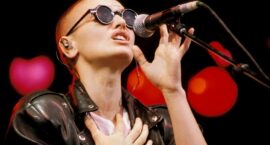
Sinead O’Connor Was Right: It’s Time to Revisit Some of Pop Culture’s Most Maligned Women

An excerpt from Allison T. Butler’s The Judgment of Gender: How Women Are Centered and Silenced in Pop Culture, published March 8, 2026:

While Sinead O’Connor was roundly criticized for ripping up the picture of the pope, the passage of time has revealed: She was right.

O’Connor was labeled a pop star, but she never saw herself that way. From Rememberings: “Everyone wants a pop star, see? But I’m a protest singer. I just had stuff to get off my chest. I had no desire for fame.”