Transphobia in Women’s Sports Is Dangerous for All Women

Olympic athlete and women’s boxing gold medalist Imane Khelif recently became a target for anti-trans activists and know-it-all couch potatoes. They decided Khelif was a man based on her perceived appearance and strength, rather than actual facts. So hyped are the anti-trans police that any woman who doesn’t seem to conform to gender norms is suspect and fair game, particularly if she’s public and successful. This is dangerous for all women, no matter their gender identity, and especially women of color.

If we accept transphobes’ arguments against all trans women in all sports, we inevitably accept a set of assumptions that harm women, trans and cis alike.
Thirty Years of the Violence Against Women Act Shows Progress Is Possible

On a long list of issues in the newly released survey, women identified domestic and sexual violence as the third most important one facing U.S. women collectively, behind abortion access and cost of living.

As we mark the 30th anniversary of the Violence Against Women Act today, it’s worth remembering one lesson that law teaches: Progress is possible.  

Front and Center: ‘Maybe It’s Just Not My Time to Be Doing Everything I Hope For,’ Says Mississippi Mom of Four

Front & Center began as first-person accounts of Black mothers living in Jackson, Miss., receiving a guaranteed income. Moving into the fourth year and next phase of this series, we’re expanding our focus beyond a single policy intervention to include a broader examination of systemic issues impacting Black women experiencing poverty. This means diving deeper into the interconnected challenges they face—including navigating the existing safety net; healthcare, childcare and elder care; and the importance of mental, physical and spiritual well-being.

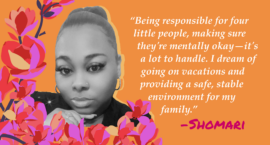
Shomari is a mom of four who is struggling to find work because she doesn’t have reliable childcare. “My ideal future includes working a career I like, my kids doing well in school and extracurricular activities, and living in a house with a yard where my kids feel comfortable. I dream of going on vacations and providing a safe, stable environment for my family.”

You Should Call House Members ‘Representatives,’ Because That’s What They Are—Not ‘Congressmen’ or ‘Congresswomen’

For most of the nation’s history, members of the U.S. House of Representatives have been addressed as “Congressman” or “Congresswoman.” By contrast, a senator is referred to as, well, “Senator.” These gendered terms for House members dominate in journalism, everyday conversation and among members of Congress.

“Whereas ‘congressman’ or ‘congresswoman’ tends to call our attention to a House member’s Capitol Hill activities and to his or her relationship with colleagues,” wrote the late Richard Fenno, “‘representative’ points us toward a House member’s activities in his or her home district and to relationships with constituents.”

In This Debate, a Woman Was the ‘Bigger Man’

If there was any doubt that a woman could lead this country, it was put to rest last night. From the moment she crossed the stage and reached out her hand to greet Donald Trump, Kamala Harris dominated the presidential debate on substance, style and seriousness.

Like the prosecutor she used to be, the vice president made her case sharply and cleanly, identifying and exploiting Trump’s weaknesses. In doing so, she effectively undercut her opponent’s longtime strategy of snidely attacking, denigrating and even looming over women in debates.

She Said, He Said: Your Fast Feminist Guide to the Harris-Trump Debate

Republican Donald Trump and Democrat Kamala Harris had their first and only debate on Tuesday night in Philadelphia. According to CNN, Trump spoke for about 42 minutes and 52 seconds, while Harris spoke for 37 minutes and 36 seconds. Trump spoke 39 times to Harris’ 23 times.

Here’s what each candidate said on some of the issues feminists care about—including access to abortion and other reproductive healthcare, the Affordable Care Act, childcare, immigration, racial unity and the economy.

Misogynist Manifesto: Fighting Project 2025’s Plans to Dismantle Democracy as We Know It

The final installment of a three-part series about the 900-plus-page right-wing “misogynistic manifesto”:

Project 2025 is a sinister plan to replace nonpartisan civil servants who enforce laws guaranteeing women’s rights, with trained ideologues determined to undermine these rights.

(This article originally appears in the Fall 2024 issue of Ms. Join the Ms. community today and you’ll get issues delivered straight to your mailbox!)

New York Voters Overwhelmingly Pass ERA Ballot Measure ‘to Protect Abortion and Reproductive Freedom’

A New York ballot measure to create constitutional protections for abortion and create explicit protections for people who experience discrimination, passed overwhelmingly on Tuesday.

Proposal 1, the first U.S. constitutional amendment of its kind, will establish comprehensive safeguards against discrimination and explicitly protect reproductive rights, including the right to abortion for state residents. According to New Yorkers for Equal Rights (NYER), a broad coalition of more than 300 diverse groups that support the initiative, the effort is different from other equal rights amendments because it includes protections for reproductive rights.

NYER campaign director Sasha N. Ahuja spoke to Ms. two months before Election Day: “We have to set the path for other states to pursue equality and provide the strongest possible protections in their constitutions.”

The Sonya Massey Case Was a Microcosm of Systemic Failures and Mistrust in Law Enforcement

The tragic shooting of Sonya Massey underscored profound systemic issues within law enforcement—especially police conduct and excessive force when it comes to Black women.

Massey, a Black woman with a known mental health condition, was shot and killed by a deputy from the Sangamon County Sheriff’s Office in Springfield, Ill. This incident has intensified scrutiny of racial bias, inadequate mental health crisis responses and the erosion of trust between marginalized communities and police.