‘The Economy Isn’t Flourishing for Us’: A Single Mother’s Reality Check From Mississippi

As costs climb and support systems lag, one Mississippi mother shares what it takes to raise three children, stay in school and fight for stability in an economy that isn’t built for families like hers.

“A lot of our leaders are trying to paint a picture that the world is in a great place and the economy is flourishing. That’s not what I see as a low-income, working-class, single Black mother.

“Meanwhile, it seems easy for the government to send billions overseas, but somehow there’s not enough to properly support citizens here at home who are working and paying taxes that fund that money in the first place?

“I tell my story because I hope that if they keep hearing from families like mine, they will finally feel moved to make a real change.​

“To every mother working hard and caring for your children—with help or without—keep going. Life will try to knock you down, but if you keep praying, keep your faith, and keep putting in the work toward your goals, you will see good results. Just keep moving forward and keep being the great mother you are; you will get where you need to be.​”

The Antidote to Despair Is Finding our Role in Community Building

In my daily life and organizing, I encounter people of various ages and backgrounds who feel stuck or unsure of what to do in this America. That’s when I recall Mr. Rogers’ wise words: “Look for the helpers”—particularly, the helpers most impacted and closest to the issues. In the quest for basic human rights and justice, I look for the everyday people in my community, across the country, who are carving paths of resistance—often with limited recognition or resources—who hold steady even when comforted with extreme pushback.

In the era of encrypted messaging and social media, mutual aid groups and meal trains offer different ways to plug in and engage. Each of us can play a role, based on our interests and strengths, in co-creating a world where we all thrive across identity, geography and difference.

(This essay is part of a collection presented by Ms. and the Groundswell Fund highlighting the work of Groundswell partners advancing inclusive democracy.)

Equal Pay Is Getting Pushed Further Away. We’re Pushing Back.

Amid the celebrations of Women’s History Month, it is a bitter irony Equal Pay Day—marking how far into the year women must work to earn what men did in the previous year—has been pushed back to March 26. The end of the month is shadowed by the knowledge that the gender pay gap still exists and is widening.

Black women, women with disabilities, moms and all women of color are paid significantly less than white men in comparable positions. Affordability is already a concern, with prices rising at the gas station and the grocery store. The pay gap is compounding these concerns to create further financial disparities for women of color.

Living in the Archive: How the Trump Administration Is Forcing Women’s Rights Back Into History

Every March, we look back to honor the lineage of feminist progress. But in the wake of the Trump administration’s sustained assault on women’s rights, “history” has taken on a darker meaning. This Women’s History Month, the celebration is overshadowed by an ominous reality: The rights we assumed were permanent have become dangerously historical.

True freedom is predicated on the right to full civic participation, bodily autonomy and equitable access to healthcare and economic security. While generations of feminist struggle have successfully expanded these freedoms to strengthen the fabric of our democracy, the Trump administration is rolling back the clock on the hard-fought progress we have made in these areas over decades.

Women Make Our Movements Powerful. They Shouldn’t Have to Suffer in Silence.

New York Times investigation released this week broke news of shocking sexual abuse allegations against labor leader César Chávez—from two women who were young teenagers at the time, and from Dolores Huerta, our long-time Ms. advisor, Feminist Majority Foundation (publisher of Ms.) board member, friend, and feminist and labor icon who co-founded the United Farm Workers with Chávez.

In fighting the culture that makes these actions not only possible, but permissible—and that encourages women like Huerta to remain silent for over 60 years—we must consider the role of men.

Men, argues Ms. contributor Jackson Katz, are essential to shifting the narrative. In describing the case of Gisèle Pelicot, a woman who had been secretly drugged by her husband and set up to be raped by dozens of men over a 10-year period, Katz mentions the evocative nickname the case acquired in French media reports: Monsieur Tout-le-monde. Mr. Everyman. 

If the 50 men who assaulted Pelicot were just “ordinary men” (“many were married and had kids. They were blue- and white-collar workers: a restaurant manager, nurse, computer technician, prison guard, firefighter, journalist, soldier,” Katz writes), then consequently, every man has a role to play in dismantling systemic violence against women.

A Movement Responds: Leaders Rally Around Dolores Huerta After Chávez Allegations

In the wake of a New York Times investigation detailing allegations of sexual abuse by labor leader Cesar Chavez—including testimony from Dolores Huerta—a chorus of feminist leaders, organizers and advocates are rallying around Huerta, centering her story and the broader truths it reveals. 

“She birthed children he forced into her womb. She convinced herself to endure it alone to free others. My God, this grief I howl.”

“She’s always been an icon, an inspiration, and a shero. Today, in her 90s she continues to lead by speaking out. Her voice probably ensured that others’ stories were told.”

“It feels both fitting and just that the holiday bearing his name be revised to Farmworkers Day—El Día del Campesino—and that every boulevard, park, and street honor Dolores Huerta instead.”

“We need to investigate why so many women who are the heartbeats of our movements are made to pay so dearly and are failed by the community so deeply.”

A Reckoning Long Overdue: Dolores Huerta’s Moment of Truth Must Also Be Ours

Civil rights icon Dolores Huerta has shared a devastating truth she carried alone for 60 years: that her closest colleague, mentor, boss and the internationally revered face of the farmworker movement, César Chávez, sexually abused her. As she approaches her 96th birthday, and in the wake of a New York Times investigation revealing that she was not alone—that Chávez also preyed upon other young women, including underage girls—Dolores made the painful, courageous decision that she could no longer keep this secret.

Across Latino, immigrant, labor, civil rights and farmworker communities—and far beyond—hearts broke and jaws dropped. César Chávez had ascended to the pinnacle of untouchable legend. And from that height, there was a long, painful fall.

There will be many debates about what comes next: what to do with the written history, the plazas, streets, schools, parks and holidays that bear Chávez’s name; how to reconcile the image so many of us learned with the disturbing portrait described by Dolores and the other survivors. I will leave the deeper historical reckoning to others.

But it feels both fitting and just that the holiday bearing his name be revised to Farmworkers Day—El Día del Campesino—and that every boulevard, park and street honor Dolores Huerta instead.

The Latest Cache of Epstein Files Haven’t (and Won’t) Spark Wall Street’s #MeToo Moment

In 2010, a 28-year-old woman working at the London branch of a Wall Street bank was leaving the office around 10 p.m. when a colleague pushed her against a wall and tried to forcibly kiss her. “A cab driver saw what was happening and physically pulled him off me,” the woman, who asked not to be named for fear of repercussions, told me. She reported the incident the next day to her manager, who told her she “should dress for the job I want” and not “like a stripper.” The women quit a month later. “I just wanted out,” she said. “I was mortified.”

What is notable about this story is how common it is. Even now, she said, you can speak to almost any woman who has spent time working in finance and she will know someone who has been harassed or assaulted. Often she has her own story.

That culture, and Wall Street’s willingness to perpetuate it, is back in the spotlight after the latest release of emails linked to Jeffrey Epstein, which are reviving scrutiny of his extensive connections across the industry.

Keeping Score: Trump Attacks Iran, Pressures Senate Republicans to Pass ‘Show Your Papers’ Voter Registration Bill; States Expand Access to Childcare and Paid Leave

In every issue of Ms., we track research on our progress in the fight for equality, catalogue can’t-miss quotes from feminist voices and keep tabs on the feminist movement’s many milestones. We’re Keeping Score online, too—in this biweekly roundup.

This week:
—Dolores Huerta breaks her silence at 96: “I have never identified myself as a victim, but I now understand that I am a survivor.”
—Trump pressures Senate Republicans to pass the SAVE America Act, a “show your papers” policy that would require U.S. citizens to show a passport or birth certificate in order to register to vote.
—A performative personnel exchange at DHS: from Kristi Noem … to Markwayne Mullin?
—The U.S. and Israel launched strikes on Iran, killing at least 1,332 people.
—March 10 is Abortion Provider Appreciation Day.
—DHS Secretary Kristi Noem was fired, as ICE reports 32 deaths in detention facilities in 2025.
—Access to early prenatal care is declining in the U.S., especially in states with abortion bans.
—A record one-third of American workers not have access to government-mandated paid leave.
—The U.S. deported a gay woman to Morocco, where her sexuality is illegal and she faces violence from her family.
—Texas Attorney General Ken Paxton claimed gender-affirming mental healthcare for trans youth is “child abuse.”
—New Mexico and New York take steps towards free universal childcare.
—Jessie Buckley took home the Academy Award for Best Actress in a Leading Role for her role in Hamnet. The film was directed by Chloé Zhao, one of nine women to ever be nominated for the award of Best Director and the only woman nominated this year.

… and more.

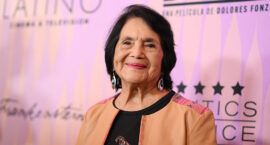
In Her Own Words: Dolores Huerta on Surviving Abuse, Speaking Out at 96 and Honoring the Movement Beyond One Man

In the wake of newly reported sexual abuse allegations against labor leader César Chávez, our hearts are with our long-time Ms. advisor, Feminist Majority Foundation (publisher of Ms.) board member, friend, and feminist and labor icon Dolores Huerta. The fact that she felt she had to bear this in silence speaks to the layers of harm that women who suffer sexual assault must bear.

In the wake of going public for the first time, Huerta writes, “I have never identified myself as a victim, but I now understand that I am a survivor—of violence, of sexual abuse, of domineering men who saw me, and other women, as property, or things to control.”

“The knowledge that he hurt young girls sickens me. My heart aches for everyone who suffered alone and in silence for years. There are no words strong enough to condemn those deplorable actions that he did. César’s actions do not reflect the values of our community and our movement.”