bell hooks Taught Us to Imagine Freedom. Universities Are Forcing Us to Fight for It.

On the day bell hooks became an ancestor, four years ago today, my beloved friend, comrade and co-conspirator Black feminist sociologist Shawn McGuffey and I were consoling one another over text when he wrote, “We should do something.” “Say less,” I replied.

We had institutional support from Northeastern University at a time when universities and other institutions were publicly and ceremoniously committing to funding DEI related initiatives in the tidal wave of so-called racial reckoning that occurred in the aftermath of George Floyd’s death. The first symposium took place two months later on a cold and clear February morning in 2022. This annual gathering became an important tradition that we looked forward to each year.

This week, we mark four years since the woman born Gloria Jean Watkins, a Black feminist writer, academic, professor and activist became an ancestor. But in 2026, there will be no bell hooks symposium at my university. Due to university wide fiscal austerity, we will not mark the anniversary this year in any official way. It is a tremendous loss, for our students and for our community locally, nationally and internationally.

As I grappled with my own grief over this loss, I had to also reflect deeply about what it means to be a Black feminist scholar in the academy today.
When Black Feminist Movements Receive Sustained and Abundant Resources, the World Wins

As the world approaches a critical juncture with over half its population heading to the polls by the end of 2024, philanthropy faces a pivotal moment.

While conservative foundations intensify funding to restrict rights, progressive donors often stall. Black feminist movements, working at the forefront of transformative change, receive a shockingly small fraction of philanthropic funds—between 0.1 to 0.35 percent. There is an urgent need for philanthropy to support these efforts in the face of growing global challenges and anti-rights organizing.

(This essay is part of a Women & Democracy package focused on who’s funding the women and LGBTQ people on the frontlines of democracy. We’re manifesting a new era for philanthropy—one that centers feminism. The need is real: Funding for women and girls amounts to less than 2 percent of all philanthropic giving; for women of color, it’s less than 1 percent. Explore the “Feminist Philanthropy Is Essential to Democracy” collection.)

From The Vault: Joan Little and The Dialectics of Rape (June 1975)

“A little more than 100 years ago … rape served not only to further [the Black woman’s] oppression but also as a means of terrorizing the entire Black community. It placed brutal emphasis on the fact that Black slaves were indeed the property of the white master. … The social incentive given to rape is woven into the logic of the institutions of this society. It is an extremely efficient means of keeping women in a state of fear of rape, or of the possibility of it.”

( For more ground-breaking stories like this, order 50 YEARS OF Ms.: THE BEST OF THE PATHFINDING MAGAZINE THAT IGNITED A REVOLUTION (Alfred A. Knopf)—a collection of the most audacious, norm-breaking coverage Ms. has published.)

Reads for the Rest of Us: The Most Anticipated Feminist Books of 2024

Books can be a comfort in dark times. They can provide understanding and light. They provide ideas, knowledge and the bravery to speak up when others cannot and to act on their behalf. 

So I read to feel. Read and reflect. Read and take action. We all have gifts to share and strengths to utilize for others who need our help. Let books inspire you to find and develop your own power and courage to be a support through someone’s dark time. Let them relax you so you can get up and fight another day. I am looking for these 100 books to be of service to me so that I might be of service to others. I hope you’ll find some here that will do the same for you. 

So, let’s read. Read and encourage others to do so. Gift books to others. Read one and pass it on. Visit and support your local libraries. But please read. Read as though your life (or someone else’s) depends on it. Because it just might.   

Celebrating Black Women Trailblazers—From Shirley Chisholm to Marsha P. Johnson: Weekend Reading on Women’s Representation

Celebrating Black Women Trailblazers—From Shirley Chisholm to Marsha P. Johnson: Weekend Reading on Women's Representation

Weekend Reading for Women’s Representation is a compilation of stories about women’s representation.

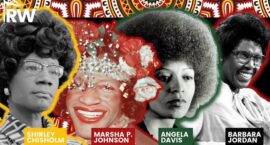
This week: highlighting Shirley Chisolm, Marsha P. Johnson, Angela Davis and Barbara Jordan; notable Black women express support for President Biden’s commitment to nominate a Black woman to the Supreme Court; Biden’s continued reliance on the old-boys network; the power of incumbency for women in politics; feminist and women’s movements on the frontlines against rising authoritarianism and militarization; women’s representation and political power in the European Parliament; 50 years of Title IX; and more.

Angela Davis’s Legacy of Collective Solidarity

“The masculinist mode of representing history makes it so that, too often, credit is not given where it’s due.” These words—among an impassioned treasure-trove of others—were delivered by longtime political activist, radical queer feminist, writer and scholar Angela Davis this past Monday night. On the 43rd anniversary of her release from prison following her acquittal […]

With These Posters, Celebrate Black History Month All Year Long

For the past 28 days of Black History Month, photographer Eunique Jones Gibson has put up a photo poster a day of an African American child posed as an historic figure–from Martin Luther King, Jr., to Malcolm X to Frederick Douglass to Barack Obama to Muhammad Ali. Of course we at the Ms. Blog are […]

Alice Walker: Beauty In Truth

I am the woman: Dark, repaired, healed Listening to you. … —Alice Walker, from her poem “Remember?” For more than four decades, Alice Walker has used the written word to make visible that which has been made invisible as a result of exploitation and marginalization. Equally as important, she is a humanitarian and social-change agent […]

Top 100 Feminist Non-Fiction Countdown: 40-31

As we get closer to the top, here are career-defining works from the likes of Angela Y. Davis, Kate Bornstein, Sheryl WuDunn and Nicholas Kristof, Patricia Hill Collins, Susie Orbach and Mary Pipher. If you’ve heard of these folks, it’s probably because of the books below. If you haven’t, you have some great reading ahead! […]