Gloria Steinem: The People’s Feminist

Lately I’ve been in a groove that has me up before the sun most days. Though I try resist the impulse to pick up my phone, this morning I opened Instagram at 4 a.m. and saw Gloria Steinem’s account—a somber post that she died peacefully overnight at age 92. It took several hours before the media started reporting on it, and in those quiet moments, I reflected on the myriad ways her words and deeds have impacted the world we inhabit and altered my own world view.

As Contrarian readers may know, I am also proudly part of the team at Ms. magazine—one of Gloria’s many legacies, and which still thrives as an essential feminist news and storytelling hub today. Her words, her wisdom, her exclamations of “fan-fucking-tastic,” even her very physical appearance—honey hair, ever-cool aviators, low-slung belts—swirl in my psyche every day.

By mid-morning, my social media feed had exploded into a wall of tributes—photos, anecdotes, news clips. I surely knew how much she meant to women of all ages—it seems everyone can quote a pithy on-the-mark phrase attributed to Gloria Steinem—but what I found so riveting was how many have an intimate firsthand interaction to recount, a prized selfie to share, a sense of real connection and meaning when it comes to Gloria. My Ms. colleague Roxy Szal refers to her as the “people’s feminist”—a pairing of words that may seem simply strung together, but represent a depth of generosity, compassion, savvy and social intelligence and skill that is rare.
‘At Last, We Know We Are Not Alone’: Gloria Steinem on Ms., the Feminist Movement and the Work Still Ahead

Gloria Steinem helped bring feminist ideas, voices and movements into the mainstream through journalism, organizing and activism—and helped build Ms. into what it remains today: not simply a magazine, but a movement. She continued working for equality until the end of her life.

“At the time that first issue [of Ms.] was published, there were local feminist publications here and in some other countries, but there was no national voice for those of us who had the radical idea that women are people,” Steinem wrote for Ms.’ 50th anniversary in 2022. “I didn’t know what the response would be, especially on newsstands, with no precedent or place for a women’s magazine that wasn’t about home, family and children.

“The response was shocking. … It sold out in eight days. … Soon, bags of mail began arriving in our offices—so many that there was room for little else.

“The letters were irresistible to read, personal notes or small novels, as if Ms. were a friend who had entered readers’ homes. One common theme was, ‘At last, I know I’m not alone.’ A movement is a contagion of truth telling: at last, we know we are not alone. …

“I won’t be around for the next 50 years, but you who are reading this may be. Imagining is the first step to creating. Let’s do it together!”

Her words feel especially resonant now: a reflection on what feminist movements inherit from one generation—and what each generation must carry forward.

‘We’re 53 Years Ahead of Where They Were Then’: Looking Back at 50+ Years of Ms.—and Looking Forward to a Feminist Future

In a new bonus episode of Looking Back, Moving Forward, Ms. executive editor Kathy Spillar, consulting editor Carmen Rios, Ms. Committee of Scholars co-chair Janell Jobson, and legendary author, activist and professor Loretta Ross explore how the stories of our past can continue to inspire us—and give us hope in the fight forward.

“I don’t believe that the assault on women and women’s rights can be extracted from the overall dysfunction of all societies.”

“We have to keep rewriting history and reclaiming history, especially knowing that the forces out there are doing what they can to erase us.”

“There’s a long lineage of people who have been fighting this fight, because they know that we deserve justice.”

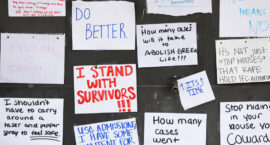
‘A Patriarchal, Male-Dominated, Use-of-Violence Society Is Not Good for Anybody’: Ellen Sweet on the Historic Ms. Study of Campus Rape, 40 Years Later

The former senior editor and writer for Ms. coordinated what became the first-ever national survey of campus sexual violence. In the latest episode of Looking Back, Moving Forward, Sweet assesses what she learned from the study about rape, activism, and backlash—and what has and hasn’t changed since it was published.

Listen to the latest episode of Looking Back, Moving Forward, “How Feminists are Breaking the Cycle of Gender-Based Violence and Harassment (with Ellen Sweet, Jane Caputi, Vanessa Tyson, Victoria Nourse, and Debra Katz)” on Spotify, Apple Podcasts or wherever you get your podcasts.

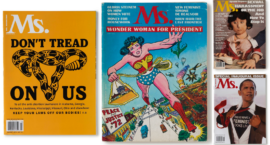
Women’s History: 10 of the Most Iconic Ms. Magazine Covers 

From calling attention to the endless labor performed by women in the home, to being the first magazine to put the first female speaker on its cover, Ms. covers allowed the magazine to make a statement on newsstands—and bring feminist conversations into the mainstream.

In honor of Women’s History Month, here are our picks of 10 of the magazine’s most impactful covers. 

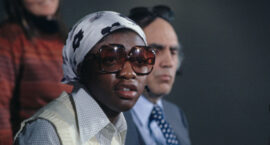
From The Vault: Joan Little and The Dialectics of Rape (June 1975)

“A little more than 100 years ago … rape served not only to further [the Black woman’s] oppression but also as a means of terrorizing the entire Black community. It placed brutal emphasis on the fact that Black slaves were indeed the property of the white master. … The social incentive given to rape is woven into the logic of the institutions of this society. It is an extremely efficient means of keeping women in a state of fear of rape, or of the possibility of it.”

( For more ground-breaking stories like this, order 50 YEARS OF Ms.: THE BEST OF THE PATHFINDING MAGAZINE THAT IGNITED A REVOLUTION (Alfred A. Knopf)—a collection of the most audacious, norm-breaking coverage Ms. has published.)

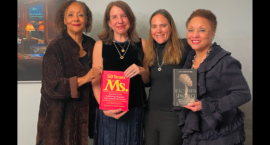
Looking Back and Forging Ahead: Three Feminist Writers on Women’s History, Feminist Media and Intergenerational Engagement

Friends of Ms. gathered last month to discuss two extraordinary anthologies, Blackbirds Singing: Inspiring Black Women’s Speeches from the Civil War to the Twenty-First Century by Janet Deward Bell and 50 Years of Ms.: The Best of the Pathfinding Magazine That Ignited a Revolution. Both give voice to extraordinary women throughout history who fought to define and demand equality.

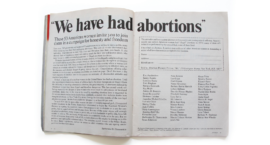
From The Vault: We Have Had Abortions (Spring 1972)

In what The Washington Post says “changed the course of the abortion rights movement,” Ms. published “We Have Had Abortions” in its first issue, featuring the signatures of 53 prominent American women. Women who have had abortions have spoken out many times during the past 50 years, and millions of women and men have marched in countless rallies and demonstrations for abortion rights.

For more ground-breaking stories like this, order 
50 YEARS OF Ms.: THE BEST OF THE PATHFINDING MAGAZINE THAT IGNITED A REVOLUTION (Alfred A. Knopf)—a collection of the most audacious, norm-breaking coverage Ms. has published.

Celebrating the Legacy of Feminist Reporting: 50 Years of Ms. Magazine at UCLA’s Hammer Museum

Ms. has always broken the silence on issues that mainstream media barely touched or refused to cover.”

(This essay is part of the “Feminist Journalism Is Essential to Democracy” project—Ms. magazine’s latest installment of Women & Democracy, presented in partnership with the International Women’s Media Foundation.)