Keeping Score: Threats Against Abortion Clinics Doubled in 2025; Sounding the Alarm on ‘Horrible Conditions’ of Delaney Immigration Center; Pride Celebrations Around the U.S.

In every issue of Ms., we track research on our progress in the fight for equality, catalogue can’t-miss quotes from feminist voices and keep tabs on the feminist movement’s many milestones. We’re Keeping Score online, too—in this biweekly roundup.

This week:
—”Trump only seems to have the capability to fire female secretaries,” observes AOC.
—Two-thirds of abortion clinics reported violence or harassment in 2025.
—The TAKE IT DOWN Act (Tools to Address Known Exploitation by Immobilizing Technological Deepfakes on Websites and Networks Act) took effect last month. It requires social media sites to take down non-consensual sexual imagery within 48 hours.
—Members of Congress visited the Delaney Hall Immigration Detention Center after detainees started a hunger strike to protest inhumane conditions.
—The Trump administration announced an investigation into E. Jean Carroll, who Trump sexually abused and defamed.
—Harvey Weinstein’s New York rape trial resulted in another mistrial.
—A North Carolina bill would allow deadly force against patients seeking abortion care.
—Healthcare premiums have skyrocketed, forcing 21 percent of HealthCare.gov enrollees to lose coverage.
—Women freelancers charge an average of 19 percent less per hour than men.
—Americans are struggling to access disability benefits after cuts to the Social Security Administration.
—Social media platforms are enabling anti-LGBTQ hate and censorship.
—Rep. Ayanna Pressley (D-Mass.) and Sen. Dick Durbin (D-Ill.) reintroduced the Federal Death Penalty Prohibition Act to ban the death penalty at the federal level. Last month, the DOJ announced they would bring back firing squads and potentially electrocution and lethal gas for executions.
—A comprehensive calendar shows all the Pride parades this month, across the country and globe.

… and more.

Rest in Power: Marjane Satrapi, Whose Masterpiece ‘Persepolis’ Transformed the World’s Understanding of Iran

Marjane Satrapi, best known for her memoir and film Persepolis, has died, aged 56. The death of this much loved Iranian French artist, graphic novelist, filmmaker and activist has been met with widespread celebration of her life—and its dedication to resistance, freedom and humanity. French president Emmanuel Macron paid tribute to “a great artist who transformed an Iranian childhood into a universal fable.”

Satrapi illustrated the dislocations of revolution, migration, adolescence and return in such a way that her memoir travelled far beyond her home country.

Through its deceptively simple black-and-white illustrations, Persepolis became globally influential because it offered an intimate account of revolutionary Iran and exile that challenged dominant stereotypes.

For many readers, Satrapi is still the woman who explained Iran in the simplest, yet most powerful way.

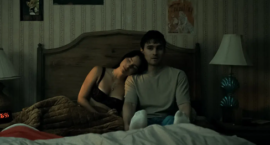
‘Obsession’ and the Rise of Incel Horror: When Men’s Entitlement Becomes the Monster

When I first watched Curry Barker’s Obsession, I assumed the horror was obvious. Not the supernatural curse at the center of the film but the decision that sets it in motion: a man deciding he is entitled to a woman’s love, to a woman’s body, regardless of her consent. 

Online, women have begun calling this kind of story “incel horror.” Particularly on TikTok, women for the first time are naming a terrifying and longstanding element in horror films often left unsaid. The real nightmare being the expectation that men depicted as the hero or the victim believe they are owed the bodies of the women in the story. As one TikToker shares, women’s reinterpretation of past films and casting a new light on modern films like Obsession (2026) through a feminist lens is going to change the future of cinema. 

In Barker’s film, it wasn’t the occult magic in the “One Wish Willow” toy that caused Bear to “control” Nikki—it was Bear’s belief that it was okay for him to make this wish in the first place. Barker places the central threat within Nikki who becomes obsessed with Bear and kills several of their friends. Conversely, feminists recognize that it’s Bear’s expectation that he is owed her affection and that he is right to use a supernatural entity to gain it, as the true horror.

Where to Watch ‘Ask E. Jean,’ a New Documentary on the Wit, Fury and Fearlessness of E. Jean Carroll

E. Jean Carroll—the colorful author and advice columnist who beat Donald Trump in court twice—is finally getting the documentary treatment in Ask E. Jean, a film that is as poignant as it is entertaining.

Director Ivy Meeropol first reached out to Carroll after reading the devastating yet vibrant New York Magazine piece in which Carroll accused Trump of raping her in a Bergdorf Goodman dressing room decades earlier.

Carroll’s initial response: “I’d rather eat my shoe.”

But Meeropol persisted, eventually convincing Carroll she wanted to tell the fuller story of her life—not just the trials, but her remarkable rise during the heyday of glossy magazines and New York media culture.

The resulting film traces Carroll’s evolution from Indiana cheerleader to professionally fabulous Manhattan raconteur, weaving together archival footage, legal depositions and deeply personal interviews.

Some of the documentary’s most powerful moments come from previously unseen deposition footage, where Carroll recounts the 1996 assault while enduring invasive questioning from Trump attorney Alina Habba. Even in those moments, Carroll remains irrepressibly funny.

Meeropol says the footage reveals “what really happens when someone who’s brought a charge of rape or sexual abuse is deposed,” while also exposing the broader misogyny women confront “from the minute we’re born.”

Meeropol also describes struggling against “The Trump Effect”—fear within the entertainment industry about supporting projects that could provoke retaliation from Trump or his allies. Distributors hesitated, some producers reportedly asked not to be credited, and the film was repeatedly stalled despite strong festival reviews.

But Ask E. Jean is now expanding into theaters nationwide, bringing Carroll’s story to audiences at a moment when the politics of gender, power and public accountability remain impossible to ignore.

Black Women, Beauty Politics and the Power of Rage in ‘Is God Is’

In one of the film’s most surreal scenes, the twins at the center of Is God Is—Racine, “the Rough One,” and Anaia, “the Quiet One”—pretend to be strippers for a room full of men. But while Racine is welcomed, Anaia is rejected because her scarred face disrupts the men’s fantasies.

That moment crystallizes one of the film’s central questions: What happens when Black women refuse to shrink themselves for the comfort of others?

In Aleshea Harris’ Gothic revenge thriller, ugliness becomes both a burden and a source of power, as the film transforms into a stereotype-busting meditation on misogynoir, beauty politics and righteous rage.

As the twins travel cross-country seeking vengeance against the father who burned their mother alive, Harris layers the conventions of the revenge genre with distinctly Black feminist aesthetics. The film moves between absurd comedy, trap music, intimate sisterhood and brutal violence while interrogating the ways Black women are expected to manage their pain, suppress their anger and perform acceptability. Anaia’s scarred face and Racine’s consuming rage become mirrors of the same misogynoir that shapes Black women’s lives—whether through beauty standards, domestic violence or the demand to remain silent.

What makes Is God Is so striking is its refusal to look away from the “ugly.” Harris insists that Black women marked by violence, scars and fury still deserve visibility, complexity and even divinity.

The film embraces the “angry Black woman” and the “ugly” Black woman as figures worthy of space, power and humanity. In doing so, it expands the tradition of Black feminist filmmaking by asking viewers to confront the realities dominant culture would rather ignore—and to recognize the beauty, dignity and selfhood that exist beyond respectability.

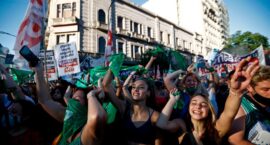
Beyond American Exceptionalism: What the Success of the Green Wave Can Teach U.S. Abortion Activists

While the idea of the U.S. as a bastion of moral superiority has always been a myth—evident, for example, in efforts to shield Jim Crow laws from scrutiny in the founding of the United Nations—the overturning of Roe v. Wade is one of the latest reminders of this fallacy, particularly as it pertains to global health and women’s rights. It is also a cautionary tale for the rest of the world about the fragility of reproductive rights.

As states across the U.S. have banned abortion post-Dobbs, advocates and experts here have been forced to look outside of our borders for assistance, recognizing that other nations have recently mobilized to legalize abortion and have much to teach us, particularly those that have done so by enshrining abortion as a human right.

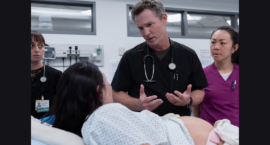
What ‘The Pitt’ Got Right and Wrong About a Major Pregnancy Risk

The Emmy award-winning medical drama The Pitt closed its second season with a storyline about a patient with preeclampsia, a hypertensive disorder of pregnancy most identified through high blood pressure and protein in urine.

As the patient’s condition worsens, including a horrible seizure leaving her nonverbal and her baby at risk, she is diagnosed with eclampsia and hemolysis, elevated liver enzymes and low platelets (HELLP) syndrome. The patient is ultimately (unbelievably) spared as her baby is surgically removed, and both are cleared to head to obstetrics and the neonatal unit, respectively. 

As a two-time preeclampsia survivor and CEO of the Preeclampsia Foundation, I want to wholeheartedly thank The Pitt producers for featuring preeclampsia, HELLP syndrome and eclampsia in their season finale. Hypertensive disorders of pregnancy, which include all three disorders plus gestational hypertension, are not rare: They affect 15 percent of all pregnancies. We need greater awareness of hypertensive disorders of pregnancy, the signs and symptoms, and the importance of fast, reliable intervention by medical professionals to save the lives of mothers and their babies. 

That said, I have thoughts—as does the broader community of preeclampsia survivors.

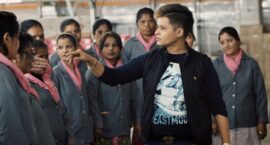
‘Pink Belt’ Documentary Follows Aparna Rajawat’s Mission to Train Women and Girls in Self-Defense Across India

Even as a child, Aparna Rajawat could see how boys in India were more respected, safer and freer than girls.

Wanting a way to defend herself, Rajawat cut her hair short and disguised herself as a boy, attending karate lessons behind her father’s back with the help of her mother and sister. By the time he discovered her secret, she was so good her coach was able to convince her father to let her continue. She went on to become a national champion and compete internationally, all while she was a teenager.

But that’s only the beginning of Rajawat’s story—a story in which her own achievements are only a backdrop to a life-long quest to inspire other Indian women and girls to achieve their dreams and protect themselves in a country where, despite its many advancements, incidents of sexual assault are still rampant and survivors struggle to get justice.

Enter Pink Belt Mission, Rajawat’s nonprofit, through which she works as a motivational speaker as well as training thousands of girls and women in self-defense.

It’s also the subject of a new documentary directed by John McCrite. A remarkable film, Pink Belt starts with Aparna Rajawat’s story, but goes much further, illuminating a path for anyone who cares about human rights to take that first step towards making a difference in their own communities and beyond.

Fewer Teen Births Is Good, Unless You’re the Patriarchy

How on-brand for the federal government to announce that U.S. birth rates are falling—just as The Testaments, the long-awaited sequel to The Handmaid’s Tale, dropped on Hulu.

In the fictional nation of Gilead, first envisioned by Margaret Atwood in her 1985 dystopian novel and expanded on screen for nearly a decade now, declining fertility catalyzed a Christian nationalist revolution in modern-day America, spawning a society rooted in patriarchal dominance and state-sanctioned violence. The Testaments, now three episodes in, is making a deliberate appeal to Gen Z and young viewers, featuring the spectacularly savvy Chase Infiniti and Lucy Halliday among Gilead’s tradwife-in-training rebels.

Doubly fascinating then, that it is the real-life status of teen birth rates in particular now driving the news. In a drop considered “extraordinary” by statisticians, the number of babies born to mothers between the ages of 15 and 19 fell by 7 percent in 2025.

Nevertheless, many on the right jumped directly into the fray to publicly lament that teens are having fewer babies.

‘The Other Roe’ Film Shines a Light on Forgotten Abortion-Rights Case Doe v. Bolton

On June 24, 2026, we’ll reach the fourth anniversary of the Supreme Court’s infamous Dobbs decision that overturned Roe v. Wade in 2022. This year, which would have been Roe’s 53rd anniversary, also coincides with the United States’ 250th, reminding us that while the U.S. has been independent since 1776, American women are still far from having full rights and power over our own bodies.

Roe v. Wade, which passed in 1973 and stood for 49 years, gets most of the credit for establishing the national right to abortion. Many people think of Roe as the first big bookend ushering in the right to abortion in the U.S., with Dobbs as the other bookend taking that right away again.

However, Roe wasn’t the only groundbreaking case that paved the way for abortion rights in the U.S. 

Doe v. Bolton, Roe v. Wade’s lesser-known companion case, was argued before the Supreme Court in 1973 the same day as Roe and was equally crucial to abortion rights in the United States.