

‘Galaxy Brain,’ Feminist Stand-Up and Looking Beyond the Netflix Algorithm

“I’ve prepared a lot. I’m taking this very seriously, because it’s still very rare for women to get Netflix specials. I had to have sex with so many executives over there.”

So begins comedian Mary Beth Barone’s new Netflix special, Galaxy Brain, with a joke about just how exceptional a woman apparently has to be to reach one of comedy’s biggest platforms.

A recent New York Times article, “Feminist Stand-Up Was Once Ascendant. Can Mary Beth Barone Revive It?” paints a picture of a stand-up scene that’s left women behind: one dominated by deliberately confrontational, anti-“politically correct” comedy and Netflix Top 10 lists littered with right-wing darlings like Tony Hinchcliffe and Andrew Schulz. 

Barone’s joke points to a real disparity in who receives the industry’s most visible opportunities. Women account for only a quarter of Netflix’s stand-up specials in 2026. And among 2025’s 10 highest-grossing comedy tours, Nikki Glaser’s Alive and Unwell was the only one headlined by a woman. 

But asking whether Barone can “revive” feminist stand-up mistakes limited mainstream visibility for an absence of feminist comedy. Women—particularly Black women, queer women and other performers pushed outside the industry’s center—have helped shape stand-up from its beginnings.
War on Women Report: Todd Blanche Is AG, Despite Pledge to Make Dobbs ‘Permanent’; Karen Attiah Is Back at WaPo (With Backpay); Rep. Cory Mills Loses Reelection After Abuse Allegations

MAGA Republicans are back in the White House, and Project 2025 is their guide, the right-wing plan to turn back the clock on women’s rights, remove abortion access, and force women into roles as wives and mothers in the “ideal, natural family structure.”

We know an empowered female electorate is essential to democracy. That’s why day after day, we stay vigilant in our goals to dismantle patriarchy at every turn. We are watching, and we refuse to go back. This is the War on Women Report.

Since our last report:
—Under mounting pressure from Defense Secretary Pete Hegseth, Scouting America eliminated dedicated community spaces for LGBTQ+ youth, girls and Scouts of color at its annual 2026 National Jamboree in West Virginia.
—An 18-year-old girl in North Carolina is facing criminal charges after allegedly taking abortion pills 31 weeks into her pregnancy, which prompted her to go into early labor.
—After a controversial two-day confirmation hearing in July, Todd Blanche has been confirmed as the new U.S. attorney general.
—In a win for domestic violence survivors, Rep. Cory Mills (R-Fla.) lost his bid for reelection amid accusations of abuse from women he has dated.
—A groundbreaking new report documents dozens of federal immigration agents who have faced administrative disciplinary action or criminal penalties for violent crimes.
—Ohio’s Bureau of Motor Vehicles (BMV) abruptly ended its policy allowing transgender residents to update the gender marker on their driver’s licenses and state IDs to match their gender identity. 
—Chicago mother Keshia Golden, who says she killed her boyfriend in self defense in 2022, accepted a plea deal for involuntary manslaughter, allowing her to avoid jail time.
—Karen Attiah, columnist for The Washington Post, has won her job back, after being fired last year for her comments on race, gender and violence in the wake of Charlie Kirk’s death.

… and more.

Misogynoir à la Française

A few days before Christmas, the French satirical magazine Charlie Hebdo featured an abhorrent caricature of esteemed journalist, author, filmmaker, and activist Rokhaya Diallo. The grotesque image, which we will not reproduce here, shows a half-naked Diallo dancing on stage dressed in a banana skirt. Her features were exaggerated in the manner of time worn racist propaganda—contorting her nose, mouth, and eyes for a minstrel-like effect. Next to the image was an audience pointing and jeering underneath a sign that read “The Rokhaya Diallo Show: she ridicules the separation of church and state all over the world.” There is no question that Diallo was targeted for her widespread international success and renown as an antiracist activist, as well as her prominence as a Black feminist voice decrying racial injustice, sexism, and misogynoir in France and abroad. The timing felt insidiously intentional— the magazine chose to end the year with a decidedly harmful message to Black French women as a holiday send off.

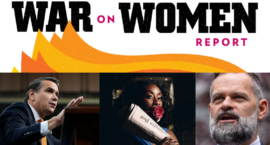
War on Women Report: Antiabortion Extremist Charged in S.C. Shooting; Army OB-GYN Accused of Abusing Over 85 Women Patients

MAGA Republicans are back in the White House, and Project 2025 is their guide—the right-wing plan to turn back the clock on women’s rights, remove abortion access, and force women into roles as wives and mothers in the “ideal, natural family structure.” We know an empowered female electorate is essential to democracy. That’s why day after day, we stay vigilant in our goals to dismantle patriarchy at every turn. We are watching, and we refuse to go back. This is the War on Women Report.

Since our last report:
—North Dakota’s Supreme Court reinstated a total abortion ban, making it the 13th state with a near-total ban on abortion.
—Trump ordered Catherine Lucey, a woman reporter for Bloomberg, to be “quiet, piggy.”
—The U.S. moved to categorize countries with state-sponsored abortion and DEI policies as violators of human rights.
—Florida Attorney General James Uthmeier has sued Planned Parenthood over allegedly “misrepresenting the safety” of abortion pills.
—On Thursday, Dec. 4, an unprecedented law banning doctors from shipping abortion pills takes effect in Texas.
—”The country’s most respected newspaper hosted a conversation about whether women’s equality and freedom was a mistake.”
—Doctor Maj. Blaine McGraw, an OB-GYN at Fort Hood military base in Texas, the third-largest base in the country, is under investigation for sexual abuse against patients. As of Monday, 85 victims have come forward.
—With Jeffrey Epstein survivors watching from the gallery above, the House agreed in a near-unanimous vote to force the release of all files related to the investigation of the convicted sex offender.

… and more.

How the Trump Administration’s Conservative Policies and Messaging Are Reshaping Body Image Standards for American Women

Body image and beauty standards for women have long shifted like fashion trends—one year in, the next out, often cycling every decade. Recently, Americans have seen a move away from body positivity and acceptance toward the ultra-thin ideals of “heroin chic.” Celebrity, influencer, and everyday social media posts alike are discussing dissolving their BBLs and turning to Ozempic or similar drugs to lose weight.

Women are sacrificing their health to fit into a very narrow standard of beauty. Ozempic, originally meant for diabetes management, has become a weight-loss tool for those who can afford it. “You can spend $1,000 a month and be thin,” says Dr. Caroline Heldman, Ph.D., author, journalist, and executive director of the Representation Project. Its long-term efficacy for weight loss has not been tested enough, yet the pressure to conform continues to grow.

This pressure is intersectional, both classist and racist. “About 300 years ago, we started to see the rise of white, thin purity as a way to differentiate white women from Black women with voluptuous bodies,” Heldman explains. Today, diet culture and society’s obsession with thinness still reflect these historic, racialized ideals, pushing women into unsafe beauty trends and fostering psychological distress.

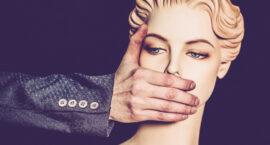
Tools of the Patriarchy: How Communication Double Standards Silence Women

“Sorry, but—”

I paused as the words flew from my mouth, forming an apology before I could even consider why I felt the need to begin my confrontation with one. A moment earlier, my friend had interrupted me during a heated debate, and I wanted to finish making the point I had been in the middle of.

“No worries, it’s all good,” he said with a smile, continuing with his argument. I sat stunned by how in a matter of seconds, I had been interrupted, then enabled to apologize for trying to address the interruption—all with the end result of my friend getting to speak over me.

These types of interactions happen to women all the time. Compulsive apologies, interruptions, mansplaining and emotional weaponization are all barriers that get in the way of women getting their point across, and being heard.

Communicating is already complicated enough, but it is even more difficult as a woman—so let’s talk about it.

What Do Women Really Want? HBO Max’s ‘Hacks’ Has Some Ideas (and Nine Emmy Nominations)

For creatives and studio executives looking to reach new and more diverse audiences—especially in a time when cultural divisions often push networks to oversimplify or water down content—Hacks offers a roadmap: Respect women viewers. Tell stories that reflect the complexity of their work, relationships and daily realities. And above all, recognize that validation and understanding aren’t side notes to entertainment—they’re at the core of what makes it resonate.

FX’s ‘The Bear’ Season 4 Embraces Feminist Leadership, Challenging Aggressive Masculinity and Reimagining the Workplace

The renowned show’s newest season is carving a new, feminist path for recognition of women-led workplaces, in spite of a history of white, male dominance.

Cultural depictions of feminist leadership, even when fictional, can help us both imagine and demand better. We need not settle for egotistical, unpredictable, manipulative leaders who focus on personal gains and grievances.

How Being Slut-Shamed by The New York Times Brought Out the Feminist in Joan Didion

In 1984, Joan Didion’s best-selling, critically acclaimed books didn’t stop a respected critic such as Christopher Lehmann-Haupt from presuming he had the right to criticize the publicity photo for her novel Democracy. The black-and-white image, he wrote, “presents the author wading in a skirt and sweater that cling sufficiently to reveal somewhat more of the anatomy than one is accustomed to seeing in a dust-jacket portrait”—then, without providing evidence, that “Miss Didion’s dust-jacket image was thought to be in questionable taste by a number of fastidious observers, including her English publisher.”

Joan Didion’s husband, the writer John Gregory Dunne, wrote a long, fuming, deadly serious and rather hilarious letter to Lehmann-Haupt defending his wife’s honor, arguing he “would stick pasties on the Venus de Milo and call it taste. It is a taste I want no part of.”

Lehmann-Haupt conceded defeat. The New York Times critic responded, “Dear John: Thanks for writing. I guess you’re right.” 

Fast Facts About Bea Feitler, the Pioneering Graphic Designer You’ve Never Heard Of

For our Summer 2025 issue, Ms. is going retro. The cover for the latest print issue is an homage to the October 1975 issue, which offered a “Special Issue on Men.” Both covers, 50 years apart, show a man in jeans and a T-shirt (the 1975 model was, no joke, Robert Redford) with a rolled-up issue of Ms. in his back pocket, honing in on the idea that women’s rights is a men’s issue too.

It’s the perfect time to remember Bea Feitler, the early Ms. art director who designed the 1975 men’s issue cover. Despite being a prominent designer (she art-directed Harper’s Bazaar and other magazines throughout the 1960s and ’70s), Feitler is largely unknown today.

In honor of her incredible legacy, which inspires Ms. staffers to this day, here are some of our favorite facts about Feitler and her remarkable life and work.