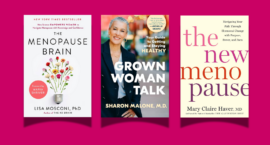
Three New Best-Selling Books on Menopause

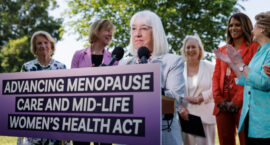
A new, modern menopause movement is underway, mobilized by a diverse coalition of doctors, journalists, and social and racial justice activists.

In particular, we recommend: The New Menopause: Navigating Your Path Through Hormonal Change With Purpose, Power, and Facts by Dr. Mary Claire Haver; Grown Woman Talk: Your Guide to Getting and Staying Healthy by Dr. Sharon Malone; and The Menopause Brain: New Science Empowers Women to Navigate the Pivotal Transition with Knowledge and Confidence by Dr. Lisa Mosconi.

(This article originally appears in the Summer 2024 issue of Ms. Join the Ms. community today and you’ll get issues delivered straight to your mailbox!)

Menopause Is Fueling a Movement

A new generation of women are demanding that the next chapter of their lives no longer be ignored, overlooked or squandered.

Dr. Sharon Malone, author of Grown Woman Talk, will be in conversation with Jennifer Weiss-Wolf at Ms. headquarters (433 S. Beverly Dr., Beverly Hills, Calif., 90212) on Thursday, June 27, at 8 p.m. PT—or come at 6 p.m. to watch the presidential debate! RSVP for the free event here.

(This article originally appears in the Summer 2024 issue of Ms. Join the Ms. community today and you’ll get issues delivered straight to your mailbox!)

‘A Virtual Abortion Doula in Your Pocket’: Aya Contigo Helps Latinas Find Abortion Care

U.S. abortion bans impact 6.7 million Latinas in the United States—the largest group of women of color impacted by these bans. Many lack insurance, cannot travel and face language and cultural barriers to reproductive healthcare. 

To address these barriers, two Canadian physicians—Dr. Roopan Gill and Dr. Genevieve Tam—co-created Aya Contigo, an app with an embedded live virtual chat to help people access contraception and abortion. Ms. spoke with Dr. Gill, an OB-GYN with advanced training in complex family planning about her work with Vitala Global and Aya Contigo.

Protect More Than Women’s Bodies on Campus

Research shows that among college students, women report more mental health issues than men. The work to protect women’s bodies is so important and still needed—but it is also important that we take steps to proactively protect the mental health of our female students. 

The year I went up for tenure, I had a series of unexpected and traumatic experiences. I know I am not the only faculty to experience a mental health breakdown at a high-stress and highly important time in my academic career. In fact, mental health problems in academia are under-discussed and relatively common. 

The Quest for Perfection Is Stunting Women’s Academic Potential

In the latest study on gender and perfectionism by the National Institutes of Health (NIH), the majority of women in the surveyed group were perfectionists. And Harvard economics professor Claudia Goldin conducted a study that found female students responded more negatively to imperfect grades than male students.

“It seems like the strongest social pressure affecting college-educated, professional women today isn’t that they’re afraid to succeed; it’s that they’re afraid not to,” wrote Amanda Hess, critic and regular contributor to
The New York Times

We Must Stop Catholic Hospitals From Closing More Labor and Delivery Units

When I became a registered nurse two decades ago, I chose to work at my local Catholic hospital: Ascension Via Christi St. Francis in Wichita, Kansas. This Mother’s Day provides a bleak reminder of the stark contrast between my Catholic employer’s public image and the reality inside its hospitals.

Ascension is one of the largest and wealthiest nonprofit and Catholic hospital systems in the United States. Ascension cut a quarter of its labor and delivery units, just in the last decade.

The Catholic health ministry boasts the mission of giving “special attention to those who are poor and vulnerable.” Act like it.

Access to Contraception Should Not Be Up for Debate

I’m a women’s health nurse practitioner (NP) and educator at Emory University, teaching the next generation of NPs to care for individuals across the lifespan including for the sexual and reproductive healthcare needs.

From the first over-the-counter birth control hitting the shelves, to attacks on FDA-approved drugs, it’s felt like whiplash for reproductive freedoms in this country. 

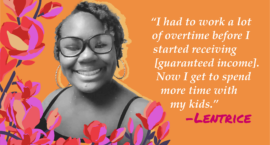
I Used to Work Two Jobs and Made $1400 a Month. With Guaranteed Income, I Can Spend More Time With My Kids.

Front and Center is a groundbreaking Ms. series that offers first-person accounts of Black mothers living in Jackson, Miss., receiving a guaranteed income. First launched in 2018, the Magnolia Mother’s Trust (MMT) is about to enter its fifth cohort, bringing the number of moms served to more than 400 and making it the longest-running guaranteed income program in the country. Across the country, guaranteed income pilots like MMT are finding that recipients are overwhelmingly using their payments for basic needs like groceries, housing and transportation.

“Before the Magnolia Mother’s Trust, I was making about $680 every two weeks. Rent was my biggest monthly expense. … I had to work a lot of overtime before I started receiving MMT. Now I get to spend more time with my kids.”


Overturning Harvey Weinstein’s Conviction Shows Poor Understanding of Violence Against Women

Context is everything when it comes to sexual and physical violence against women. Harvey Weinstein had more than a “propensity” for sexual assault; he demonstrated a serially predatory pattern of behavior of targeting and violating women and learned from the systems that enabled him that he could get away with it. Knowledge of this pattern is not prejudicial; it is necessary for a thorough understanding of the perpetrator.

The overturning of Weinstein’s conviction merely emphasizes the degree to which protection of sexual predators at their victims’ expense and permissibility of male violence against women are entrenched in our institutions. If our legal system cannot appreciate the relevance of historical patterns of behavior, we can never combat violence against women successfully.

Arizona’s 1864 Abortion Law Was Made in a Women’s Rights Desert. Here’s What Life Was Like Then.

In 1864, Arizona—which was an official territory of the United States—was a vast desert. Women in Arizona could not vote, serve on juries or exercise full control over property in a marriage. They had no direct say in laws governing their bodies. Hispanic and African American women had even fewer rights than white women.

The Arizona Supreme Court ruled on April 9, 2024, that a 160-year-old abortion ban passed during this territorial period will go into effect. Since that ruling, the Arizona legislature has been grappling with how to handle the near-total ban. Even if the ban is fully repealed, it could still take temporary effect this summer.

As someone who teaches history in Arizona and researches slavery, I think it is useful to understand what life was like in Arizona when this abortion ban was in force.