As the SAVE America Act moves through Congress and outside groups mobilize on both sides, confusion about what the bill would actually require has fueled misinformation and political spin. If passed, the legislation would require Americans to show a passport or birth certificate to register to vote—adding a new layer of federal documentation requirements that could block millions of eligible voters. Supporters describe it as a simple measure; critics warn it would create sweeping new barriers at the registration stage.
More than 21 million Americans don’t have ready access to those documents. Married women who have changed their names could face mismatched records. And the bill rests on a premise that researchers have repeatedly debunked: widespread noncitizen voting.
To cut through the noise, Ms. has put together this guide to the SAVE America Act, answering common questions about what it would do and how it could affect your right to vote.
1. What is the SAVE Act, in plain language?
The SAVE Act is a voting bill that would require U.S. citizens to show specific proof of citizenship—a passport or birth certificate—in order to register to vote. Critics describe it as a “show your papers” policy because it adds new documentation requirements at the registration stage.
The original SAVE Act is no longer the active frontline bill. The current flagship version moving through Congress is the SAVE America Act (HR 7296), which rights‑advocacy groups often call “SAVE Act 2.0” because it tightens eligibility rules even further.
3. What’s the difference between the SAVE Act and the SAVE America Act?
The SAVE Act and the newer version, the SAVE America Act, share the same core policy: requiring U.S. citizens to provide documentary proof of citizenship (specifically a passport or birth certificate) in order to register to vote.
The SAVE America Act keeps that core requirement but adds additional provisions, including:
- a strict government-issued photo ID requirement when casting a ballot
- a mandate that states share voter registration data with the Department of Homeland Security
2. What documents would people have to show to register? Would I need to show proof of citizenship to register to vote? What counts?
The bill would require voters to present an original passport or original birth certificate to register. Many Americans don’t have ready access to a passport or birth certificate, don’t know where those documents are, or have never had a passport at all.
The current version also includes a strict government-issued photo ID requirement when voting, layering additional requirements on top of registration rules.
4. Would the SAVE America Act affect only certain voters, or everyone?
The SAVE America Act would apply to everyone—but it would not affect everyone equally. Because it adds new documentation requirements at the registration stage, it would disproportionately burden voters who already face structural barriers to participation, including:
- Married women who have changed their names
- Voters of color
- Younger voters
- Naturalized citizens
- Low-income voters
- Older voters
- Voters with disabilities
- Unhoused voters
- Native American voters
- Rural voters
- Trans Americans who have changed their names
Any policy that increases the cost, time or complexity of registering tends to disproportionately affect voters who already face structural barriers. Requiring original proof-of-citizenship documents—such as a passport or birth certificate—creates hurdles for people who may not have easy access to those documents, cannot afford replacement fees, or whose identification records don’t perfectly match.
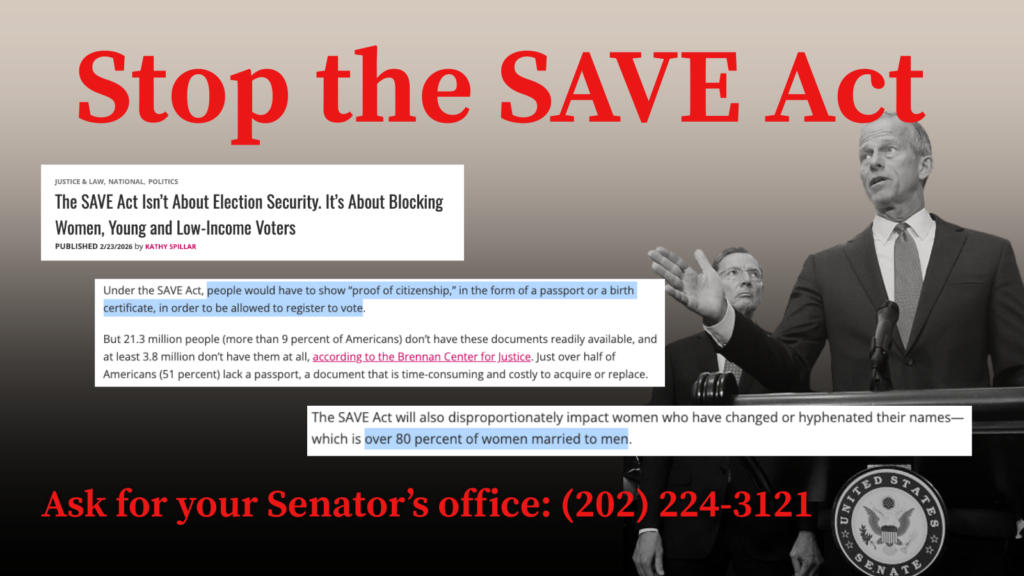
For married women in particular, mismatched documents can become a barrier. Nearly 90 percent of women change or hyphenate their names after marriage, meaning their passport, birth certificate and driver’s license may not align, potentially requiring additional paperwork to register.
Many trans people have changed their legal name and may not have updated every document (or cannot, given hostile state policies), so their birth certificate, passport (if any) and state ID may all show different information. All this on top of strict ID rules already in effect that make voting difficult for trans people: Before these new proposals, an estimated 210,800 trans Americans in voter‑ID states lacked IDs that correctly reflected their name or gender, exposing them to challenges or disenfranchisement at the polls.
5. How many people could be blocked from registering?
Many millions of eligible citizens could be blocked or deterred from registering if the SAVE America Act were implemented nationwide, according to estimates from voting‑rights and research groups.
Under this law, people would have to show “proof of citizenship,” in the form of a passport or a birth certificate, in order to be allowed to register to vote. But 21.3 million people (more than 9 percent of Americans) don’t have these documents readily available, and at least 3.8 million don’t have them at all, according to the Brennan Center for Justice.
Just over half of Americans (51 percent) lack a passport, a document that is time-consuming and costly to acquire or replace.
6. What if I changed my name when I got married—will that cause problems?
Yes, it could. Under the SAVE America Act, you may have to show documents that link your current name to your citizenship record—for example, a birth certificate plus a marriage certificate plus your ID. Because an estimated 69 million married women do not have a birth certificate that reflects their current legal name, many would face extra steps, delays or even denial when trying to register or update their registration.
6. Do I have to bring documents in person, or can I register online/by mail like usual?
The SAVE America Act would require people to present original documentation in person to register to vote. This would effectively eliminate or severely disrupt online registration, mail registration and voter registration drives, making it much harder for voters with fewer resources, especially disabled, elderly or young people, to register to vote from the convenience of their own homes.
7. If I’m already registered, do I have to do anything? Could I be forced to re-register?
If you’re already registered at your current address, you generally would not be forced to start over just because this bill passes. But any time you need to update your registration—for example, if you move, change your name or switch parties—you could be treated like a new applicant and required to provide extra paperwork that links your current information to your underlying citizenship records.
8. Does a Real ID count?
Usually not. A standard Real ID driver’s license or ID card does not, by itself, count as documentary proof of citizenship under these proposals, because it doesn’t show that you are a U.S. citizen. There is a separate “enhanced” ID in a few states that can be used to prove citizenship, but only a handful of states offer it and most people don’t have one.
9. What if I can’t find my passport, or I’ve never had a passport?
Fifty‑one percent of Americans—just over half—do not have a passport. Passports are costly and time‑consuming to acquire or replace, creating new barriers for eligible voters. Because they are not available for free, requiring a passport (or similarly costly documents) to register or prove citizenship for voting would function like a modern‑day poll tax, echoing the fees Southern states once used to keep Black citizens from the ballot before the Voting Rights Act of 1965.
Under the SAVE America Act, a birth certificate could also be used. But if a voter cannot locate their birth certificate or access a free copy, they may have no realistic choice but to pay for replacement documents—such as a passport—and wait weeks for processing before they can register or update their registration.
10. Would this affect young voters or college students? Does a student ID count?
Yes, this will affect young and college voters—and no, a student ID will not count. (Already, most states don’t allow student IDs for voter registration.)
The SAVE America Act would require documentary proof of citizenship to register and a narrow list of government‑issued photo IDs to vote in federal elections. Student IDs would not count, even if they are issued by a public college or university.
Young people and students are less likely to have passports or other qualifying IDs, and they are also more likely to move frequently, which means they have to re‑register more often—each time facing these new paperwork and ID barriers.
11. Why do voting-rights advocates call it a “voter suppression bill” instead of a “voter ID bill”?
This isn’t “show your ID” at the polls—it’s “show your passport or birth certificate” just to get on the rolls.
The bill requires proof of citizenship at the registration stage, before someone ever gets to vote, and then adds a strict government‑issued photo ID requirement at the polling place. Layering documentation requirements at both registration and voting creates extra hurdles that many eligible voters cannot easily clear, so it is more likely to shut people out than simply verify identity.
12. Why are Trump and Republicans pushing so hard for this bill?
The SAVE Act isn’t new—it’s just the latest version of a bill extreme House Republicans have been shopping since 2023, repeatedly passing the House only to flop in the Senate.
Supporters of the SAVE America Act say it is about preventing noncitizen voting and strengthening election integrity. But repeated research shows that noncitizen voting is extremely rare.
Critics argue the bill fits within a broader right-wing effort to reshape who participates in American political life, and on what terms. Policies like the SAVE America Act reflect agendas advanced by conservative groups, including the Heritage Foundation’s recently released report “Saving America by Saving the Family: A Foundation for the Next 250 Years”—described by some observers, including Jill Filipovic, as “Project 2275.”
Decades of research show that when barriers to participation increase, progress toward gender parity slows. When voter registration becomes more complex or restrictive, participation declines—not evenly, but along lines shaped by lived realities. Women are more likely to encounter administrative barriers related to name changes, caregiving responsibilities, and time, financial and mobility constraints.
In that sense, opponents say the SAVE America Act is not simply about documentation requirements. It is about who bears the burden of those requirements—and who is most likely to be pushed to the margins of political power.
Some predict the move will backfire: “Despite claims from the president that the SAVE America Act would ensure Republicans win elections, based on data, Republican voters are actually more likely to face obstacles under the legislation, including showing the two primary forms of citizenship required,” writes Sam Hananel at the Center for American Progress, building on research by Gréta Bedekovics.
13. Is this law yet? What’s the status—and could it really pass the Senate?
It’s not law yet. Last month, the U.S. House passed the SAVE America Act 218–213, with lone Democrat Rep. Henry Cuellar of Texas joining all House Republicans in voting yes for the bill. The bill now heads to the Senate, where it reportedly has “nearly unanimous” support among Republicans on the merits, but there is no evidence of the minimum seven Democratic votes they would need to overcome the filibuster.
Right now, the Senate is focused on negotiations over Department of Homeland Security (DHS) funding, but the SAVE America Act is expected to become a priority once that fight is resolved, and Majority Leader John Thune has reportedly promised some kind of vote. Voting‑rights advocates say the Democratic caucus is currently united against the bill and that it does not have 60 votes, meaning Republicans would need Democratic support to advance it—unless Thune engineers a rules change to weaken or bypass the filibuster and regular Senate procedures.
14. If it doesn’t pass, what else might the administration try instead?
Many Republican lawmakers and conservative allies are pushing for aggressive tactics, including trying to tie the bill to DHS funding or urging Senate Republicans to use procedural moves to force consideration.
Meanwhile, Trump has said he is interested in taking unilateral action on elections, with or without Congress. Anti-voting activists are eyeing executive actions: MAGA activists—including “Peter Ticktin, the attorney for Tina Peters, the former GOP Colorado county clerk … currently serving a nine-year state prison sentence for her role in a 2021 voting system breach, in an attempt to find voter fraud based on election conspiracies,” writes Democracy Docket—have circulated a 17‑page draft “emergency” executive order that would let Trump declare a national emergency over alleged foreign interference and then ban mail voting, restrict or ban voting machines, and mandate nationwide voter ID and hand‑marked paper ballots.
Any such order would face immediate, likely successful legal challenges. A prior 2025 Trump executive order on election administration was already blocked by federal judges for exceeding presidential power, which is why groups are warning that a new emergency order would likely meet the same fate.
15. What can I do right now? Who should I call?
You can call your senators—especially if you live in states with one or two Republican senators—and urge them to oppose the SAVE America Act. Click here to find your senators’ information, or call the Capitol switchboard directly at (202) 224-3121, and ask for your senator’s office.
We also urge you to call Sen. Majority Leader John Thune at (202) 224-2321. As the head of the Senate, he needs to hear from everyone outraged by this blatant attempt to curtail women’s voting power.
Now is the time to speak out, and to speak loudly.