Prime Day, in this economy? Apparently so.

Roman holiday (noun): an occasion on which enjoyment or profit is derived from others’ suffering or discomfort.
Amazon Prime Day has become one of the largest shopping events in the United States, but its success tells a story far bigger than discounts. It is a portrait of an economy that has learned to call desperation “savings,” exhaustion “efficiency” and surveillance “innovation.”
This year, that consumer ritual reached a staggering scale: U.S. online spending hit $8.3 billion on the first day of Prime Day alone. The four-day event is projected to generate more than $26 billion in total spending.
That number is especially striking in 2026, when many families report struggling to afford basic necessities, including groceries, rent, healthcare and childcare.
To be sure, none of this is an indictment of families trying to stretch their budgets. Prime Day is often marketed as a chance to save money, and for many consumers, especially parents and caregivers, the sale can feel less like indulgence than strategy. Discounted diapers, toiletries, cleaning supplies, school items and household goods matter when wages are stretched thin. (Of course, not every advertised “deal” is as dramatic as it appears; some are inflated.)
But the enormous scale of Prime Day also raises a harder question: What does it mean when one of the country’s biggest shopping events depends on a labor system that workers, regulators and advocates have repeatedly described as dangerous, underpaid and deeply unequal?
Fast, Faster, Amazon
Amazon’s scale is what makes its labor practices politically urgent. The company employs more than 1.5 million people worldwide, roughly 1.1 million in the United States. Amazon also counts well over 200 million Prime members worldwide, making its labor model not simply a business strategy but a defining feature of everyday American life.
When a corporation that large normalizes speed, surveillance and injury risk as the cost of convenience, it does not just shape one workplace—it shapes expectations across the entire low-wage economy.
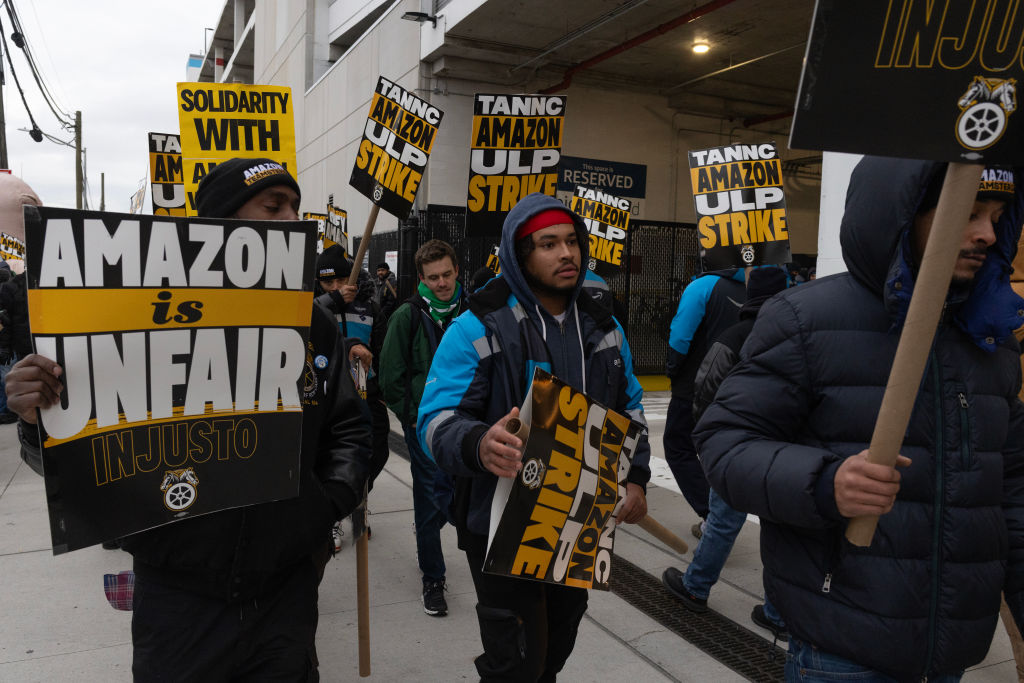
Amazon has long faced scrutiny over warehouse conditions, especially during peak shopping periods. A 2024 Senate Health, Education, Labor and Pensions Committee investigation found that Amazon warehouse workers face greater injury risks during high-pressure shopping periods like Prime Day and holiday rushes, when employees are expected to move quickly to fill and deliver a surge of orders.
Those conditions have helped fuel worker organizing, but even successful union efforts have been met with delay and resistance. At a warehouse in Staten Island, N.Y., workers voted in 2022 to form the first union at an Amazon warehouse in the United States. Yet two years later they still did not have a first contract, and Amazon continued to resist bargaining despite pressure from then-Biden-era federal labor regulators.
Amazon is not just competing in the retail economy; it is teaching consumers what to expect … and what workers may be forced to endure. When one company teaches consumers to expect near-instant delivery at massive scale, competitors that might otherwise offer safer conditions, better wages or more sustainable delivery timelines, are pressured to match that speed, or risk losing their customer base. The result is a convenience economy where speed is treated as innovation, while the human cost of that speed is treated as an unfortunate but manageable side effect.
The burden is not evenly distributed. Warehouse and delivery work is often performed by low-wage workers, immigrants, women and people of color, many of whom have limited power to challenge unsafe conditions or unpredictable schedules.
Researchers at Harvard’s Shift Project have argued Amazon’s employment practices have helped reshape labor standards across local labor markets, influencing scheduling expectations, turnover and wage competition. Labor advocates argue that companies such as Amazon and Walmart effectively shift some labor costs onto taxpayers when workers rely on public assistance.
Amazon has also faced specific allegations related to gender, pregnancy and disability discrimination. In 2025, New Jersey Attorney General Matthew Platkin filed a complaint accusing Amazon of a widespread pattern of pregnancy and disability discrimination in its warehouses, alleging that pregnant and disabled workers were denied reasonable accommodations, pushed onto unpaid leave or forced out of their jobs.
Deregulation, But Make It Prime
The political context makes this even more urgent. In 2026, labor protections are being debated alongside a broader push toward deregulation and corporate-friendly policy. Under the Trump administration and congressional Republicans, worker advocates have warned that federal labor enforcement is weakening at the very moment companies like Amazon require more oversight, not less.
Senators led by Elizabeth Warren argued OSHA conducted fewer inspections and issued fewer fines for severe workplace violations in 2025, arguing that the Labor Department was retreating from its responsibility to protect workers. Good Jobs First has similarly warned of a collapse in federal labor enforcement under the second Trump administration.
The politics of Prime Day cannot be separated from the politics of billionaire power. Jeff Bezos remains one of the richest people in the world, with Forbes estimating his net worth at more than $240 billion in June 2026. Meanwhile, Amazon donated $1 million to Trump’s inaugural fund, and Amazon MGM paid a reported $40 million for a Melania Trump documentary—examples of large corporations seeking influence with an administration committed to deregulation.
At a time when the richest 1 percent of households own 31.7 percent of all U.S. wealth (the highest share on record since the Federal Reserve began tracking in 1989) and billionaire wealth is at a record-high $18.3 trillion, Prime Day exposes the widening gap between those who profit from the convenience economy and those whose bodies absorb its cost.
If Prime Day is America’s Roman holiday, then the sales were never really the point—the power was.
Support more work like this article
The reporting you just read is possible because of readers like you. Since 1972, Ms. has delivered independent, feminist journalism that tells the stories too often overlooked by other news media, challenges systems of inequality and holds power to account. We have no corporate owners, no advertisers and no billionaires dictating what we cover. Instead, we answer to our readers and our mission. If you value reporting that centers women and girls—and covers the issues others leave out—please support Ms. today by making a tax-deductible donation, becoming a member to receive a magazine subscription, or gifting a membership to a friend. Together, we can continue reporting, rebelling and truth-telling.