Secretary of Agriculture’s Anti-Trans Crusade Won’t Save Our Food System

The U.S. Department of Agriculture has long been a sprawling agency with often-conflicting goals. It’s in charge of both promoting healthy diets through the Dietary Guidelines for Americans, school food and nutrition assistance programs and boosting commodity crops, which are dumped into our food system in the form of unhealthy, ultra-processed foods and excessive amounts of meat and dairy.

But since its founding, the USDA’s role has been to recognize the vital importance of agriculture in our country and to protect America’s food supply.

So if you’re wondering how attacking transgender youth helps our food system, you’re not alone.

Scientists Understood Physics of Climate Change in the 1800s—Thanks to a Woman Named Eunice Foote

Long before the current political divide over climate change, and even before the U.S. Civil War (1861-1865), an American scientist named Eunice Foote documented the underlying cause of today’s climate change crisis.

The year was 1856. Foote’s brief scientific paper was the first to describe the extraordinary power of carbon dioxide gas to absorb heat—the driving force of global warming.

Social Movements Constrained Trump in His First Term—More Than People Realize

As The New York Times noted not long ago, Trump “had not appeared to be swayed by protests, petitions, hashtag campaigns or other tools of mass dissent.” That’s a common perspective these days. But what if it’s wrong?

In fact, popular resistance in Trump’s first term accomplished more than many observers realize; it’s just that most wins happened outside the spotlight. In my view, the most visible tactics—petitions, hashtags, occasional marches in Washington—had less impact than the quieter work of organizing in communities and workplaces.

Understanding when movements succeeded during Trump’s first term is important for identifying how activists can effectively oppose Trump policy in his second administration.

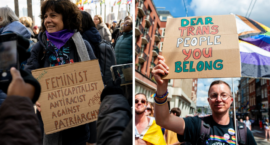
Budget Cuts, IVF Access and the Feminist Resistance: Dispatches From Week 1 of Women’s History Month in Trump’s America

Beyond the sheer cruelty, Trump’s antagonism toward government—and the attempts to swiftly dismantle federal agencies’ productivity and purpose—is a simultaneous affront to and attack on women and LGBTQ communities. Make no mistake: That is by design. As Professor Tressie McMillan Cottom underscores: “By giving people a scapegoat, giving men a scapegoat … it says not only are women the enemy, are people of color and minorities the enemy, but the government is protecting them. So not only do we need to push these people out, but we need to delegitimize and gut the government that made them possible so it doesn’t happen again.” In the weeks and months to come, as we collectively continue to litigate and report and write and resist, we must not lose sight of this reality—because countering attacks on gender is foundational to the work of protecting and preserving democracy.

As today’s headlines highlight Trump’s withdrawal of aid to Ukraine and imposition of tariffs on China, Canada and Mexico—and the lowlights of his remarks to a joint session of Congress—here are stories that also warrant attention.

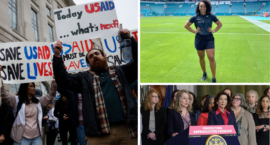
Keeping Score: Devastating Attacks on USAID; Louisiana Indicts N.Y. Doctor; Autumn Lockwood Is First Black Woman Coach to Win Super Bowl

In every issue of Ms., we track research on our progress in the fight for equality, catalogue can’t-miss quotes from feminist voices and keep tabs on the feminist movement’s many milestones. We’re Keeping Score online, too—in this biweekly roundup.

This week: Musk and Trump’s USAID attacks have devastating impacts; 80% of the clean energy investments from the 2022 Inflation Reduction Act—which Trump wants to roll back—are in Republican congressional districts; Louisiana indicts a New York doctor for prescribing abortion pills; new executive orders go after workers and LGBTQ people; the Laken Riley Act was signed into law; childcare costs affect the health of parents; and more.

We Heart: Altadena Girls Is Turning Nail Polish and Curly Hair Products Into Healing Tools for Fire Survivors

With 40,000 acres burned and more than 13,000 buildings destroyed in the SoCal wildfires, which have decimated whole neighborhoods of Los Angeles over the last two weeks, most recovery efforts have focused on providing shelter and food for the 10,000-plus people evacuated from their homes.

Fourteen-year-old Avery Colvert, whose school was destroyed in the fire, started the donation drive Altadena Girls to help young girl survivors find less obvious (but equally comforting) items. While GoFundMe has countless pages of drives for individual families who lost their homes, Altadena Girls sent out a call on Instagram for supplies like nail polish, pimple patches and curly hair products.

“For teenage girls who have lost everything, feeling like ourselves again is also really important for our mental health.”

Building Strong Homes and Businesses: Empowering Cherokee Women Founders Through Access to Capital

Under 2 percent of women founders receive venture funding, and it’s not getting better, according to Lesley Robinson, director of education at the Ayana Foundation. Venture capital funding for Indigenous Native American women is significantly lower: just .0013 percent of venture capital funding.

The University of Tulsa Cherokee Women’s AcceleratHER Fellowship is working to change that.

“[It’s] not just understanding who you are as a founder and really focusing on the business, but really more about the identity and intersectionality of who you are. Then having this really beautiful, intentional, impactful handshake in the Cherokee Nation, and then the resources as a business woman that you can begin to cultivate from there,” said Robinson. 

Keeping Score: More Attacks on Trans Rights; Sexual Assault Should Disqualify Cabinet Nominees, Americans Say; Female Professors Win Lawsuit and Backpay for Pay Disparity

In every issue of Ms., we track research on our progress in the fight for equality, catalogue can’t-miss quotes from feminist voices and keep tabs on the feminist movement’s many milestones. We’re Keeping Score online, too—in this biweekly roundup.

This week: The Supreme Court considers a ban on gender-affirming healthcare for trans teens; data shows crimes in public restrooms and changing rooms are extremely rare, and are not decreased by laws preventing trans people from using public bathrooms; analyzing Trump’s cabinet nominees; midwives say climate change is harming their communities; Nevada maintains a majority woman legislature; criminal justice reform for probation, parole and bail is critical; Arizona moves to end 15-week abortion ban; Sens. Elizabeth Warren and Richard Blumenthal have asked the Biden administration to limit the federal government from deploying troops domestically; and more.