Trump’s Support Erodes as Women, Workers and Even Republicans Push Back

It seems like with each week, Trump just keeps getting more and more unpopular—even among those who are most primed to like him. Trump’s approval rating is currently the lowest it’s been this term, seeing a significant decline among Independents and even some decline among Republicans.

And the “Big Beautiful Bill” has played no small role: Polling shows that majorities of voters continue to disapprove of the Republican economic plan. Seventy percent are concerned about cuts to Medicaid (which, by the way, remains overwhelmingly popular in the polls), regardless of when those cuts go into effect—indicating that the Republican strategy of delaying the cuts’ implementation till after the midterm elections might not be working.

Regardless of how dark things feel, there are countless feminist battles in our past, both near and far, that we can draw hope and strength from.

What Would Social Media Look Like if it Was Made for Women? How Women are Navigating Social Media During the Second Trump Administration

Following the 2024 election and the presidential inauguration, women faced a dramatic increase in online harassment. Across X, TikTok, Facebook and other social platforms, statements calling for the repeal of the 19th Amendment resurfaced and increased by 633 percent compared to the previous week. Increasingly jarring, “Your body, my choice,” became a trending phrase on Facebook and grew by over 4600 percent on X. 

Olivia DeRamus, the founder and CEO of Communia, a social networking app and self development platform made for women, said that the social networking app has become a place for women to take refuge from the dramatic uptick in online harassment following the 2024 election and the inauguration. 

I’m a Texas-Born OB-GYN—But Abortion Bans Are Forcing Me Out

Vi Burgess is a resident physician in Colorado, in training to specialize in obstetrics and gynecology. The Texas resident went to medical school in the Lone Star State, but says she’d be terrified to return home to practice medicine.

“I’d be terrified to go back to Texas to practice as an OB-GYN after I finish my residency. I’d be absolutely terrified. It’s not so much that I’d be terrified of getting thrown in jail, but terrified that I won’t be able to provide care to a woman—and that would lead to serious harm or death.

“I think that’s every doctor’s biggest fear—not being able to help and ultimately ending up hurting someone. But that’s the situation that OB-GYNs and other doctors are now in, in Texas.”

Doesn’t Gen Z Have the Right to Life? Young People Sue Trump Administration Over Climate Catastrophe as State-By-State Battle Continues

At least 137 people are dead after devastating flash-flooding in Texas in early July, including many children. As climate change induced disasters grow more common and the Trump administration rolls back environmental protections, several organizations are pursuing creative legal strategies to defend children’s fundamental right to a safe, healthy and stable natural environment.

On behalf of 22 young people, Our Children’s Trust filed Lighthiser v. Trump in May as part of its multi-case Youth v. Gov effort, asserting that three of the president’s pro-fossil fuel executive orders violate their constitutional rights to life, health and safety.

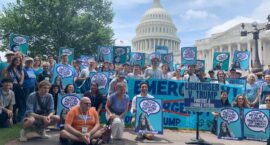
On July 16, hundreds gathered outside the U.S. Capitol to hear from Lighthiser plaintiffs and members of Congress at a press conference hosted by Our Children’s Trust and several organizational partners.

The same day, the Children’s Fundamental Rights to Life and a Stable Climate System resolution was introduced by Sen. Merkley (D-Oreg.) and Reps. Schakowsky (D-Ill.), Jayapal (D-Wash.) and Raskin (D-Md.). More than 50 additional senators and representatives joined the resolution as cosponsors.

Eva Lighthiser and Lander Busse were also plaintiffs in Held v. State of Montana, in which the Montana Supreme Court ruled that state law restricting consideration of climate change in environmental reviews violated youth plaintiffs’ right to a clean and healthful environment. The suit saw success largely because Montana has a Green Amendment—a constitutional amendment in the Bill of Rights section of the state Constitution explicitly declaring the legal right to a safe, healthy and stable natural environment for all people. Thus far, only Montana, Pennsylvania and New York have Green Amendments. The organization Green Amendments for the Generations (GAFTG) is working state-by-state alongside community partners to get new state-level Green Amendments passed.


Teaching Sex to Empower, Not to Control: Sex Ed in Sweden vs. South Carolina

Sweden was the first country to mandate sex education in 1955 and now has a national sex ed curriculum integrated through all course subjects. Swedes divorce sex ed from discussions about religious morality. Their curriculum instead encourages students to ask questions and critically examine gender and sex norms, while teachers instruct students with medically accurate information. 

Swedes were shocked to learn that in our local South Carolina school district, sex ed teachers use a memorable acronym (H.A.M.) to remember what their districts won’t allow them to discuss with students. “H.A.M.” stands for homosexuality, abortion and masturbation—three topics which are forbidden. If students ask about these subjects, teachers are told to redirect their questions. 

Young Men May Not Be as Conservative as You Think

Gen Z men in their teens and twenties are leaning further right than ever… or so mainstream media would have you believe.

For months before and since the November 2024 election, news articles, podcasts and polls have been pointing to the widening gender gap between young men and young women. (Young white men in particular voted for Donald Trump by a 28-point margin in 2024, compared to 2020 when young white men between 18 and 29 supported Joe Biden over Trump by six points.)

However, new polling from the Young Men Research Project (YMRP) suggests there might be more to the story.

“The share of young men who say they voted for Trump in 2024 but no longer view him favorably, it’s on the order of 5 to 8 percent of young men,” John Ray, YMRP team member and senior director of polling at YouGov, told me in an interview.

Floods, Fear and Family Crisis: The Impact of Texas’ Natural Disasters on Domestic Violence

Devastating floods began sweeping across Central Texas on July 4, causing the Guadalupe River to surge at an alarming rate: 20 feet in the first three hours. The disaster ranks among the deadliest and most catastrophic in the state, claiming at least 136 lives, with four individuals still missing.

The floods captured national attention and served as yet another chilling reminder of the real and rising consequences of climate change. And as climate-driven disasters only grow more frequent and intense, Texans continue to suffer the fallout—both seen and unseen.

Among these unseen and overlooked consequences: increased risk of domestic violence.

Extreme weather events—floods, heatwaves and hurricanes—not only displace families and destroy homes, but they also strain financial resources and fracture essential support systems. These stressors can intensify existing inequalities and create volatile conditions increasing the risk of violence, particularly against women and girls. 

‘Giving Women a Chance to Choose When the World Didn’t’: Massachusetts Doctors Provide Telehealth Abortion in States with Bans

As abortion bans have swept the country, Massachusetts doctors are stepping up by providing thousands with lifesaving telehealth abortion care, regardless of their ability to pay. 

On July 12, reproductive health advocates and local office holders filled the common room of a Northampton, Mass., co-housing community to celebrate and support the vital work of The Massachusetts Medication Abortion Access Project (The MAP). Based in Cambridge, the MAP is one of a handful of medical practices in the U.S. providing telehealth abortion care to patients in states with abortion bans or severe restrictions. Each month, MAP provides abortion pills to 2500 patients—nearly a third from Texas—using an asynchronous telemedicine platform built to provide prompt, private and convenient abortion care that is affordable to all.

“I want to thank The MAP from the depths of my soul,” one patient said. “You have saved me.”

Why Is the Vice President Sitting Like That?

That awkward posture isn’t accidental. When Vance spreads his legs and plops down for an interview, he is directly addressing young men. He wants to prove that he’s just one of the guys, while also issuing a dire warning. “The boys,” he asserts, are under attack.

Advancements in women’s rights have always been followed by countermovements, each one lamenting, “But what about the boys?”

In reality, the cure for loneliness can’t be found in calling your friends the f-word or finding a “trad wife” who will stay in her place. It requires genuine relationships. It’s about having your feelings valued but with the equal expectation of emotional reciprocity. Behold and be held. That’s the deal.

Guys: You all, like all people, deserve to be loved. The problem is, the messengers who claim to be your friends are lying. Those guys don’t love you. They love their power over you.

Pregnant and Unmarried? In Tennessee, That’s Now Grounds for Denial of Care.

This week marked the first reported case of a woman being denied prenatal care for being unmarried in the state of Tennessee and the country. And it is the direct result of the state’s 2025 Medical Ethics Defense Act, which went into effect in April. The law enables physicians, nurses, hospitals and insurers to invoke religious, moral or ethical objections to the provision of care and treatment, with no legal requirement to provide patients with a referral or alternative.