What Judge Ketanji Brown Jackson’s Historic Nomination Means to Women of Color in Law

Approximately one in three lawyers are women. Fewer than two in 10 lawyers are people of color. And only one in 115 justices of the Supreme Court has ever been a woman of color. That number could soon double as Ketanji Brown Jackson has become the first Black woman ever nominated to the highest court in the country. 

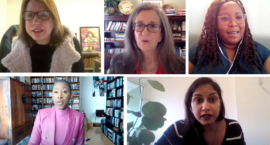
Madiba Dennie and Elizabeth Hira are uniquely positioned to discuss this historic nomination: They’re both women of color, they’re both attorneys, and they both work at the Brennan Center for Justice on issues of democracy and equity. This discussion highlights the networks they have relied on, the progress that has been made and the challenges that remain, and the democracy they hope to build.

Women’s Rights and Democracy Are Inextricably Linked

Last fall, America was featured for the first time on a list of backsliding democracies. With inadequate progress in women’s participation in government, reproductive rights, and maternal mortality, this title may reflect recent attacks on gender equality. Amer­ica’s long­stand­ing and abysmal record on myriad gender equity mark­ers has been the true harbinger for our down­graded democracy status.

U.S. Backslide on Abortion Rights Is a Grave Danger to Democracy, Say Both Reproductive Rights Experts and Legal Analysts

Saturday, Jan. 22, marked Roe v. Wade’s 49th anniversary—and it very well may be its last. 

On Friday, Jan. 21, experts on democracy and elections from the Brennan Center and Ms. discussed the implications of the Texas abortion law S.B. 8 and the Dobbs v. Jackson Women’s Health Organization case that directly challenges the precedent of Roe.

Sponsored by Ms. and the Gender and Policy Center at George Mason University’s Schar School, the rousing discussion set the stage for how the U.S. got to this point, and outlined where we go from here.

The Justices Have No Robes

supreme court abortion

The Supreme Court faces a rule-of-law crisis of its own making.

We residents of the United States who are governed but not protected by its laws must now wonder: Which right will be next? And for whom? And if the Court does not exist to respect rights, why does it exist and why should it be respected?

What Happens When the Law Fails Those Who Are Learning to Protect It?

law students abortion

When rights, especially those that sustain our equal citizenship, are stripped away, it is inevitably deeply upsetting to all those who believe in and rely on those rights. But it is a unique and profound loss for law students, who are also experiencing an attack on their nascent professional identities. They are relying on those rights to fulfill their dreams. 

The Government Has a Long History of Controlling Women—One That Never Ended

bodily autonomy abortion

Abortion is not (just) a health issue. Whether we are willing to let women and people capable of becoming pregnant control their own bodies, for health or any other reason, is an equity issue—a question of who deserves bodily autonomy and freedom to reach their full potential.

Ultimately, abortion bans and restrictions are part of broader legal and societal structures that were unambiguously designed to not recognize women’s inherent equality.

Abortion Funds Enable Access: The Time to Invest in Direct Aid Is Now

Abortion Funds Enable Access: The Time to Invest in Direct Aid Is Now

Expanded investment in abortion funds is urgently needed to keep up with current demand for direct aid, as well as to prepare for an uncertain and surely more challenging future.

Central to the defense of reproductive rights for all must be the provision of and commitment to direct aid to the communities facing those attacks head-on.

A Vocal—and Wealthy—Minority Is Controlling Abortion Access

Conservatives have relentlessly focused on reshaping the Supreme Court for decades. And now, they’ve allowed Texas’s six-week abortion ban to stand for months because a handful of oil and gas tycoons exerted massive influence over Texas politics by funneling millions into statehouse races.

To a large extent, this stunning outcome is a story of democratic failures and the power of big money in American politics.