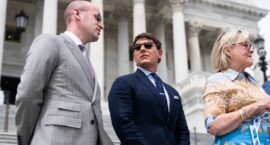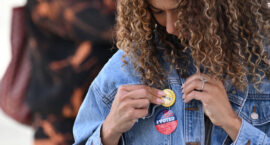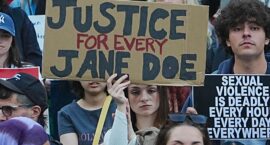
Furious, Fearless and Defiant: Our Favorite Protest Signs From No Kings 3.0

On Saturday, March 28, 2026, millions showed up for the latest wave of No Kings protests, drawing an estimated 8 million people across more than 3,300 events worldwide.

The flagship event was held in Minneapolis-St. Paul, the site of a controversial immigration enforcement surge resulting in the deaths of two residents, Renée Nicole Macklin Good and Alex Pretti, at the hands of federal agents.

War on Women Report: Kentucky Woman Arrested for Miscarriage; Kansas Anti-Trans Bill Takes Effect; Polls Show Most U.S. Women Disapprove of Trump

MAGA Republicans are back in the White House, and Project 2025 is their guide—the right-wing plan to turn back the clock on women’s rights, remove abortion access, and force women into roles as wives and mothers in the “ideal, natural family structure.” We know an empowered female electorate is essential to democracy. That’s why day after day, we stay vigilant in our goals to dismantle patriarchy at every turn. We are watching, and we refuse to go back. This is the War on Women Report.

Since our last report:
—Texas Attorney General Ken Paxton is suing Delaware abortion provider Debra Lynch, who operates the organization Her Safe Harbor, for allegedly mailing abortion pills into Texas.
—More than a year after seeking medical help for a miscarriage, Deann and Charles Bennett, a young couple in Booneville, Ky., have been arrested for alleged “reckless homicide.”
—Trump’s Department of Justice used the Freedom of Access to Clinic Entrances (FACE) Act, intended to protect abortion clinics from harassment, to prosecute journalist Don Lemon for attending an anti-ICE protest.
—The Trump administration withdrew a Biden-era rule that required pharmacies receiving federal funding to carry and dispense mifepristone, misoprostol and methotrexate.
—Arkansas’ near-total abortion ban is facing its first legal challenge since Dobbs
—Some good news from Cleveland: The Cleveland City Council passed Tanisha’s Law, creating a Community Crisis Response department to respond to non-violent mental health emergencies with trained, unarmed crisis teams.
—In a landmark victory for survivor accountability, an Arizona jury in Phoenix has ordered Uber to pay $8.5 million to Jaylynn Dean.
—Also in Arizona: Judge Gregory Como struck down several abortion restrictions, ruling them unconstitutional.

… and more.

The SAVE Act Isn’t About Election Security. It’s About Blocking Women, Young and Low-Income Voters

The SAVE Act—the Republicans’ attempt to strip voting rights from millions of Americans under the guise of “safeguarding” elections that are already quite safe—is now headed for debate in the Senate, and President Donald Trump is pushing hard for the bill. Top Democrats say the GOP’s real aim is to “rig the system” by putting paperwork and ID barriers in front of millions of currently eligible voters, and that the bill is part of a larger, ongoing effort to undermine trust in elections and reshape rules in Trump’s favor.

Under the SAVE Act, people would have to show “proof of citizenship,” in the form of a passport or a birth certificate, in order to be allowed to register to vote.

But 21.3 million people (more than 9 percent of Americans) don’t have these documents readily available, and at least 3.8 million don’t have them at all, according to the Brennan Center for Justice. Just over half of Americans (51 percent) lack a passport, a document that is time-consuming and costly to acquire or replace.

The SAVE Act will also disproportionately impact women who have changed or hyphenated their names—which is over 80 percent of women married to men.

Likewise, elderly voters, young voters and voters without the financial means to acquire these documents will be overwhelmingly impacted.

When in Doubt, Blame Young Women: The Evergreen Electoral Existential Crisis of Young Women in U.S. Politics

While the right-wing media ecosystem views young women as an affliction, the Democratic Party risks taking this group for granted and overlooking their real-life concerns.

Women are more likely to support Democratic candidates than their male counterparts. This pattern, coined the “gendergap” by Ellie Smeal, has remained a fixture of American politics in every presidential election since 1980. That support shows that women’s Democratic support is consistent and can be politically decisive. Still, this support should not be taken for granted.

A Month of Fear: ICE’s Surge in Minneapolis and the Backlash That Won’t Quit

For the people of Minneapolis, it has been another week of startling violence as the Trump administration continues to mobilize ICE officers into the city—shuttering schools and businesses and leaving residents afraid to leave their homes. Still, thousands have taken to the streets to resist.

One such resister’s story came to us through our Ms. community: Skye, a disabled U.S. Marine Corps veteran who has been participating in citizen observer efforts to warn neighbors about ICE presence. “This is my duty,” she told Ms. “I took an oath to defend the United States of America against all enemies, foreign and domestic. … [ICE agents] are terrorizing our citizens.”

If there’s a silver lining, it’s that people aren’t staying silent. Protests have filled streets in Minneapolis and far beyond. As we honor Martin Luther King Jr. Day, we’re reminded that racial justice, gender equality, reproductive rights and an end to state violence are intertwined struggles.

Six Ways Masculine Stereotypes Are Still Limiting Boys

Rigid norms of manhood—based in manly confidence and toughness, emotional stoicism, disdain for femininity and dog-eat-dog banter—are influential among boys and young men.

Between one quarter and one half of boys and young men endorse these norms. Over half feel pressure from others to live up to them, believing most people expect them always to be confident, strong and tough.

These are some of the findings from a new Australian survey of adolescents aged 14-18 years, conducted by The Men’s Project at Jesuit Social Services.

In a climate of heightened concern about boys and young men and violent masculinity, this study provides invaluable data on boys’ and young men’s own views. This includes the pressures they feel to live up to stereotypical masculine norms and the profound impact of those beliefs.

Actually It’s Good That Fewer High Schoolers Want to Get Married

High schoolers, and especially high school girls, are less likely than ever to say that they want to get married someday, according to new research from Pew Research Center. While boys have stayed fairly stable in how many of them say they want to marry, girls have gone from overwhelmingly wanting marriage to being even less likely than boys to want to wed.

Conservative groups and writers have met this new survey with some panic. If 12th graders don’t want to get married, I guess the logic goes, then they won’t get married, and America’s declining rates of marriage and childbearing will continue and will eventually destroy society. To them, this new survey indicates a broader social shift away from marriage and childbearing, which is bad, because in their view, the nuclear family is the good and necessary backbone of any moral and functional culture. 

But actually, it’s great that far fewer high school girls are even thinking about marriage.

The teenage girls who are thinking about their weekends instead of their weddings? They’re doing something right. 

Election Results: Historic Gender Gaps Shape 2025 Outcomes in Virginia, New Jersey and Beyond

We’ve curated the results of all the state-by-state election results that feminists most care about.

Together, the early data from this week’s elections paints a clear picture: Women voters were the decisive force in the 2025 elections, driving sweeping Democratic victories across key states. Women turned out at higher rates than men and made up a majority of voters. Support for women’s rights, reproductive freedom, gender equality and fair immigration policies powered a Democratic sweep this election season.

Historic gender gaps reshaped the political landscape:
—In Virginia, 65 percent of women voted for Democrat Abigail Spanberger for governor, compared to just 48 percent of men, a 17-point gender gap
—In New Jersey, women backed Democrat Mikie Sherrill by 62 percent, compared with 49 percent of men, a 13-point gap that proved decisive in her win. 

Our Favorite Protest Signs From No Kings 2.0

On Saturday, Oct. 18, 2025, millions of Americans poured into the streets for the second No Kings protest this year. Organizers from hundreds of national and local progressive groups say nearly 7 million people participated in about 2,700 different No Kings events. In every state, in cities big and small, protesters used signs, costumes and chants to double down on democracy and accuse President Donald Trump of behaving more like a monarch than an elected official during his first 10 months back in office.

Marchers carried “We the People” signs and references to the U.S. Constitution, including: “The Constitution is not optional,” “Democracy not monarchy” and “No kings since 1776.” Signs and chants varied by region: In New York City, protesters dressed up as the Statue of Liberty; in Florida, signs said the Florida heat would melt ICE; in Texas, marchers called for Gov. Abbott and Sen. Cruz to stand up to the Trump administration’s abuses of power.

Here are some of our favorite signs from Saturday’s No Kings protests.

This International Day of the Girl, ‘Doing Nothing Is Not an Acceptable Choice’

On Oct. 11, we celebrate International Day of the Girl, a global call to recognize girls’ rights and confront persistent inequality.

When hope wavers and progress stalls, I look for words that steady me. Recently, I found them in writer Roxane Gay’s powerful essay in The New York Times, “Civility Is a Fantasy,” where she writes: “As a writer, as a person, I do not know how to live and write and thrive in a world where working for decency and fairness and equality can be seen as incivility … I worry and I worry and I worry, and I feel helpless and angry and tired, but also recognize that doing nothing is not an acceptable choice.”

After reading Gay’s words, I reminded myself of the girl I am and the change I lead, and thought about the many girls who might be feeling that same helplessness right now—those watching rights roll back, hearing their worth debated or wondering if their voices still matter. So, on International Day of the Girl, this letter is for them. It’s a call for action.