‘This Is Our Country Too!’: The Enduring Legacy of Spanish-Speaking Women in Early America

Centuries before the American Revolution, Spanish-speaking women crossed oceans and deserts to build communities whose legacies still shape the United States.

As anti-Latino sentiment coincides with the 250th anniversary of the United States, we must remember that long before the American Revolution, Spanish-speaking women inhabited territory that would become the United States. 

Like their English Protestant counterparts in New England, Spanish-speaking women were founding mothers of our nation. Their legacies live on through their descendants and the many other Latinas who immigrated to the U.S. over the past 250 years. Faced with the widespread detention of Spanish-speaking women, it is crucial to remember that it has long been their country too.  

(This essay is part of the FEMINIST 250: Founding Feminists series, marking the 250th anniversary of America by reclaiming the revolution through the women and gender-expansive people whose ideas, labor and resistance shaped U.S. democracy.)

From DM’s to I Do’s: Five Ways Social Media Is Reshaping Child Marriage

As the world goes digital, so does the ancient practice of child marriage. 

More than half a billion women and girls living today are, or were, child brides. Among young adult women aged 20 to 24, one in five was married before age 18.

But that doesn’t mean that child marriage has stayed the same. There has been gradual progress in ending child marriage (around a decade ago, one in four women was married under 18). And technology is playing a growing role, both in cases where girls say “I do” and in cases where they say “I don’t.”

The Road to the ERA Runs Through Congress

In 1916, just as Americans were beginning to enjoy the new travel freedoms that came with motorized vehicles, a couple of frustrated leaders of the campaign to secure women’s rights to vote, Alice Snitjer Burke and Nell Richardson, secured one of the first gas-driven automobiles in the country. They named the car, a Saxon, Golden Flyer and set off across the country to get support for what would become the 19th Amendment, guaranteeing women the right to vote.

Yes, the original ‘road trip’ was an act of political audacity. Long before women even had the vote, these two women drove into towns across America, on their own, spoke in town squares, slept in boarding houses and not surprisingly, endured ridicule and resistance. They were history’s first “Thelma and Louise.” This road trip had a very different ending, of course, as it led to the passage of constitutional clarity on the question of voting rights, at least for white women, with the 19th Amendment. Getting that right guaranteed for all women, whatever race or circumstances, would still take other struggles. And the campaign for full equality for all women didn’t end with the Drive across America for voting rights.

The struggle for a constitutional guarantee of equality has led to another road trip across America: Driving the Vote for Women’s Equality Tour.

When Burke and Richardson set out in the Golden Flyer in 1916, they did not know the outcome. They only knew that democracy requires action. And the action now is to finish the work through the ERA joint resolution. The message to policymakers is direct and clear: Recognize the will of the states and acknowledge that the ratification threshold has been met. Finish the work.

Equal means equal. It did in 1916. It does now. And this time, we will not stop until the Constitution says so.

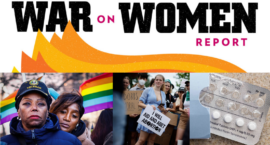
War on Women Report: Kentucky Woman Arrested for Miscarriage; Kansas Anti-Trans Bill Takes Effect; Polls Show Most U.S. Women Disapprove of Trump

MAGA Republicans are back in the White House, and Project 2025 is their guide—the right-wing plan to turn back the clock on women’s rights, remove abortion access, and force women into roles as wives and mothers in the “ideal, natural family structure.” We know an empowered female electorate is essential to democracy. That’s why day after day, we stay vigilant in our goals to dismantle patriarchy at every turn. We are watching, and we refuse to go back. This is the War on Women Report.

Since our last report:
—Texas Attorney General Ken Paxton is suing Delaware abortion provider Debra Lynch, who operates the organization Her Safe Harbor, for allegedly mailing abortion pills into Texas.
—More than a year after seeking medical help for a miscarriage, Deann and Charles Bennett, a young couple in Booneville, Ky., have been arrested for alleged “reckless homicide.”
—Trump’s Department of Justice used the Freedom of Access to Clinic Entrances (FACE) Act, intended to protect abortion clinics from harassment, to prosecute journalist Don Lemon for attending an anti-ICE protest.
—The Trump administration withdrew a Biden-era rule that required pharmacies receiving federal funding to carry and dispense mifepristone, misoprostol and methotrexate.
—Arkansas’ near-total abortion ban is facing its first legal challenge since Dobbs
—Some good news from Cleveland: The Cleveland City Council passed Tanisha’s Law, creating a Community Crisis Response department to respond to non-violent mental health emergencies with trained, unarmed crisis teams.
—In a landmark victory for survivor accountability, an Arizona jury in Phoenix has ordered Uber to pay $8.5 million to Jaylynn Dean.
—Also in Arizona: Judge Gregory Como struck down several abortion restrictions, ruling them unconstitutional.

… and more.

Community Groups Sharing Free Abortion Pills Expand to States Where Abortion Is Legal But Out of Reach

In response to abortion bans and restrictions, feminists across the country have created networks of community groups that share abortion pills by mail, free of charge, with people who need them. Mostly run by volunteers, these mutual aid networks have served over 100,000 people since 2022. 

“Everybody deserves bodily autonomy,” said one volunteer, who got involved out of rage after the Supreme Court revoked women’s constitutional right to abortion in 2022.

Increasingly decentralized and moving closer to the people they serve, these community providers are expanding their reach. While originally focused on states with bans and severe restrictions, they are now increasingly serving people in states where abortion is legal, but may not be affordable or accessible.

The Next Phase of the Abortion Wars: Targeting Pills, Helpers and Patients

The first year of Trump’s second term marked major blows for reproductive healthcare. Medicaid funding cuts forced about 50 Planned Parenthood clinics to close throughout the U.S. and blocked 1.1 million Planned Parenthood patients on Medicaid from using their insurance to pay for reproductive healthcare. Twenty-three independent abortion clinics throughout the country also shut down in 2025.

Now, at the start of 2026, there are only nine states where it is possible to get a legal abortion with no restrictions.

Four years after the Supreme Court’s Dobbs decision overturned Roe, here are some of the key ways states are pushing harder than ever to end any access to abortion.

Doctors Say Texas’ Abortion Laws Cost a 37-Year-Old Mother Her Life, After 90 Doctors and Months of Crisis

Tierra Walker was just 37 years old when her son JJ, 14, found her lying facedown and unresponsive on her bed. As he desperately called 911, he cried, “I need you, I need you,” and tried his best to bring her back to life with CPR, following the instructions of the emergency operator. It was too late. He lost his mother and best friend on his birthday.

Walker died at 20 weeks pregnant after multiple ER trips and hospitalizations. She had been examined by 90 doctors, including 21 OB-GYNs, during the previous months. Yet not one of those 90 medical experts Walker met with ever suggested that she do the only thing that could have definitively saved her life—undergo an abortion to end the pregnancy.

One doctor interviewed for this story sums up the chilling stakes Walker faced as she pleaded with dozens of doctors for care as her condition spiraled. “It’s unfortunate she didn’t come upon a physician who was willing to stick their neck out,” despite the legal risks. In Texas, that’s exactly what it takes to keep a patient like Tierra Walker alive.

Iranti Ẹ̀jẹ̀ and Menopausal Mapping: How Womanist Cartographies Make People Into Place

A Black feminist menopause convening in Durham reimagines “place” as something created by bodies and community—mapping care, memory and power across physical, digital and spiritual terrains often erased from mainstream menopause discourse.

(This essay is part of the latest Women & Democracy installment, published in the middle of Black History Month, in partnership with Black Girls’ Guide to Surviving Menopause. Menopause is not only a physical transition—it is also cultural, social and political. Recognizing its full scope is essential to advancing true health and civic equity.)

Independent Clinics Still Provide Most U.S. Abortions

2025 was a year marked by attacks on reproductive freedom, including a staggering wave of forced Planned Parenthood closures. About 50 of Planned Parenthood’s 600 locations have shut down as of December, largely due to last year’s combined loss of Title X funds and Medicaid reimbursements.

In the midst of these closures, independent abortion clinics continue to play a crucial role in the abortion access landscape. Even before last year’s Planned Parenthood cuts, independent clinics provided most U.S. abortions, offering care to women in big cities and rural healthcare deserts alike. In 2025, independent clinics provided 58 percent of U.S. abortions, compared to 38 percent through Planned Parenthood (and 3 and 1 percent through hospitals and doctors’ offices, respectively), according to the annual Communities Need Clinics report from Abortion Care Network (ACN), released in December.

How Attacks on Immigrant Teens Helped Build the Post-Roe Playbook

A conversation between legal scholar Shoshanna Ehrlich and Brigitte Amiri, deputy director of the ACLU’s Reproductive Freedom Project.

“In the first Trump administration, we still had Roe. By losing that underlying constitutional right to abortion at the federal level, the door has been opened for the second Trump administration to both compound the attacks and move in new directions,” Amiri told Ms.

“We were screaming from the rooftops that they were coming after Roe, and abortion was going to be banned, and we were not believed. … As with all rights, they’re tenuous and you have to continue to fight to enforce them.

“It’s always the most marginalized, as we’ve been talking about. It’s the people who have the fewest resources, people who live in rural areas, young people, people without documentation, people with limited language skills. That is who will feel the brunt the hardest of these policies.”