March 31, Join Ms. Live: All You Ever Wanted to Know About Menopause, From Symptoms to Systemic Reform
Despite affecting roughly half the population, menopause remains under-researched, underfunded and often stigmatized—leaving many without adequate medical guidance or institutional support.
On Tuesday, March 31, Ms. magazine will convene a panel of physicians and policy experts to demystify menopause, addressing everything from symptoms and treatment gaps, to the broader structural changes needed.
The virtual event, “All You Ever Wanted to Know About Menopause, From Symptoms to Systemic Reforms (2026 Edition),” will take place at 5 p.m. PT / 7 CT / 8 ET. Registration is free and open to the public.
The panel will feature:
—Huong Nghiem Eilbeck, M.D., M.P.H., a physician affiliated with Pandia Health and AltaMed Health Services, with additional clinical experience across maternal health and labor medicine. She holds certifications from The Menopause Society and the Johns Hopkins Bloomberg School of Public Health.
—Jennifer Weiss-Wolf, executive director of partnerships and strategy at Ms., executive director of the Birnbaum Women’s Leadership Center at NYU Law, and a leading voice on menstrual equity. Her forthcoming book, When in Menopause: A User’s Manual and Citizen’s Guide (October 2026), expands her work connecting reproductive health to policy and democratic participation.
—Sophia Yen, M.D., M.P.H., a physician trained at MIT, UCSF and UC Berkeley, and CEO and co-founder of Pandia Health, a birth control delivery company. Yen specializes in adolescent medicine and reproductive health, with a clinical focus that spans contraception, menstrual regulation and broader gynecological care.
-
Sally Hemings and the Making of Democracy
-
Furious, Fearless and Defiant: Our Favorite Protest Signs From No Kings 3.0
-
In a Time of Backlash, the Combahee River Collective Still Shows the Way
-
We Need a Word for What’s Happening to Jewish Women
-
Could This Be the Last Women’s History Month?
-
The War on Our Bodies Is a War on Democracy
-
Decades of Feminist Reporting, at Your Fingertips: Ms. Magazine Archive Connects Feminist History to Today’s Fights

Get the Ms. Weekly News Digest:
Sign Up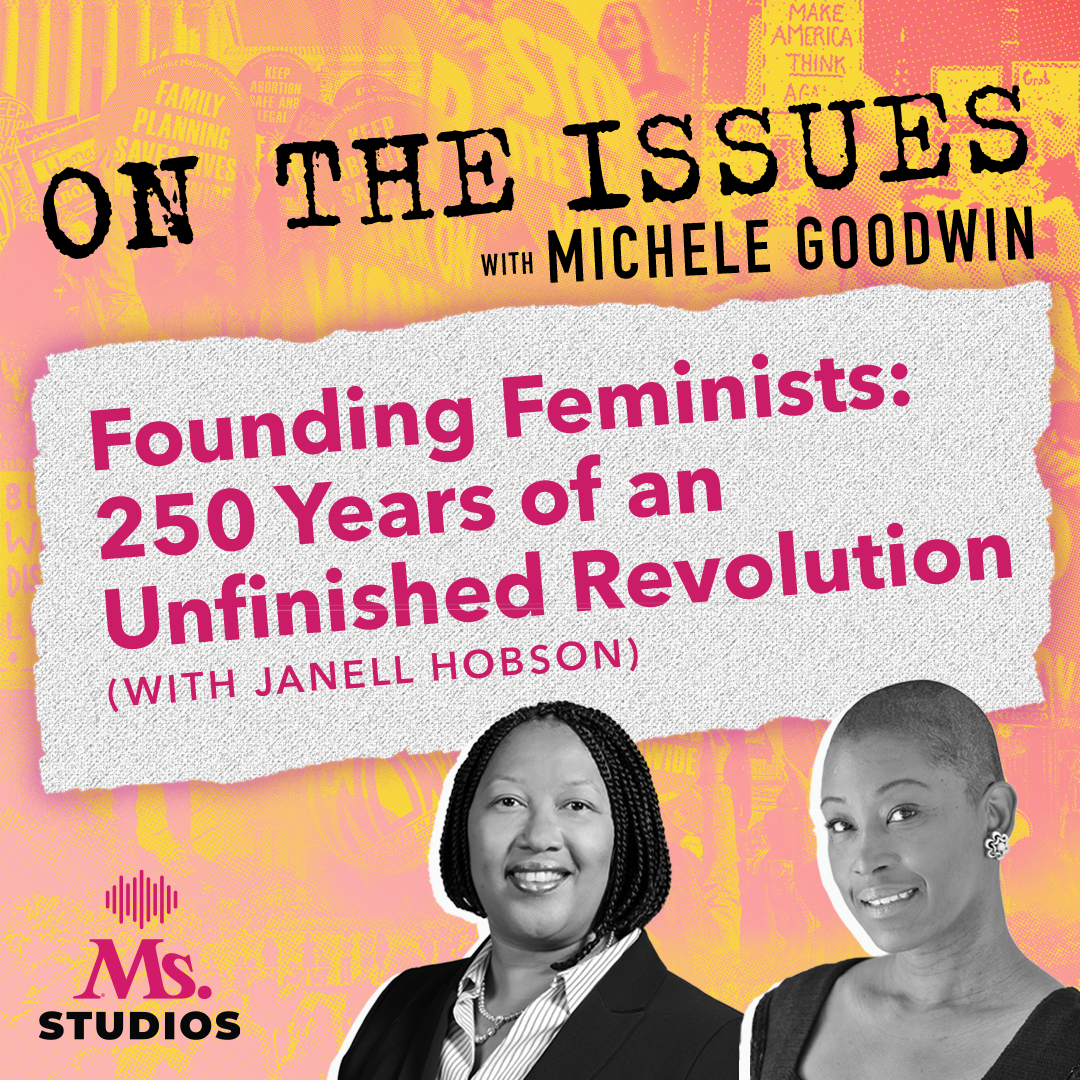
Listen, Rate, Review and subscribe on:



Founding Feminists: 250 Years of an Unfinished Revolution (With Janell Hobson)
Two hundred and fifty years ago, a small group of men declared that “all men are created equal,” casting a vision of liberty that has shaped the American imagination ever since. But even as they debated freedom in Philadelphia, women were writing, organizing, governing, resisting and insisting on their place within the nation taking form.
As Ms. launches a new series on our country’s Founding Feminists this month, Dr. Michele Goodwin is joined by the series’ editor, Professor Janell Hobson, to discuss what America’s 250th anniversary means for women and the feminist agenda.
-
Get the magazine and join the community
Become a Member -
Support Ms.
Donate



Feminist Daily Newswire
 Feminist Majority Foundation
- Afghanistan Faces Growing Crises as Aid Cuts, Regional Conflict, and Diplomatic Uncertainty Deepen Civilian Suffering
- We stand with Dolores Huerta
- UN Report: Taliban Policies Are Driving a Health and Human Rights Crisis for Women in Afghanistan
- Taliban Criminal Code Authorizes Beating of Wives as Long as It Does Not “Break Bones”
- The SAVE Act: New Barriers for Women to the Ballot Box

From the Magazine:

Get Ms.’s award-winning feminist reporting delivered directly to your mailbox!
-
Cover Reveal and Spring 2026 Issue Sneak Peek: ICE Is ‘the Army of the Patriarchy’
In early February, while the nation was still reeling from the murders of Renee Good and Alex Pretti by federal agents, Loretta Ross and Jackson Katz—two feminist academics with decidedly different backgrounds and identities—discussed how U.S. federal agents became the enforcement arm of the nation’s racism and misogyny.
You’ll find this, and more, in the Spring 2026 issue of Ms.


On the Road, One Conversation at a Time: The Case for the ERA Is Landing
From Georgia to Tennessee to Alabama to Louisiana, the Golden Flyer II carried the legacy of the 1916 suffrage journey into direct conversation with the present-day push for constitutional equality. At each stop, the approach remained consistent: Meet people where they are, explain the stakes and invite them to take action.
The responses were often immediate and unscripted. A restaurant owner in rural Georgia signed on the spot. A mayor in Knoxville, Tenn. issued a proclamation and added her name. Visitors at civil rights sites in Montgomery, Ala. stopped to ask questions and sign. In Baton Rouge and Lafayette, La., passersby—from veterans to pedestrians on their daily routines—engaged with the campaign, many expressing surprise that gender equality is still not explicitly guaranteed in the Constitution.