
The United States has the highest maternal mortality rate among wealthy countries. And it may get worse as abortions become more difficult to obtain, say public health experts.


More Than A Magazine, A Movement

The United States has the highest maternal mortality rate among wealthy countries. And it may get worse as abortions become more difficult to obtain, say public health experts.

In every issue of Ms., we track research on our progress in the fight for equality, catalogue can’t-miss quotes from feminist voices and keep tabs on the feminist movement’s many milestones. We’re Keeping Score online, too—in in this biweekly round-up.
This week: A leaked Supreme Court draft decision would overturn landmark Roe v. Wade ruling; new library program will secure access to “banned books” for teens; Oklahoma Heartbeat Act bans abortion after six weeks; Karine Jean-Pierre appointed first Black White House press secretary; and more.

Focusing on other consequences of overturning of Roe v. Wade makes us forget that the Supreme Court’s decision is really about misogyny.

Menstrual data and period tracking has already become a lucrative industry for apps. Selling private and personal reproductive health data to companies has created income many fertility apps.
The availability of this data already poses a unique threat to the lives of all people with uteruses, but in a world without Roe the risk of this data becoming a weapon for the anti-abortion movement. They have been known to use such data to influence decision making and reproductive choices. In order to keep this vital data out of their hands action needs to be taken to provide protection and safe alternatives for menstruators.
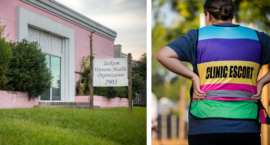
For nearly 50 years, as anti-abortion legislators in states around the country have chipped away at the constitutional right to a safe and legal abortion, they have done so with the steady drumbeat of violence at their back. In the face of the recent leak of a draft opinion from Justice Samuel Alito that confirmed that the Supreme Court is set to overturn Roe v. Wade, abortion advocates and providers are bracing for a surge in clinic violence.

Late Monday night, a leaked version of the draft of the majority decision in Dobbs v. Jackson Women’s Health Organization was made public. When the final decision is issued, there will no longer be a federally guaranteed right to abortion in America for the first time in nearly 50 years.
What are the democratic dysfunctions that have led to this pivotal point? How should we consider parallel affronts to participation and representation—the wave of voting restrictions and outsize role of big money in politics—and the anti-abortion agenda? Can we look to state courts to provide new avenues for protecting reproductive rights? And what is the legal and societal impact of criminalizing pregnancy and abortion, especially on communities of color?

Few details have emerged about what happened leading up to the arrest of 26-year-old Lizelle Herrera. But the criminalization of pregnant women has a long history in Texas.
“Prosecutors who bring cases like this are trying to groom people in the United States to think of those who have abortions as criminals,” said Lynn Paltrow, executive director of the National Advocates for Pregnant Women. “That stigma, eventually, is likely to stick and results in efforts to throw them in jail.”

If you Google “abortion services near me,” chances are the top of your search will show an anti-abortion “crisis pregnancy center.”
With the Supreme Court poised to reverse Roe v. Wade and states racing to pass increasingly draconian abortion restrictions, many people are unaware that fake abortion clinics now blanketing the country are an equal and escalating threat to abortion access.

In the midst of a news cycle that’s largely been dominated by bad news, this week we were elated to celebrate the confirmation of Judge Ketanji Brown Jackson to the Supreme Court—making her the first Black woman to ever serve on the nation’s highest court when Justice Breyer officially steps down this summer.
But the Supreme Court nevertheless remains dominated by a 6-3 right-wing majority that appears likely to overturn—if not at least severely gut—the Roe v. Wade decision that 50 years ago established a woman’s constitutional right to abortion.

In five years (1968-1973), the Janes provided an estimated 11,000 safe abortions to women and girls in and around the city of Chicago. The documentary The Janes provides a somewhat chronological account of their work, ending with the public arrest of several of its members, the threat of long prison sentences, and the interventions of their attorney. But it’s so much more than a mere history lesson—it’s a vibrant, attentive film that emphasizes the collaborative spirit and radical potential of a small community able to do tremendous work on a large scale.