‘This Is About Life or Death’: Leading Feminists Discuss Women’s Rights in Post-Roe America

Clara Bingham, Jamia Wilson and Jessica Valenti on the state of abortion access and the feminist resistance rising up in every state in the U.S.:

“The 14th Amendment is what antiabortion activists are using right now to fight for fetal personhood. Anytime you see the 14th Amendment mentioned, that’s what it’s about.”

“We are no longer first-class citizens in banned states.”

“There are countries in this world where the pro-life movement is the movement that is about choice. … They’re surprised when they hear the framing of pro-life being used to dominate and control women’s bodies.”

“As terrible as things are every single day, in every single community and in every single state, there are rooms full of women, and there are rooms full of activists who are working their asses off, who are using their time, their money, their energy to make sure that if someone needs care, they can get it, whether or not we see it.”


Roe Is Gone, Abortion Isn’t: Authors Carole Joffe and David Cohen on the Resilience of Reproductive Freedom

Three years ago, the U.S. Supreme Court overturned Roe v. Wade and denied women a right to abortion that had existed for nearly half a century. Fourteen states have since banned the procedure completely, with almost no exceptions. Four more have passed time limitations so onerous that the services are effectively unavailable.

And yet abortions continue to take place across the country, in numbers equal to or greater than before. How has this been possible?

In their new book, After Dobbs: How the Supreme Court Ended Roe but Not Abortion, sociologist Carole Joffe and legal scholar David C. Cohen uncover and analyze the courageous and innovative work of medical providers, politicians, lawyers, advocates and private donors, working tirelessly on the ground to secure continued access.

She Was Tracking Post-Roe Abortions. The Trump Administration Just Pulled Her Funding.

Diana Greene Foster is responsible for landmark research on the effects of abortion access—a massive 10-year study that tracked thousands of people who had an abortion or were denied one. But funding for a follow-up to her seminal Turnaway Study has just been cut as part of a wave of canceled health policy research. 

Foster received a MacArthur “genius grant” for the Turnaway Study. That piece of research, which examined the impact of restrictions even before the fall of Roe v. Wade, helped shape public understanding of how abortion access can affect people’s health and economic well-being by finding that people who were denied abortions were more likely to experience years of poverty compared to those who could terminate their unplanned pregnancies.

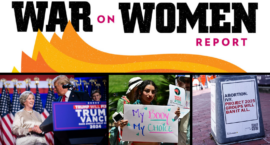
War on Women Report: Infant Mortality on Rise Post-Roe; Want a President Who Isn’t Accused of Rape? ‘Request Denied,’ Tweets Andrew Tate

U.S. patriarchal authoritarianism is on the rise, and democracy is on the decline. But day after day, we stay vigilant in our goals to dismantle patriarchy at every turn. The fight is far from over. We refuse to go back, and we refuse to let the incoming Trump administration quietly dismantle the progress we’ve made. We are watching. This is the War on Women Report.

Since our last report…
—Since the Dobbs decision, U.S. infant mortality rates were higher than usual, with hundreds more infants dying than expected. Abortion bans can hurt access to broader healthcare for both babies and mothers, including reducing a state’s number of maternal healthcare providers as bans lead to OB-GYN exoduses.
—Seven women, including three in Texas, have died after receiving inadequate miscarriage and abortion care.
—Trump’s win, after being accused of sexual assault by 27 women, sends a disheartening message to victims of sexual assault and advocates.

… and more.

The Same Conservative Playbook That Overturned Roe Is Now Coming for Trans Healthcare

2024 marks the first time in several years that the U.S. Supreme Court will not hear a significant case relating to abortion rights—but the question of the constitutional right to bodily autonomy remains on the docket. On Wednesday, Dec. 4, the U.S. Supreme Court will hear arguments in U.S. v. Skrmetti, a case challenging Tennessee’s ban on healthcare for trans youth. The case is the first of its kind to be heard by the nation’s highest court—and as such will likely set an important precedent for future trans rights cases.

“The Court has the opportunity and duty to apply the law fairly, which means returning medical decisions to where they rightfully belong: to parents, their children and their doctors.”

‘Forced to Return to the Butcher’s Lair’: The Reality of Abortion Before Roe and the Fear of What’s to Come

Abortions are sought by a wide range of people for many different reasons. There is no single story. Telling stories of then and now shows how critical abortion has been and continues to be for women and girls. (Share your abortion story by emailing myabortionstory@msmagazine.com.)

“Instead of protecting our right to freedom of choice, they would have women go through what I went through and perhaps die in the process.”

“The night before the procedure, the nurse gave me a sleeping pill and as I became sleepy, I shed a few tears. But, I knew that it was the only decision for me as the baby was unplanned. I was too young and my spirit had to be eternally free to create and experience my own type of utopia.”

Post-Roe, States With Abortion Bans Saw Steep Declines in Birth Control Prescriptions

Between abortion bans and decreasing access to contraception post-Dobbs, women are facing ever-increasing barriers to maintaining control over their reproductive lives, whether ending unwanted pregnancies—or preventing them.

(This article originally appears in the Fall 2024 issue of Ms. Join the Ms. community today and you’ll get issues delivered straight to your mailbox!)

1969, a Pre-Roe Experience: An Excerpt From New Memoir, ‘A Termination’

In her new memoir, A Termination, writer and actor Honor Moore recounts her decision to have an abortion in 1969: “I didn’t think about I’m having an abortion, I just did it. Blasted through fear; I want this life, not that life. … I made the decision by myself. But also with the remote-control help of my mother: ‘Don’t come home pregnant.'”

Abortions are sought by a wide range of people for many different reasons. There is no single story. Telling stories of then and now shows how critical abortion has been and continues to be for women and girls. (Share your abortion story by emailing myabortionstory@msmagazine.com.)