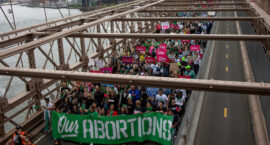


In Absence of Roe, Healthcare Providers Have a Professional and Ethical Duty to Step Up

As the human rights crisis in the U.S. intensifies, every healthcare worker has a role in protecting people who need abortion care. We must empower ourselves, patients, and the public with accurate, actionable information to access the resources they need. Not acting in this crisis goes immediately against one of the first oaths we made joining the health professions: Do no harm.

The Overturn of Roe Is a Social War

In overturning Roe v. Wade, the U.S. Supreme Court justices have signaled that this is not a legal fight anymore but a social war. They are now poised to go after birth control, gay rights, sodomy laws and who knows what else.

Republicans have already told us that if they take control of Congress in the fall—which, unless there is a broad public outcry, they certainly could—one of their first orders of business will be to pass a law making abortion illegal throughout the country. There will be no safe state for a woman.

President Biden Condemns Supreme Court Decision: ‘This Is Not Over … Roe Is on the Ballot’

Shortly after the U.S. Supreme Court released its opinion overturning constitutional abortion rights in Roe v. Wade, U.S. President Joseph Biden delivered scathing remarks condemning the decision and announced actions he will take to ensure abortion healthcare access for all Americans. In its sweeping decision, the Supreme Court eliminated 50 years of Supreme Court precedents.

“It’s a sad day for the Court and for the country,” said Biden. “The health and life of women of this nation are now at risk.”

Keeping Score: U.S. Gymnasts Sue FBI for Failure to Investigate Nassar; SCOTUS Expands Religious Liberty Rights; Physicians Fear Post-Roe World

In every issue of Ms., we track research on our progress in the fight for equality, catalogue can’t-miss quotes from feminist voices and keep tabs on the feminist movement’s many milestones. We’re Keeping Score online, too—in in this biweekly round-up.

This week: Physicians fear for their patients’ health outcomes without abortion access; Supreme Court rules to protect federal officers’ immunity over Fourth Amendments rights; U.S. women gymnasts sue FBI for failure to investigate doctor Larry Nassar; House passes legislation to ban purchase of semiautomatic weapons before age 21; first transgender performer is nominated for a Tony, and first non-binary composer wins for best original score; and more.

Thousands of Medical Professionals Urge Supreme Court To Uphold Roe: ‘Provide Patients With the Treatment They Need’

Over 2,500 healthcare professionals from all 50 states have signed a letter urging the Supreme Court to scrap their leaked Dobbs v. Jackson Women’s Health Organization draft opinion and uphold Roe.  

“As medical professionals, we have a duty to provide our patients with the treatment they need to be safe and healthy. Patients should be able to make their own decisions about their health, using science and medical guidance from their physicians, without interference or influence from politics or the courts.”

Abortion Clinics’ Post-Roe Future: ‘We Will Be Forced to Close Our Doors Within 30 Days’

A decision in Dobbs v. Jackson Women’s Health Organization is due out any day, one that feminist organizers are now sure will reverse Roe v. Wade and strip millions of their longstanding right to abortion. Clinics in protected areas are bracing for an influx of patients while those in anti-abortion states are preparing to operate in a hostile environment — or shut down completely.

“We are aware that Washington and other states where abortion is legally protected are being seen as the safety net,” said clinic director Sanchez in Washington. “And honestly, the safety net has holes in it.”

Resisting the Overturn of Roe: What U.S. Feminists Can Learn From El Salvador

In a grim moment nationally, let us look to Latin America for the sustained will to resist and overturn abortion bans.

Most notably, U.S. reproductive rights organizers should think of legal and cultural campaigns that can move across states. Though combatting abortion bans in the U.S. will be difficult because states exert their own jurisdiction over abortion laws, we can create a national movement and anticipate the challenges ahead through learning from Latin American feminists, especially the resilient people of El Salvador since 1998.

Access to Birth Control Is in Danger if Roe is Overturned

In a post-Roe world, legislators—most of whom have no medical expertise and cannot get pregnant themselves—in one state could assert that life begins at fertilization, while a neighboring state could say life begins at birth.

Next, all hormonal contraception and IUDs might be outlawed just because some people believe they interfere with implantation and therefore “endanger” the new “life.” Defining personhood as starting at fertilization also has significant implications for in vitro fertilization, a process that creates fertilized eggs.