
A troop of Girl Scouts visited the Capitol to see the promise of America and instead watched their fundamental constitutional right to abortion healthcare get stripped away from them.


More Than A Magazine, A Movement

A troop of Girl Scouts visited the Capitol to see the promise of America and instead watched their fundamental constitutional right to abortion healthcare get stripped away from them.
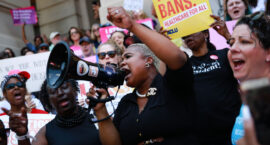
Since the overturn of Roe, states now have further jurisdiction to prosecute women in cases of illegal abortions, miscarriages and many other instances of so-called child abuse—something they’ve been doing for years, especially to low-income women and women of color.
National Advocates for Pregnant Women (NAPW) has launched a resource guide for prosecutors, police, healthcare providers and welfare workers alike in protecting pregnant women. “Now is not the time to give up,” said NAPW. “The opportunities for potential allyship, collaboration and solidarity are numerous.”

With the Supreme Court’s abortion decision, the U.S. finds itself in numerous human rights violations: the right to equality and nondiscrimination, the right to privacy, the right to life, the right to health and the right to be free from torture and cruel, inhuman or degrading treatment.
It is crucial to take inspiration from feminists across the globe in using international human rights laws to stop states from eroding abortion access.
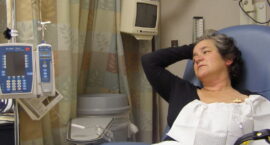
On the morning of May 2, hours before the leaked Supreme Court draft striking down Roe v. Wade, I sat waiting for an infusion of Herceptin, an essential drug I was prescribed when diagnosed with breast cancer. Herceptin has saved countless women’s lives since 1990, but it can cause fetal harm.
I was denied medical care until I could prove I wasn’t pregnant. Where was my agency in this situation? And what if I had been pregnant? Would I have been denied the very drug that saved my life and which protects my future—which ensures that my young children will continue to have a mother—in order to protect a pregnancy I did not want or plan to keep?

Without the protections of Roe, we stand to see gross inequalities in fertility care and reproductive decision-making.
State laws defining ‘life’ as the moment an egg is fertilized will limit or prohibit the freezing or discarding of embryos—a process fundamental to successful fertility treatments. These practices could all but vanish in some places. These restrictions emerge at a moment where fertility technology is becoming ever more precise. Combined with existing anti-poor fertility policies, the reality is that poor women of color will have even less opportunity to determine the time and circumstance in which they decide to have a family.

Overturning Roe also casts a shadow over the right to contraception and family planning services. We must face up to how reproductive decisions threaten our common future. Empowering people to make them responsibly will protect future generations in ways that other approaches have failed to do.

Violence against abortion providers rose significantly in 2021, following the trend of the past decade. Harassment of providers and patients also rose. After Roe, the focus must be on providing care and protecting providers.

Almost 2 percent of babies born in the United States are the result of fertility treatments, together referred to as assisted reproductive technologies (ART). The recent overturning of Roe v. Wade by the Supreme Court threatens the ability to access the treatments people need to build their families, such as ART.

The U.S. ranks as the 19th most dangerous country for women, 11th in maternal mortality, 30th in closing the gender pay gap, 75th in women’s political representation, and painfully lacks paid family leave and equal access to health care. But Ms. has always understood: Feminist movements around the world hold answers to some of the U.S.’s most intractable problems. Ms. Global is taking note of feminists worldwide.

A peek into the first class of medical professionals applying to residency in a post-Roe America.
“My personal take is that it’s really hard to learn in an environment of scarcity and an environment of fear,” said Dr. Lauren Thaxton, an ob-gyn professor at the University of Texas Dell Medical School. “And I think that those are two things that are very realistic in some of these restrictive states.”