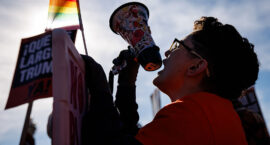
The Kids Really Are All Right—But Opponents of Marriage Equality Won’t Admit It

Within days of Donald Trump’s second inauguration, the administration began erasing LGBTQ+ people from federal websites, while Republican governors across the country rebranded Pride Month as celebrations of the “traditional” or “nuclear” family.

At the same time, public support for marriage equality has begun to slip, and conservative activists are seizing the moment to revive their campaign against Obergefell v. Hodges. Emboldened by the Supreme Court’s decision to overturn Roe v. Wade, they are laying the groundwork for a new legal challenge—one designed to persuade the Court’s conservative majority to reconsider the constitutional right to same-sex marriage.

But this latest effort relies on a familiar myth dressed up as a new argument: that children are the “real victims” of marriage equality. The evidence tells a very different story. Decades of research—and a recent meta-analysis examining children’s developmental well-being—show that children raised by same-sex parents do just as well, and in some measures even better, than those raised by heterosexual parents. The real harm comes not from loving families, but from efforts to deny them equal dignity under the law.

Opponents of marriage equality are working hard to revive old attacks on marriage equality. We cannot allow this campaign of erasure to succeed.

How Corporate Finance Took the Fun—and the Values—Out of Ben & Jerry’s

I still remember standing in line outside the original Ben & Jerry’s, trading neighborhood gossip while debating which new flavor to try. Back then, the company stood for more than ice cream—it was proof that a business could put people, workers and communities alongside profits. That’s why watching its social mission slowly unravel under corporate ownership has felt like losing something much bigger than Cherry Garcia.

Ben & Jerry’s story isn’t just about one beloved brand. It’s a cautionary tale about what happens when Wall Street’s demand for ever-higher returns collides with a company built on “caring capitalism.”

The result is a lesson in how corporations redefine sustainability—not as a commitment to people or the planet, but as a strategy for maximizing shareholder value.

Documentary ‘State of Firsts’ Follows Sarah McBride’s Historic Journey to Congress

A new documentary, State of Firsts, released during Pride Month, chronicles Rep. Sarah McBride (D-Del.)’s historic path to Congress amid growing anti-transgender rhetoric. It is now showing in select theaters across the country.

Directed by trans filmmaker Chase Joynt, the documentary offers a behind-the-scenes look at McBride’s journey to becoming the first openly transgender elected official in the U.S. Congress.

Even in Summertime, We Can’t Lose Focus: State-Level Democracy Dispatches From Maine, Kansas, Idaho and Virginia

Summertime—and the fight for democracy—is sizzling, especially in the states. Here’s what is happening across the country.

Sudden shakeups in U.S. Senate elections have foisted reproductive rights front and center. The upcoming primary in Maine to replace Graham Platner as the Democratic candidate, combined with deep antipathy voters there have toward Republican incumbent Sen. Susan Collins, is a golden opportunity to elevate abortion in the midterms—especially given Collins’ recent comment that she has no regrets about her pivotal vote to confirm Brett Kavanaugh to the Supreme Court.

In South Carolina, Sen. Lindsey Graham’s unexpected death last weekend has created a surge of public attention and momentum for the Democratic candidate, Dr. Annie Andrews, a pro-choice, pro-science pediatrician (with an A+ Instagram game).

Too often, summer is a season all too ripe for sneak attacks on direct democracy. Ohio Republicans made a case study out of the strategy when they orchestrated a special election in August 2023 to quietly raise the threshold for ballot measures—all in service of attempting to thwart a popular abortion proposal. In the end, voters saw the power grab for what it was and rejected the rules change while turning out in force that November for abortion.

Now Kansas is resurrecting the play and will hold an August election to decide how state Supreme Court justices are chosen.

In Maine, a measure was also proposed, but Secretary of State Shenna Bellows (one of the potential U.S. Senate candidates) invalidated more than 12,000 signatures on the citizens’ petition that had been forged and/or duplicated. Last week a judge upheld blocking the referendum; any appeal will need to be resolved by Aug. 25 for it to appear on the November ballot.

It is a tough balancing act—the need to revel in the lazy, hazy days of summer and grasp the reality that these fights require our constant vigilance. This is where we have to hold each other up. Please take the time to refresh and rejuvenate, and be ready to come back swinging.

Saving Seneca Falls: The U.S. Birthplace of ‘All Men and Women Are Created Equal’ Must Be Preserved

A caved-in roof. A crumbling porch. A memorial water wall in need of restoration.

These are just a few areas of the $10 million of deferred maintenance needed at the Women’s Rights National Historical Park in Seneca Falls, N.Y., one of 11 sites on the National Trust for Historic Preservation’s 2026 list of “Most Endangered Historic Places.” The Women’s Rights National Historical Park celebrates the first Women’s Rights Convention, held on July 19 and 20, 1848. Of the 433 parks within the National Park System, only 13 are dedicated to women’s history, making the inclusion of the Women’s Rights park on the “most endangered” list even more imperative. Rather than merely lament a need for restoration, the list, according to the trust, aims to increase “visibility, public attention and new resources to save and activate historic places for the public good.”

The story of suffrage, like so many stories in our nation’s history, is neither uncomplicated nor is it a “single story” that’s “preserved in amber,” insists Miranda Johnson-Haddad, president of the Friends of the Women’s Rights National Historical Park, the non-profit philanthropic group that supports the park. Johnson-Haddad emphasizes that the park’s leadership wants to continue to have “brave conversations about difficult subjects,” including that some suffragists, like Stanton, succumbed to white supremacist thinking—despite being active in the abolition movement—championing the right to vote for white women, but not for Black men and women. No Black women were known to be in attendance at the first Seneca Falls Convention, and only one Black man, Frederick Douglass, signed the declaration.

Still, “these are stories that belong to all of us in all their messiness and complexity,” Johnson-Haddad stresses, “and that can guide us through the current messy complexity.” She cites “Bread and Roses,” a protest song dating back to 1912: “As we go marching, marching, we bring the greater days / The rising of the women means the rising of the [human] race.”

‘The Wrong Kind of Girl’: Feminists Warn of Fallout After Supreme Court Says States May Exclude Trans Girls From School Sports Teams

The Supreme Court ruled 6-3 on Tuesday, June 30, that states may prohibit transgender students from participating in school sports consistent with their gender identity, holding that the Equal Protection Clause of the 14th Amendment does not prohibit such bans. The decision leaves in place laws already enacted in 27 states and marks another major setback for transgender rights after months of escalating attacks on LGBTQ+ communities.

Feminist organizations, reproductive justice advocates, physicians, civil rights leaders and lawmakers swiftly condemned the ruling, arguing that it harms transgender youth, undermines Title IX’s protections against sex discrimination and fits into a broader campaign targeting marginalized communities.

Human Rights Campaign president Kelley Robinson argued the ruling would fuel suspicion and harassment not only toward transgender athletes but toward girls more broadly.

“When politicians convince the public that any girl could be ‘the wrong kind of girl,’ they invite harassment, intimidation, invasive questioning or even an inspection of their body by a total stranger. While we know this administration and other anti-equality politicians won’t stop obsessing over trans kids, we must all call on states to adopt inclusive policies so that no one gets left behind for being their authentic selves. We must show up in large numbers for every school board, local and state and federal election to be sure our communities are heard. We must continue this fight with full force until freedom, justice and equal opportunity are not flimsy promises but nationwide guarantees.”

Keeping Score: Feminists Denounce Supreme Court Anti-Trans Ruling; Trump Tries to Hijack America 250; Camp Mystic Will Not Reopen; Birthright Citizenship Safe for Now

In every issue of Ms., we track research on our progress in the fight for equality, catalogue can’t-miss quotes from feminist voices and keep tabs on the feminist movement’s many milestones. We’re Keeping Score online, too—in this biweekly roundup.

This week:
—The Supreme Court upheld birthright citizenship, but also allowed discrimination against trans student athletes. “When politicians convince the public that any girl could be ‘the wrong kind of girl,’ they invite harassment, intimidation, invasive questioning or even an inspection of their body by a total stranger,” warns Kelley Robinson, president of the Human Rights Campaign.
—Feminists mark four years without Roe.
—Trump continues to push voter suppression tactics through any means necessary.
—Young women who receive the HPV vaccine are at almost zero risk of dying from cervical cancer.
—A weekend of action on voting rights will take place from July 17-19.
—Olivia Rodrigo launches all-women music festival to raise money for organizations centered on women and girls.
—Ninety-seven percent of single moms experienced housing hardships in the past year, and 85 percent reported food insecurity.
—Federal agents shot and killed Joan Sebastián Guerrero in Maine and Lorenzo Salgado Araujo in Texas, during traffic stops by ICE. Both men had been living in the U.S. for years with their partners and children.
—Feminist Majority Foundation president and publisher of Ms. Ellie Smeal won the National Organization for Women Lifetime Achievement Award, honoring her decades of feminist activism and organizing.
—The inhumane “Alligator Alcatraz” immigration detention center has closed.
—Camp Mystic in central Texas won’t reopen this summer, a year after the tragic flood that killed 28 people, primarily young girls.
—Ahead of their wedding, Taylor Swift and Travis Kelce donated a total of $26 million to 20 charities, including food banks, children’s hospitals, Dolly Parton’s Imagination Library and other education nonprofits.
—Aviator Wally Funk died at age 87. She was the first female flight inspector for the Federal Aviation Administration and taught more than 3,000 people how to fly.

… and more.

The Antiabortion Movement Has a New Plan for a National Abortion Ban

Judges, lawyers and sexual abuse survivors have raised very strong reasons why it would be reckless and unconscionable for the Senate to confirm Todd Blanche to the post of Attorney General of the United States. One of the under-reported issues, though, is Blanche’s backing from well-funded antiabortion groups.

If the Republican Congress confirms Blanche, he could weaponize the DOJ in service of the antiabortion machine’s wish list, increasing the potential for some of the biggest blows to abortion access since Dobbs. 

Blanche’s confirmation could mean the further decimation of access to abortion healthcare in the United States at the behest of the antiabortion machine, which has already successfully pressured the Trump administration to meet its demands by, for example, calling for FDA head Martin Mackary to be fired. Meanwhile, the antiabortion machine is ratcheting up the pressure to push its agenda at various levels across the U.S.

Reasonable members of Congress who believe in the independence of the DOJ from outside pressure, including that of the administration itself, will vote to oppose Blanche’s nomination for U.S. attorney general. 

Women’s Sports Were Built by Letting Girls In

When the Supreme Court upheld West Virginia’s ban on transgender girls participating in girls’ school sports in West Virginia v. B.P.J., it said the ruling was about protecting the safety and fairness of women’s and girls’ sports. I hear that claim against everything I actually lived.

Thirty years ago, in United States v. Virginia, the Supreme Court held that generalizations about “the way women are” cannot justify denying opportunity to women whose talent and capacity place them outside the average description. That principle didn’t just build my generation of athletes. It built a generation of women: the litigators and judges, the surgeons, the CEOs and entrepreneurs, the senators and governors, the police officers and firefighters and fighter pilots, the women who were the first of everything. Every one of those doors was held shut by the same argument Virginia made: Most women wouldn’t want this, most women couldn’t do it.

Women of my generation didn’t fight to be seen as individuals—as athletes, as leaders, as whatever they had it in them to be—only to watch that principle eroded now, in their name and over their objection.

More than half a century ago, this country decided that girls who had been told they didn’t belong on the field belonged there after all. I got to live the proof of that promise. The work now is to keep that promise for every kid who wants to play.