How Can Feminists Advance Racial Equity in a Post-DEI World? Join Book Talk With Ralina L. Joseph [Sept. 10 @ Ms. HQ in LA]

As attacks on diversity, equity and inclusion intensify across the U.S., how can feminists deepen their commitment to racial justice—and sustain that work without succumbing to exhaustion?

On Thursday, Sept. 10, at 6 p.m., Ms. will welcome author and scholar Ralina L. Joseph for a special evening examining the interconnectedness of race, equity and feminism. Joseph will discuss her new book, Racial Exhaustion: How to Move Through Racism in the Wake of DEI, in conversation with Sarah Banet-Weiser, dean of the Annenberg School for Communication at the University of Pennsylvania.

The event is at Ms. magazine headquarters: 433 S. Beverly Drive, Beverly Hills, Calif. RSVP today!

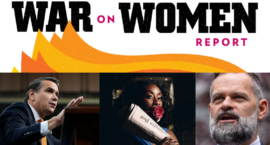
War on Women Report: Todd Blanche Is AG, Despite Pledge to Make Dobbs ‘Permanent’; Karen Attiah Is Back at WaPo (With Backpay); Rep. Cory Mills Loses Reelection After Abuse Allegations

MAGA Republicans are back in the White House, and Project 2025 is their guide, the right-wing plan to turn back the clock on women’s rights, remove abortion access, and force women into roles as wives and mothers in the “ideal, natural family structure.”

We know an empowered female electorate is essential to democracy. That’s why day after day, we stay vigilant in our goals to dismantle patriarchy at every turn. We are watching, and we refuse to go back. This is the War on Women Report.

Since our last report:
—Under mounting pressure from Defense Secretary Pete Hegseth, Scouting America eliminated dedicated community spaces for LGBTQ+ youth, girls and Scouts of color at its annual 2026 National Jamboree in West Virginia.
—An 18-year-old girl in North Carolina is facing criminal charges after allegedly taking abortion pills 31 weeks into her pregnancy, which prompted her to go into early labor.
—After a controversial two-day confirmation hearing in July, Todd Blanche has been confirmed as the new U.S. attorney general.
—In a win for domestic violence survivors, Rep. Cory Mills (R-Fla.) lost his bid for reelection amid accusations of abuse from women he has dated.
—A groundbreaking new report documents dozens of federal immigration agents who have faced administrative disciplinary action or criminal penalties for violent crimes.
—Ohio’s Bureau of Motor Vehicles (BMV) abruptly ended its policy allowing transgender residents to update the gender marker on their driver’s licenses and state IDs to match their gender identity. 
—Chicago mother Keshia Golden, who says she killed her boyfriend in self defense in 2022, accepted a plea deal for involuntary manslaughter, allowing her to avoid jail time.
—Karen Attiah, columnist for The Washington Post, has won her job back, after being fired last year for her comments on race, gender and violence in the wake of Charlie Kirk’s death.

… and more.

Was Mary Oliver a Feminist? 

From Pinterest boards to classroom walls, Mary Oliver’s words have become popular in a way that most poets could only dream. People have even gone as far as to call her “Saint Mary.”

But in a new documentary Mary Oliver: Saved by the Beauty of the World, director and producer Sasha Waters presents Oliver with complexity, hoping that more people will read her poetry with the poet behind it in mind.

“I think there’s also this way in which she becomes a little flattened and one-dimensional through the way that she circulates now,” says Waters. “Understanding that she was very much a complicated person and woman until the end of her life is what I hope people take away from her.”

Too Soft, Too Tough, Never Just Right: The Impossible Standard for Women Leaders

Weekend Reading on Women’s Representation is a compilation of stories about women’s representation in politics, on boards, in sports and entertainment, in judicial offices and in the private sector in the U.S. and around the world—with a little gardening and goodwill mixed in for refreshment!

This week:
—”My mother started in politics in her early thirties. Over the course of her career, she tried to run multiple times. But for one reason or another, it was never quite her turn. … Whatever regrets, pity or unfairness she’s carried, she has simply accepted in silence, just like lots of other women I have encountered in my life.”
—Wednesday was Women’s Equality Day. Even with every constitutional right guaranteed on paper, would our electoral system actually produce a government where women hold their fair share of power? Right now, the answer is no.
—Already the first Muslim woman and first Afghan American to serve in the California state senate, Wahab is the first Afghan American to serve in Congress.
—Minnesota is among 18 states to never elect a woman as governor. But earlier this month, women swept the nominations for open seats for governor and U.S. Senate in their primaries.
—Tressie McMillan Cottom asks, “Is Ocasio-Cortez ready for the glass cliff?”
—”Defense Secretary Pete Hegseth’s blocking of promotions for high-ranking women in the military has contributed to the lowest percentage of such nominations for women in at least 25 years,” according to a New York Times analysis.

… and more.

Rest in Power, Dolly Parton: Feminist Country Icon, Advocate for Women and Children, Philanthropist and Gifted Songwriter

Dolly Parton understood the power of being underestimated. Beneath the rhinestones, towering blond hair and self-deprecating jokes was a gifted songwriter, a shrewd businesswoman and a philanthropist whose work transformed the lives of millions of children and families.

Parton left behind a body of work that stretches far beyond the songs and films that made her one of the most beloved performers in American life. She sang about the dignity of working women. She placed hundreds of millions of books in the hands of children. She supported healthcare, disaster relief and lifesaving medical research. And she repeatedly used her enormous cultural influence to affirm the humanity of people who were too often marginalized, including Black and LGBTQ+ Americans.

Parton’s concern for women and children was expressed not only through her art, but in what she did with the wealth and influence her art created. We heard her legacy in the songs that made working women feel seen. We saw it in the books delivered to children, the families supported after disaster and the medical research that saved lives.

May Dolly Parton rest in power. May her legacy live on in every child who discovers a new world inside a book, every woman who demands dignity in the workplace and every person who chooses compassion when indifference would be easier.

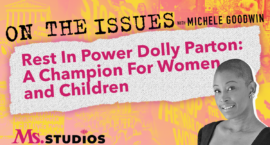
Rest In Power Dolly Parton: A Champion For Women and Children

Transcript: Dr. Michele Goodwin:  Welcome to On the Issues with Michele Goodwin at Ms. Magazine. As you know, we are a platform that reports, rebels, and we tell it just like it is. And today, we take a moment to pause to recognize the incredible life the indefatigable, beautiful, talented, wise Dolly Rebecca Parton Dean, […]

When Washington Won’t, New Jersey Will: Inside the Nation’s Strongest Combined Shield and Safety Law Protecting Abortion and Gender-Affirming Care

New Jersey Gov. Mikie Sherrill signed a law Thursday establishing the nation’s strongest physical protections for gender-affirming care patients and providers, while expanding legal safeguards for reproductive healthcare access. The law, which passed both houses of the legislature in June, is a comprehensive shield law and state FACE Act corollary, joining suit with a growing state-led movement to enshrine protections for patients and providers. 

After assuming office in 2025, the Trump administration eviscerated enforcement of the federal FACE Act protecting abortion clinics, staff and patients. Then, the administration launched unprecedented attacks on the transgender community. In response, Democratic-led states are beginning to look at new ways to safeguard abortion and gender affirming healthcare providers and patients. Some states already have FACE laws protecting abortion clinics, providers and patients from threats, obstruction, intimidation and violence. And several states enacted shield laws to protect patients and providers of reproductive and gender-affirming healthcare from criminal, civil and professional prosecutions for providing health care to individuals from states where that healthcare is banned or restricted. 

New Jersey combines both mechanisms of protections. Already a shield state for abortion, New Jersey’s laws protect patients and providers from out-of-state prosecution, extradition and investigations. The new law strengthens these protections and reaffirms the confidentiality of patient-provider relationships while also creating strong safeguards for the physical safety of clinics, providers and patients.

High School Sex Ed Is No Longer the Norm. That’s a Problem When Students Go to College.

It’s back-to-school season, and besides exams, essays and job applications, college students have another threat to worry about: sexual assault. As many U.S. universities start their fall semesters, we’re heading into the “Red Zone”—the high-risk period on college campuses from now through Thanksgiving break, when over 50 percent of all campus sexual assaults occur.

But many students arrive on campus without having received the sex education that could help prepare them to navigate consent, communication and sexual relationships. A recent survey from college sexual assault prevention nonprofit It’s On Us found that more than two-thirds of men now in college never received formal sex education in high school.

Millions of U.S. high schoolers lack comprehensive, inclusive sex education—or receive no sex education at all—leaving too many without meaningful instruction on consent and communication before they enter college. Today, 36 states and the District of Columbia require schools to teach sex ed. But not all require curricula to cover basics such as consent and contraception, and some do not even mandate that sex education taught in schools be medically accurate.

And instead of closing those gaps, the Trump administration is making them worse. Its attacks on public school sex ed include cutting millions of dollars in funding for community sex education and teen pregnancy prevention programs, while encouraging organizations to rewrite their sex ed programs to promote pregnancy and parenthood.

Don’t Let AI Become the New Sex Educator for Adolescents

“Why would I Google it when I can just ask ChatGPT for exactly what I am looking for?” 

A 16-year-old asked me this during a recent conversation with Black adolescents about where they turn for health information. Her answer was striking, but hardly surprising.

As traditional sex education faces cuts in schools and reproductive health services become harder to access—particularly for young people of color in underserved communities—adolescents are increasingly looking elsewhere for answers. AI chatbots offer something schools, clinics and even trusted adults often do not: information that feels immediate, private and judgment-free.

The Feminist Case for Loving ‘Charlie’s Angels’

I don’t remember how old I was when I first heard the term “jiggle TV,” but I know it was decades after I was a devoted, starry-eyed fangirl of the genre. And I do mean “girl”—Wonder Woman came into the world just a year after I did, Charlie’s Angels two years after, Three’s Company the year after that. I watched them all—first in weekly nighttime installments, later in endlessly imbibable reruns—as I was learning to walk, talk, dress, eat, interact with other girls and other boys, and understand how the world saw me and where I fit into it.

The term “jiggle TV” was coined in the mid-1970s by NBC exec Paul Klein to describe and deride rival network ABC’s successful lineup of shows starring women who wore excessively revealing clothing, with Charlie’s Angels as its prime example. Whatever age I was when I first heard the term, I was old enough to immediately grasp its demeaning, objectifying implications. I remember it hitting me like a ton of bricks: The fictional world I’d been gazing at with such awe and reverence was, in the eyes of others, somewhere between a turn-on and a joke.

Without making a big thing about it, I tucked my childhood obsession away in a remote-storage corner of my brain and, for decades, lived an Angels-free life.

Until this year, when Charlie’s Angels turned the big 5-0.

I decided to attempt a full-series rewatch. I wanted to see if immersing myself in the series again after all these years would pull my memories out of remote storage and give me a more detailed picture of how the show’s storylines and messages had affected my pliable young mind.

What had I picked up and taken away from the show besides starry-eyed fangirl devotion?

The answer was: plenty.