


Immigrants are often scapegoats for all kinds of societal ills: a lagging economy, dangerous reproduction, even environmental degradation. Thankfully, there is a strong and growing immigrants’ rights movement that counters these attacks and highlights the real problems: xenophobia, racism and an out-of-touch immigration policy. All too often, however, immigration is portrayed as heterosexual and male. […]
Search Results for: LGBTQ
Russia’s War on Ukraine, Recorded by the Women and Queer Journalists Living Through It

The city of Kharkiv lies 19 miles from Russia’s western border. Nestled within this historic and cultural urban center is a small news outlet that symbolizes so much of what Putin intends to erase: the truthful recounting of Russian war crimes and the lived experiences of everyday Ukrainians. The journalists of Gwara Media are determined not to let that happen.
As world leaders gather for the U.N. General Assembly, Ukrainian President Volodymyr Zelenskyy is in New York seeking support against Russia’s attacks. In Kharkiv, Gwara’s journalists are documenting the war as they contend with danger, discrimination and dwindling funds.
This is the story of how a small, award-winning independent media platform supports the diverse identities of their reporters who—in the words of Gwara’s mission statement—“ask uncommon questions, and listen to voices of the unheard.”
Interviews with three of the publication’s journalists reveal how the “voices of the unheard” have affected the journalists’ own lives and why what they have to say resonates far beyond Ukraine’s own borders.
Respectability Politics and the Making of a Menopause Justice Movement

After generations of silence, menopause has entered mainstream conversation with remarkable speed, thanks in part to Gen X’s insistence and the emergence of older millennials navigating perimenopause. People are finding language for once-isolating experiences, and researchers and clinicians are paying closer attention.
But this cultural reboot demands that we ask whose stories are treated as authoritative, whose leadership is recognized and resourced, and who can access the care and knowledge being produced. Paid memberships, subscription communities, influencer content, concierge care, exclusive events and information behind paywalls are rapidly turning menopause into a marketplace. Who gains power as the conversation grows?
What may once have operated as a strategy for surviving racial terror has hardened, in many contemporary institutions and marketplaces, into an entrance requirement: Prove you are polished, palatable, professionally credentialed, “properly” gendered, sufficiently resourced and nonthreatening before your suffering can be believed or your leadership affirmed.
We are therefore being asked to interrogate more than whose voices, stories and activism are championed and pushed to the forefront. We must also examine whose knowledge is treated as credible, whose testimony becomes evidence, and whose experiences are permitted to define the full breadth of menopause. If legitimacy still depends on proximity to whiteness, wealth, cisgender identity, able-bodiedness, professional status or institutional approval, then the table has not been transformed. It has simply diversified its guest list.
(This essay is part of the latest Women & Democracy installment, in partnership with Black Girls’ Guide to Surviving Menopause. Menopause is not only a physical transition—it is also cultural, social and political. Recognizing its full scope is essential to advancing true health and civic equity.)
Keeping Score: Texas GOP Candidate Brandon Herrera’s Vile Attack on Mothers and Children; Rest in Power Gloria, Dolly, Robin Morgan, Annie Dillard and More

In every issue of Ms., we track research on our progress in the fight for equality, catalogue can’t-miss quotes from feminist voices and keep tabs on the feminist movement’s many milestones. We’re Keeping Score online, too, in this biweekly roundup.
This week:
—The Trump administration proposed a rule that would eliminate quality standards for the Head Start preschool program.
—Todd Blanche was confirmed as attorney general, after promising to remove abortion rights nationwide.
—Democrats in the Senate call out Trump administration’s attacks on Title IX and mark its 54th anniversary with a bicameral resolution: “They will fearmonger about trans kids until the sun comes up, but the fact is this administration has all but decimated the Office for Civil Rights at the Department of Education, leaving egregious instances of sexual harassment and assault, and so much else, totally unaddressed.”
—Kindergartener Liam Tadeo and his father, Victor Martinez Nieto, both Austin residents, were detained by ICE on their way to a soccer game and later deported together to Mexico after being held at the Dilley Immigration Processing Center.
—The six recipients of the 2026 Goldman Environmental Prize are all women.
—Voters in battleground states say it’s important that lawmakers protect access to reproductive healthcare.
—At least 152 ICE or CBP agents have faced disciplinary action or criminal penalties for violent crimes.
—Women make up 35 percent of non-acting Emmy Awards, matching the record high.
—Actor Anne Hathaway, currently pregnant with her third child at age 43, faced social media hate and rumors that she faked her pregnancy, after showing her bump on a red carpet.
—Florida professor Vinita Prabhakar was fired for assigning a “political” short story in a freshman English class. The story “Bettering Myself” focuses on an alcoholic teacher at a Catholic school and is commonly taught at colleges across the country. Prabhakar is now suing to uphold her First Amendment rights.
—Aisha Wahab won the special election to replace former Rep. Eric Swalwell (D-Calif.), who resigned after sexual assault allegations. Wahab is the first Afghan American elected to Congress, and will be on the ballot for a full term in November.
… and more.
LaTosha Brown’s Case for America’s First Department of Democracy
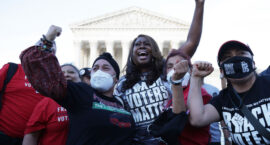
Weekend Reading on Women’s Representation is a compilation of stories about women’s representation in politics, on boards, in sports and entertainment, in judicial offices and in the private sector in the U.S. and around the world—with a little gardening and goodwill mixed in for refreshment!
This week:
—The Kettering Foundation honors Black Voters Matter cofounder LaTosha Brown, and her brilliant idea: “a Department of Democracy: a durable, people-powered, enforcement-capable institution designed to protect voting and civic rights, monitor the conduct of all three branches of government, hold states accountable, and serve as a permanent firewall against the erosion of democratic participation. It would be built to hold regardless of who’s in power.”
—A record number of women have earned nominations for state legislative elections this year.
—Data suggests a close Texas governor’s race this year.
—U.S. House incumbent Sarah McBride has been an influential voice in Congress in her first term in office.
… and more.
Next No Kings: Oct. 17 Day of Action Focused on Early Voting
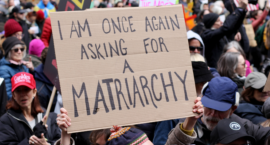
Organizers of No Kings have announced a fourth nationwide mobilization for Saturday, Oct. 17, focused on early voting and helping voters make a plan for the midterm elections.
“Power belongs to the people, but only if we use it,” organizers wrote in announcing the event.
Half the Country, a Fraction of the Research

For decades, Democratic and Republican administrations alike presided over a medical research system that routinely excluded women. The result? Modern medicine was built on incomplete science—and women are still paying the price.
It wasn’t until the NIH Revitalization Act of 1993 that federally funded clinical trials were required to include women. Yet changing who participates in research does not rewrite decades of medical knowledge overnight. By then, physicians had already been trained using male-centered evidence, diagnostic standards had been established, and countless drugs had already been dosed using evidence derived solely from men.
In 2025, the Trump administration has proposed cutting the NIH’s budget by roughly 43 percent (equivalent to $20 billion per year). Its broader HHS budget proposal called for eliminating or consolidating several programs supporting family planning and maternal and child health. Federal agencies also came under pressure to scrutinize or reject grant proposals containing terms such as women, leading to paused or cancelled fellowships and research on conditions such as uterine fibroids and pregnancy.
There are signs, however, that Congress may finally be beginning to treat women’s health across the lifespan as a serious policy issue.
On Sept. 16, the Senate Special Committee on Aging will hold Congress’ first-ever hearing devoted to menopause. Led by ranking member Sen. Kirsten Gillibrand (D-N.Y.), “Half the Country, Zero Hearings: Meeting the Moment to End the Menopause Care Gap in America” will examine the nation’s lack of menopause research, informed medical care and provider training—and make the case for greater federal investment.
The hearing represents an overdue step forward. But women’s health cannot remain vulnerable to political cycles. Regardless of which party holds power, it must become a permanent priority within American policy and medicine.
Tuesday, Sept. 22 in NYC: A Crucial Conversation on the Future of Feminist Journalism, Hosted by Ms. and Women’s Media Group
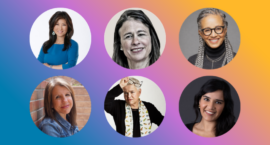
Ms. magazine and Women’s Media Group will bring together leading journalists, writers and media executives in New York City on Tuesday, Sept. 22, for a timely conversation about the role of feminist journalism, and the power of women’s voices to shape news, culture and public policy.
“Feminist Journalism Today: Continuing the Crucial Conversation About Women’s Voices in Media” will explore where feminist journalism is thriving, which approaches are most effective, the challenges confronting the field and how women in media can steer the national discourse.
Honoring Gloria Steinem’s Legacy and the Black Feminists Who Shaped It

Gloria Steinem was a person with integrity who used her celebrity to promote feminism and women’s issues—keeping them front in the public’s mind through appearances on talk shows, speaking engagements, her memoir My Life on the Road and the biographical film derived from it, The Glorias.
One moment in particular has stayed with me: Steinem’s pronouncement in a 2016 article by Zeba Blay, titled “I Learned Feminism From Black Women.” (I was so thrilled to see such a public announcement, that I used this quote in the first brochure published about the Irma McClaurin Black Feminist Archive, which I founded in 2016 at the University of Massachusetts Amherst.)
I wonder how comfortable she would be with all the hoopla that focuses attention only on her, while ignoring the countless Black, Brown, Indigenous and other white women who struggled for equal rights before her—including the Black women from whom she said she learned her feminism. Those women continued the struggle during Steinem’s lifetime, and they will continue it after her death.
I did not know Gloria well, but well enough to ask my African ancestors to welcome her soul as a kindred spirit. Asè.
Marry Young, Skip the Career Ladder: Conservatives’ Pitch to Gen Z Women

Conservative influencers and campus networks are urging Gen Z women to prioritize early marriage and motherhood over education and professional ambition.
Conservative groups now host several events and conferences aimed at young women, including Live Action’s Young Leaders Summit, Turning Point USA’s Young Women’s Leadership Summit and the Conservative Political Action Conference’s Women Warriors Summit.
In the speeches and sessions I reviewed from these gatherings, speakers offered little encouragement for career-building or financial independence. Instead, they focused on chastity, marriage, traditional gender roles and what they described as God’s design for women’s lives. Their message was clear: The most important decision facing women in their twenties is not which major to choose or which job offer to accept, but whom to marry, and how soon.
Proponents of this narrative often skip over the practical risks of marrying young. Young age and economic stress are both associated with a heightened risk of intimate partner violence, while financial dependence can make an abusive relationship far more difficult to leave.
I’m a Gen Z woman and college student pursuing a career, financial independence and a life shaped by my own ambitions. After spending the summer researching conservative media, I found its messages unsettling: reminiscent of a past when women faced legal and social barriers to employment, property ownership and independent access to credit, and were valued primarily for their roles as wives and mothers.
Although I do not believe this narrative is widely accepted across Gen Z, I worry that without greater scrutiny, more young women may begin to internalize the idea that their ambitions matter less than those of their male peers.