Meet Dr. Lincoln, the Internet’s Favorite OB-GYN

You may know—and love—Dr. Jennifer Lincoln already. If you are unfamiliar, she’s a board-certified OB-GYN and a famous content creator with 2.8 million followers on TikTok and large platforms on Instagram and YouTube. Dr. Lincoln is also a practicing OB-hospitalist who works in labor and delivery, night and day.

She makes content to dispel medical misinformation, a frequent tool of the patriarchy. As ‘MAHA’ influencers decry everything from birth control to Tylenol, at the expense of women, she’s pushing back with evidence-based information.

Like most Americans, I felt uninformed about sexual reproductive health, even after my in-school health classes. In high school, I searched YouTube for information about reproductive health, where I found my way to Dr. Lincoln, who not only provided the health class I never had, but also ignited my interest in reproductive justice. Without her influence, I likely would not have become a feminist writer at Ms.

Over Zoom, I had the privilege of chatting with Dr. Lincoln about her journey from OB-GYN to viral educator, how the post-Dobbs landscape has reshaped her work, and why she believes accurate, inclusive sex education is one of the most powerful tools we have for liberation. Our conversation spanned everything from social media strategy to Christian nationalism—and what it really means to fight misinformation with empathy.

The War on Women Report: New Texas Law Targets Abortion Pills; More Planned Parenthoods Close Amid Federal Funding Cuts

MAGA Republicans are back in the White House, and Project 2025 is their guide—the right-wing plan to turn back the clock on women’s rights, remove abortion access, and force women into roles as wives and mothers in the “ideal, natural family structure.” We know an empowered female electorate is essential to democracy. That’s why day after day, we stay vigilant in our goals to dismantle patriarchy at every turn. We are watching, and we refuse to go back. This is the War on Women Report.

Since our last report:
—A judge in Missouri is currently deciding whether a proposed amendment that would ban abortion in the state’s constitution can appear on the 2026 ballot … even though Missourians voted just last fall to keep abortion legal in the state.
—The Trump administration announced in August that it would remove gender-affirming care from the health services offered to federal workers.
—Mississippi declared a public health emergency as the state’s infant mortality rate soars to a rate nearly double the national average.

… and more.

Twenty-Five Years of Mifepristone: How Activists Brought the Abortion Pill to America and Changed Reproductive Health Forever

At the urging of antiabortion advocates and politicians, and based on a flawed and biased report put out by an antiabortion group, the Trump administration announced the launch of a new review of mifepristone—despite 100 peer-reviewed scientific studies proving the safety and efficacy of these medications and safe use by over 7.5 million U.S. women.

On the 25th anniversary of FDA approval of mifepristone, reproductive rights supporters are celebrating the creative, determined and courageous advocates who brought this medication to market.

One organization that played a critical role in bringing mifepristone, known as RU-486, to the United States was the Feminist Majority Foundation (FMF)—today the publisher of Ms.

‘We Can Do Hard Things’: Abortion Providers Fight Back Against Rising Violence [Part 4 of 4]

Across the country, abortion providers are installing new security systems, building relationships with local law enforcement, and pushing states to pass their own protections in the absence of federal enforcement. “We really want states to use every tool available to them to pass laws to protect providers and patient communities, and they’re not yet,” says duVergne Gaines of the Feminist Majority Foundation’s National Clinic Access Project.

Still, advocates refuse to back down. For many, providing abortion is more than a profession—it’s a calling. As Ruth Richardson, who herself was named on the Minnesota assassin’s target list, put it: “We can do hard things. We’ve had to do hard things. This isn’t new.”

Murder, Pardons and Impunity: How Antiabortion Violence Escalated Under Trump [Part 1 of 4]

Her friend Melissa Hortman, a longtime Minnesota lawmaker, was murdered at home in June—shot by a man posing as a police officer who had also wounded two others and left behind a hit list of dozens of abortion-rights supporters. Among the names was Ruth Richardson, CEO of Planned Parenthood North Central States. “It was one thing to get a threat; it’s another to have confirmed threats where you have a friend and colleague who is assassinated,” she told Ms.

This tragedy unfolded against a backdrop of federal retreat: Trump pardoned extremists convicted of clinic blockades and violence, and his Justice Department declared it would largely stop enforcing the FACE Act, the law meant to protect providers. Advocates warn these decisions have emboldened extremists, leaving abortion providers more vulnerable than at any time in decades.

‘Who Could Be Opposed to This?’: Why the ERA Is Kathy Spillar’s ‘North Star’ in the Fight for Gender Equality 

Kathy Spillar, executive editor of Ms. magazine, became involved in feminist organizing when the supposed ratification deadline for the Equal Rights Amendment expired in 1982. In the final episode of the Ms. podcast Looking Back, Moving Forward, she explains why, 40 years later, she’s still calling for constitutional equality.

Listen to the latest episode of Looking Back, Moving Forward, “The Feminist Fight For The Equal Rights Amendment Is Far From Over—and More Urgent Than Ever (with Pat Spearman, Ellie Smeal, Carol Moseley Braun, Kathy Spillar, and Ting Ting Cheng)” on Spotify, Apple Podcasts or wherever you get your podcasts.  

‘I’m Not Going to Tolerate Being Treated as a Second-Class Citizen’: Carol Moseley Braun Isn’t Giving Up on the Fight for Constitutional Equality

“The expectation of equality is the most important cultural thing that we can achieve, and we have to keep holding up that light.”

Carol Moseley Braun became the first Black woman elected to the Senate after her involvement in the movement to ratify the Equal Rights Amendment. In the fifth and final episode of Looking Back, Moving Forward, more than 40 years later, she asked a simple question: “Why haven’t we gotten this right yet?” 

Listen to the latest episode of Looking Back, Moving Forward, “The Feminist Fight For The Equal Rights Amendment Is Far From Over—and More Urgent Than Ever (with Pat Spearman, Ellie Smeal, Carol Moseley Braun, Kathy Spillar, and Ting Ting Cheng)” on Spotify, Apple Podcasts or wherever you get your podcasts.

The Promise of the Equal Rights Amendment Is More Urgent Than Ever

In the fifth episode of Looking Back, Moving Forward, advocates and experts reflect on more than 50 years of activism to ratify the ERA—and the power that would come from women’s constitutional equality to redefine our democracy, protect our fundamental rights and change the stories of women’s lives.

Listen to the latest episode of Looking Back, Moving Forward, “The Feminist Fight For The Equal Rights Amendment Is Far From Over—and More Urgent Than Ever (with Pat Spearman, Ellie Smeal, Carol Moseley Braun, Kathy Spillar, and Ting Ting Cheng)” on Spotify, Apple Podcasts or wherever you get your podcasts.

The Feminist Fight For The Equal Rights Amendment Is Far From Over—and More Urgent Than Ever (with Pat Spearman, Ellie Smeal, Carol Moseley Braun, Kathy Spillar, and Ting Ting Cheng)

Meet the Voices Bonus Content From This Episode Further Reading From the 50 Years of Ms. Collection Get a copy of the book. Further Reading From the Ms. Archives Explore our coverage of the Equal Rights Amendment, including our series on why The ERA is Essential to Democracy. More Links & Resources Episode Transcript [THEME […]

Keeping Score: Democrats Fight Republican Redistricting; Periods Make College Students Miss Class; Costco Refuses to Sell (Safe, Legal) Abortion Pills to Appease Antiabortion Politics

In every issue of Ms., we track research on our progress in the fight for equality, catalogue can’t-miss quotes from feminist voices and keep tabs on the feminist movement’s many milestones. We’re Keeping Score online, too—in this biweekly roundup.

This week:
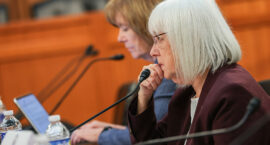
—“I am deeply alarmed by news reports that Costco is refusing to sell safe, effective, and legal medication for no other reason than to appease the politics of antiabortion fanatics,” said Sen. Patty Murray (D-Wash.).
—The Democratic Legislative Campaign Committee called for Democrat-led state legislatures to pursue redistricting: “The DLCC refuses to allow Republicans to rig the maps to keep themselves in power.”
—“A troubling shift is underway: Women are leaving the U.S. workforce in unprecedented numbers. But this isn’t a choice; it’s a consequence,” warned Catalyst president and CEO Jennifer McCollum after a report showed 212,000 women have left the workforce since January.
—A third of college students have missed class because of their period.
—The Trump administration is planning to restrict coverage of abortion care for veterans in almost all circumstances.
—RFK Jr. takes aim at antidepressant use during pregnancy, despite American College of Obstetricians and Gynecologists’ approving of their usage.
—Texas’ abortion ban has made miscarriages more dangerous.
—A federal court blocked the Trump administration’s restrictions on grants from the Office on Violence Against Women. Seventeen states had challenged the restrictions, and the order is a temporary win for organizations supporting survivors of domestic and sexual violence. 

… and more.